
Teacher Paystub Generator: How Private & Charter Schools Manage 10-Month Deferred Summer Pay (IRC § 409A) in Excel
Key Takeaways for School Business Officers & Bursars
- ✓The 10-Month vs. 12-Month Reality: While teachers deliver instruction across 10 academic months (typically 180–190 school days), most faculty elect to spread their annual compensation across 12 calendar months (24 semi-monthly or 26 bi-weekly pay periods) to maintain uninterrupted summer living income.
- ✓The IRC § 409A Legal Trap: Spreading 10-month earnings into summer months legally constitutes nonqualified deferred compensation. To avoid a catastrophic 20% federal excise penalty tax on teachers, schools must comply with the IRS Recurring Part-Year Compensation Safe Harbor (IRS Notice 2008-62, Treas. Reg. § 1.409A-1(b)(4)), requiring a signed, irrevocable written election before the school year begins.
- ✓Exact Escrow Mathematics: On a standard $54,000 contract paid bi-weekly over 26 periods, teachers earn $2,700.00 across 20 active school pay cycles but receive $2,076.92 gross per check. The school business office must hold exactly $623.08 in summer escrow reserve each active period to disburse $2,076.93 across the 6 summer pay dates.
- ✓Section 125 Benefit Pre-funding: Because health insurance premiums run for all 52 weeks of the year, schools must either pace deductions across all 26 checks or double/triple health deductions during March, April, and May to pre-fund summer insurance reserves without creating negative summer paychecks.
- ✓Escaping Enterprise ERP Overhead: Private, charter, and parochial academies do not need to spend $8,000–$25,000 per year on bloated education ERP suites like Blackbaud or PowerSchool just to issue accurate teacher paystubs. With a single $49 lifetime license of PayslipGen, schools can generate encrypted, audit-ready teacher payslips directly from their existing Excel payroll workbooks.
In private schools, public charter academies, parochial dioceses, and independent Montessori institutions, the business office faces a payroll challenge completely alien to the corporate world: the 10-month academic employment contract.
Unlike corporate employees who work consistently across all 52 weeks of the year, classroom educators perform their contractual duties across approximately 180 to 190 instructional days, spanning late August through early June. Yet virtually every educator relies on predictable, year-round disbursements to service their mortgages, pay utility bills, and support their families throughout July and August.
To accommodate this reality, educational institutions offer annualized pay options: commonly known as "10-over-12" or deferred summer escrow pay.
However, implementing deferred summer pay is not merely a matter of simple division. It sits at the complex intersection of federal tax regulations, statutory benefit compliance, and general ledger liability accounting:
- IRS Section 409A Regulations: Deferring compensation earned in one period for disbursement in a later period falls directly under the strict statutory regime governing nonqualified deferred compensation. Failing to follow the strict safe harbor rules triggers an immediate, mandatory 20% federal excise tax penalty assessed directly against the educator.
- Section 125 Cafeteria Plan Premium Catch-Up: Medical, dental, and vision insurance policies operate 365 days a year. If a teacher receives zero active earnings in July, the school must execute a structured spring benefit pre-funding schedule to guarantee uninterrupted healthcare coverage.
- Escrow Reserve Balance Reconciliations: The school business office acts as an escrow agent, accumulating liability reserves on the balance sheet across 20 active pay periods and drawing down those exact funds over 6 summer cycles.
While giant public school districts rely on state-funded mainframe ERPs to automate these calculations, independent, charter, and religious schools are caught in a painful squeeze. Mainstream small-business payroll tools like QuickBooks Online and Gusto are rigidly optimized for corporate calendars, lacking native multi-term school escrow logic. Meanwhile, enterprise education suites like Blackbaud Financial Edge, PowerSchool BusinessPlus, or Veracross charge crushing annual licensing fees ranging from $8,000 to over $25,000 every single year.
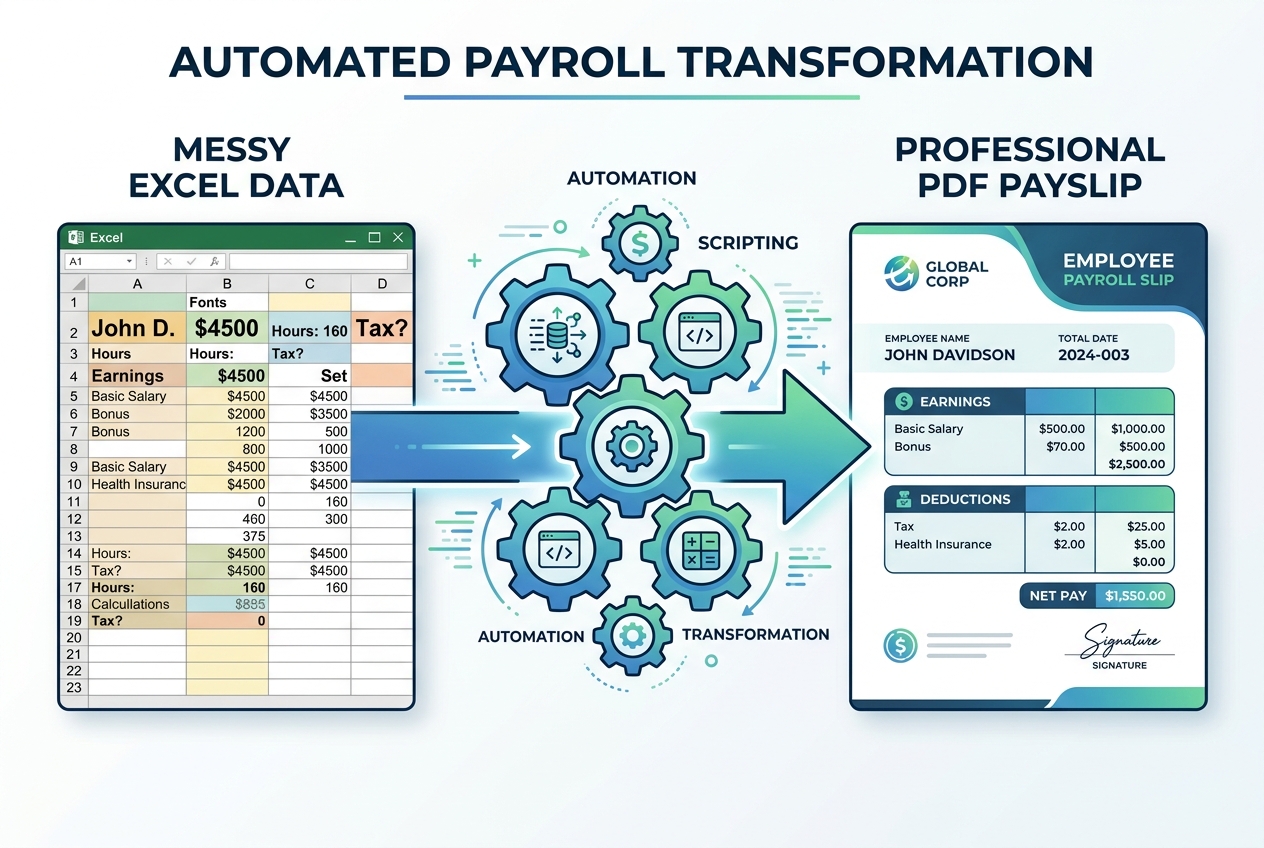
In this comprehensive operational handbook, we break down the statutory tax rules governing teacher deferred pay under IRC § 409A, provide the complete mathematical formulas for summer escrow and spring benefit pre-funding, and present the master Excel workbook architecture that allows school business managers to generate institutional-grade, password-protected PDF paystubs for just $49 lifetime with PayslipGen.
Try Our Interactive Demo Instantly
Want to see how an offline-capable, client-side payslip generator works in practice? Try our brand-new interactive demo right in your browser. Upload a sample CSV, map your columns, and generate beautifully designed PDF payslips—with zero data ever being transmitted to our servers.
Launch Free Demo NowChapter 1: The Legal Framework: IRC § 409A and the Recurring Part-Year Safe Harbor
To understand why teacher deferred compensation requires extreme administrative diligence, one must understand Section 409A of the Internal Revenue Code (IRC § 409A).
Congress enacted Section 409A under the American Jobs Creation Act of 2004 in the wake of corporate accounting scandals (such as Enron), where corporate executives accelerated deferred bonuses right before bankruptcy while rank-and-file workers lost their pensions. Congress designed Section 409A with sweeping, draconian statutory breadth: it governs any agreement where an employee acquires a legally binding right to compensation in one taxable year that is or may be payable in a subsequent taxable year.
The Accidental Teacher Dilemma
When Treasury initially drafted the comprehensive Section 409A regulations, school administrators realized with horror that traditional teacher contracts were caught in the regulatory crosshairs.
Consider a standard academic year running from August 15 through June 5. A teacher executes their teaching duties during those 10 calendar months. If the school withholds a portion of the compensation earned in August, September, October, November, and December, and pays those accumulated funds out in July and August of the following calendar year, the compensation earned in Year 1 is being paid out in Year 2! Under the literal letter of § 409A, that constitutes a nonqualified deferred compensation plan.
The Catastrophic Penalties of Section 409A Violations
If a deferred compensation arrangement violates IRC § 409A, the statutory penalty does not fall merely on the employer. The IRS imposes punitive measures directly on the individual employee:
- Immediate Acceleration: All deferred compensation across all taxable years is immediately included in the employee's gross taxable income in the current year.
- 20% Federal Excise Penalty: The employee is assessed an automatic, non-negotiable 20% excise tax on the deferred amount on top of regular personal income tax.
- Underpayment Interest: An IRS premium interest rate (federal short-term rate + 1%) is assessed retroactively back to the date the compensation was originally deferred.
For a teacher earning a modest $54,000 annual salary, an inadvertent 409A classification could result in thousands of dollars in unexpected excise tax bills and catastrophic audit liabilities for the school.
The Solution: IRS Notice 2008-62 & Treas. Reg. § 1.409A-1(b)(4)
Recognizing that public and private school teachers were never the intended target of anti-executive deferred compensation crackdowns, the Treasury Department and the IRS issued IRS Notice 2008-62 and subsequently codified the Recurring Part-Year Compensation Safe Harbor under Treasury Regulation § 1.409A-1(b)(4).
Under this statutory safe harbor, deferred summer salary arrangements are explicitly exempt from Section 409A, provided that the school strictly satisfies four specific conditions:
| Safe Harbor Criterion | Statutory Requirement | School Compliance Action |
|---|---|---|
| 1. Recurring Part-Year Service | Services must customarily be performed during regular, recurring periods of less than 12 months (e.g., standard 9-month or 10-month school term). | Ensure faculty contracts clearly specify the instructional service dates (e.g., August 18, 2026 – June 5, 2027). |
| 2. Annual Compensation Cap | The annualized compensation must not exceed the annual compensation limit under IRC § 401(a)(17) ($345,000 for 2024; $350,000 for 2025). | All standard instructional faculty fall well below this federal threshold. |
| 3. Maximum 13-Month Window | Payments for the service period cannot extend beyond the end of the 13th month following the beginning of the service period. | Disburse all summer escrow paychecks by August 31, ensuring total payouts conclude within 12 full calendar months. |
| 4. Written Irrevocable Election (The Critical Trap) | The election to receive compensation over 12 months rather than 10 months must be in writing and signed before the first day of the performance period. | Teachers must sign their payroll election form before the first day of teacher orientation or classroom duty. Once the first working day begins, the election is legally irrevocable for that school year. |
Criterion #4 is where most independent and charter schools fail audits. If a teacher signs their contract on September 2 after reporting to school for pre-service orientation on August 20, or if a teacher asks the business office in January to "switch me to 10-month pay because I need the cash," granting that request violates Section 409A. The election must be signed prior to day one of work and cannot be modified until the following school year.
Chapter 2: The Mathematical Blueprint: Calculating the Summer Escrow Reserve
Once the 409A safe harbor election is executed, how does the school business office calculate the exact paystub line items?
Let us walk through an exact, real-world case study. Consider an English faculty member at St. Jude Academy, a private preparatory school:
- Annual Contract Salary: $54,000.00
- Payroll Frequency: Bi-weekly (26 total annual payroll dates)
- Active Instructional Term: 20 bi-weekly pay dates (late August through late May)
- Summer Inactive Break: 6 bi-weekly pay dates (June, July, early August)
- Elected Pay Schedule: 10-over-12 (26 equal disbursements)
The Five-Step Mathematical Breakdown
To maintain pristine general ledger compliance and prevent negative payroll balances, the bursar executes five mathematical calculations:
Step 1: Compute the Target Annualized Bi-Weekly Pay
Under a 12-month payment election across 26 bi-weekly periods:
Step 2: Compute the Active Earning Rate
During the 20 active classroom pay periods, the teacher actually earns their full $54,000 contract:
Step 3: Calculate the Summer Escrow Withholding (Active Period Deduction)
To bring the teacher's active check down from their earned wage ($2,700.00) to their agreed annualized disbursement ($2,076.92), the school business office withholds an escrow reserve on every active paystub:
Step 4: Accumulate the Cumulative Summer Escrow Reserve
Over the course of the 20 active school-year pay dates, the school business office accumulates these funds on the balance sheet:
Step 5: Calculate the Summer Disbursement Rate
During the 6 summer break pay periods (periods 21 through 26), the teacher performs zero classroom teaching duties. The school draws down the accumulated escrow reserve to fund their checks:
*Note: A single 1-cent adjustment occurs across the final check due to rounding $54,000 / 26 ($2,076.92 × 25 checks + $2,077.00 = $54,000.00).
Tax Withholding Mechanics: Cash Method vs. FICA Timing
A major point of confusion for school bookkeepers is: When are taxes withheld? When the money is earned in October, or when the escrow is disbursed in July?
Under IRS Notice 2008-62 and the recurring part-year safe harbor, the entire arrangement is treated under the standard cash receipts and disbursements method for Federal Income Tax (FIT) withholding and Form W-2 Box 1 reporting:
- Federal and State Income Tax: FIT is calculated on the disbursed taxable gross of each check ($2,076.92). It is not taxed when the $623.08 is set aside into escrow, because the teacher does not have constructive receipt of the escrow funds until summer disbursement.
- FICA (Social Security and Medicare): Under IRC § 3121(v)(2), nonqualified deferred compensation is generally subject to FICA when services are performed. However, because recurring part-year compensation meeting the safe harbor is exempt from § 409A and treated as regular wage payments, schools uniformly withhold FICA on the actual bi-weekly disbursement amount ($2,076.92) across all 26 pay periods. This ensures consistent, predictable net checks for faculty and eliminates messy reconciliation adjustments.
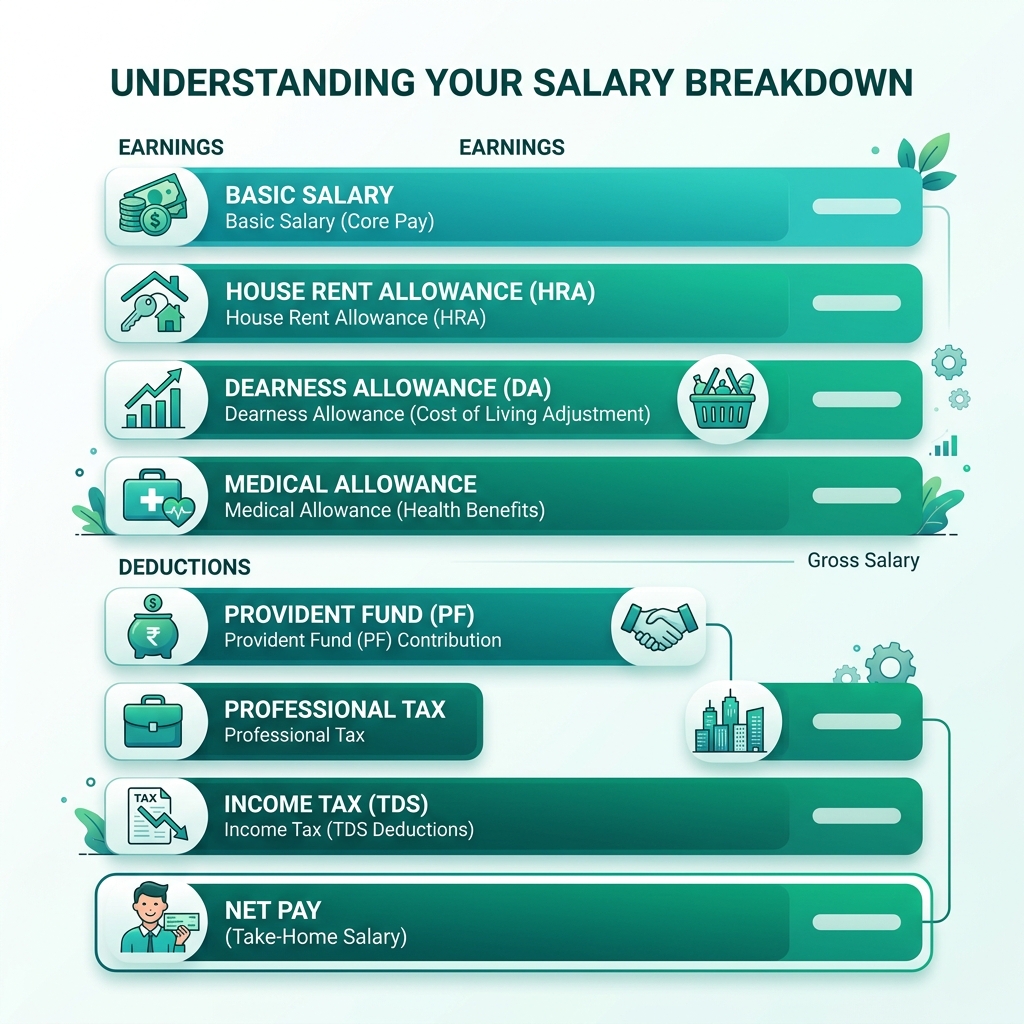
| Paystub Line Item | Active Period (Periods 1–20: Oct 15) | Summer Period (Periods 21–26: July 15) | Annual Total (26 Periods) |
|---|---|---|---|
| Contract Earned Gross | $2,700.00 | $0.00 | $54,000.00 |
| Summer Escrow Withholding | -$623.08 | $0.00 | -$12,461.60 |
| Summer Escrow Disbursement | $0.00 | +$2,076.93 | +$12,461.60 |
| Taxable Gross Pay (Box 1) | $2,076.92 | $2,076.93 | $54,000.00 |
| Employee 403(b) Deferral (5%) | -$103.85 | -$103.85 | -$2,700.10 |
| Pre-Tax Section 125 Health | -$184.62 | -$184.62 | -$4,800.12 |
| Social Security Tax (6.2%) | -$117.32 | -$117.32 | -$3,050.32 |
| Medicare Tax (1.45%) | -$27.44 | -$27.44 | -$713.44 |
| Federal Income Tax (W-4 est.) | -$168.20 | -$168.20 | -$4,373.20 |
| Net Take-Home Pay | $1,475.49 | $1,475.50 | $38,362.82 |
Chapter 3: Benefit Pre-Funding & Section 125 Cafeteria Plans
While salary math can be annualized cleanly across 26 periods, employer-sponsored group health, dental, and vision insurance policies introduce a major regulatory hurdle.
Health insurance carriers bill the school on a monthly calendar basis (12 monthly invoices per year). Under IRC Section 125 (Cafeteria Plans), employee contributions for health coverage must be deducted on a pre-tax basis through salary reduction agreements.
The Two Administrative Approaches to Summer Benefits
Independent schools generally handle summer health insurance deductions using one of two methods:
Method A: 26-Period Continuous Deductions (Standard 10-over-12)
If the school uses the 10-over-12 annualized payroll model illustrated above, the employee receives active disbursements in July and August. The business office simply deducts 1/26th of the annual employee premium share from every single paycheck (e.g., $4,800 annual premium / 26 = $184.62 per check).
This is the cleanest method for both the school and the teacher, ensuring identical gross pay, identical deductions, and identical net paychecks all 12 months of the year.
Method B: Spring Benefit Pre-Funding ("Double/Triple Deductions")
What happens if a school has teachers who elect to receive their salary over 10 months only (20 paychecks), or if summer escrow payments are disbursed as a single lump sum in late June?
During July and August, these teachers receive zero payroll checks. Yet the health insurance carrier will still bill the school for their July and August coverage (e.g., $400/month employee share × 2 months = $800 owed). If the school fails to collect these premiums, it must either front the money as an unsecured loan to the employee or demand that teachers mail personal checks to the bursar every July—a logistical nightmare that frequently results in missed payments and canceled coverage.
To solve this, schools execute Spring Benefit Pre-Funding under Section 125:
| Academic Period | Pay Date Range | Standard Deduction Rate | Pre-Funding Multiplier | Total Benefit Withheld |
|---|---|---|---|---|
| Fall & Winter (Periods 1–16) | Aug 25 – Mar 31 | $200.00 / check | 1.0x (Standard) | $3,200.00 |
| Spring Pre-Funding (Periods 17–20) | Apr 15 – May 30 | $200.00 / check | 2.0x (Double Deduction) | $1,600.00 |
| Summer Break (Zero Checks) | June 1 – Aug 15 | $0.00 / check | 0.0x (Coverage Pre-Funded) | $0.00 |
| Total Annual Health Withholding | Full Year | - | - | $4,800.00 (Fully Funded) |
Section 125 Compliance Rule for Spring Pre-Funding
Under IRS regulations, pre-tax deductions can only be taken from compensation earned within the same cafeteria plan year. If your school's medical plan year runs on a July 1 – June 30 fiscal cycle, pre-funding July and August premiums in May crosses into a subsequent plan year! To avoid disqualifying your Section 125 plan, align your cafeteria plan year with the academic calendar or structure your cafeteria plan document with an explicit pre-funding provision approved by your ERISA counsel.
Chapter 4: Retirement Deductions: 403(b) Deferrals & State Pension Credits
In non-profit independent schools and religious academies, retirement benefits are administered through IRC Section 403(b) tax-sheltered annuity plans rather than corporate 401(k) plans.
When administering a 10-over-12 deferred summer pay structure, the school business office must configure 403(b) deductions with absolute clarity:
1. Percentage vs. Fixed-Dollar Deferrals
Most teachers elect to contribute a percentage of their compensation (e.g., 5% or 8%) to their 403(b) retirement accounts:
- The Compensation Base: Does "compensation" under your school's 403(b) Adoption Agreement mean earned gross salary ($2,700.00 per active period) or disbursed taxable wages ($2,076.92 across 26 periods)?
- Best Practice: Standardize retirement deductions against the actual taxable disbursement amount ($2,076.92) across all 26 pay periods. This ensures that the teacher contributes an identical $103.85 to their retirement account every two weeks, generating 26 consistent contributions that maximize dollar-cost averaging into their investment portfolio.
2. State Teacher Retirement Systems (STRS / TRS / PERS) in Charter Schools
Public charter schools are frequently mandated by state law to participate in state teacher retirement systems (such as STRS Ohio, CalSTRS in California, or TRS Texas).
State retirement boards have rigid, unforgiving reporting requirements. They track service credits based on instructional days:
- Full Year Service Credit: A teacher who completes the 180-day school year is legally entitled to 1.0 full year of pension service credit, regardless of whether they are paid over 10 months or 12 months.
- Summer Reporting Flags:Some state pension portals will flag an error if pension contributions are remitted in July and August with zero reported "days worked." Charter school payroll officers must ensure their spreadsheet export formats flag summer paystubs as "Summer Deferred Payout - Service Completed" to prevent pension credit delays for retiring faculty.
Chapter 5: Master Excel Teacher Payroll Spreadsheet Blueprint
Rather than paying tens of thousands of dollars to enterprise software vendors, school business officers can execute flawless 10-over-12 payroll using a standardized master Excel payroll workbook.
Below is the architectural blueprint for structuring your master payroll schedule:
| Col | Header Name | Sample Value (Active) | Excel Formula / Logic | Regulatory & Accounting Function |
|---|---|---|---|---|
| A | Teacher_ID | TCH-1042 | Static Text | Unique faculty identifier (used for PDF encryption) |
| B | Employee_Name | Sarah Jenkins | Static Text | Full legal name matching Form W-4 / SSN |
| C | Department_Role | Upper School Biology | Static Text | Instructional classification for cost-center accounting |
| D | Annual_Contract | $54,000.00 | Static Currency | Total approved contract salary for academic year |
| E | Pay_Cadence | 10-over-12 | Static Selection | Elected distribution schedule (26 periods) |
| F | Earned_Gross | $2,700.00 | =IF(IS_ACTIVE, D2/20, 0) | Salary earned based on instructional delivery |
| G | Summer_Escrow_Ded | $623.08 | =IF(IS_ACTIVE, F2 - (D2/26), 0) | Withholding deferred into balance sheet liability |
| H | Summer_Escrow_Disb | $0.00 | =IF(IS_SUMMER, (D2/26), 0) | Drawdown of escrow reserve during summer break |
| I | Taxable_Gross | $2,076.92 | =F2 - G2 + H2 | Disbursed cash compensation subject to taxation |
| J | PreTax_403b | $103.85 | =I2 * 0.05 | Voluntary pre-tax retirement reduction (5%) |
| K | Sec125_Health | $184.62 | =Annual_Health / 26 | Pre-tax medical/dental cafeteria plan deduction |
| L | FICA_Medicare | $144.76 | =(I2 - K2) * 0.0765 | FICA (6.2% OASDI + 1.45% Medicare) |
| M | Federal_FIT | $168.20 | =FIT_FORMULA(I2 - J2 - K2) | Federal income tax withholding based on Form W-4 |
| N | Net_Pay | $1,475.49 | =I2 - J2 - K2 - L2 - M2 | Final check amount disbursed via ACH or check |
| O | Cumulative_Escrow_Bal | $2,492.32 | =PREV_BAL + G2 - H2 | Running balance displayed on paystub for faculty clarity |
The General Ledger Double-Entry Accounting Pattern
To ensure the school's trial balance reconciles down to the penny at fiscal year-end, the bursar enters the following journal entry for each active pay cycle:
| GL Account Number | Account Description | Debit ($) | Credit ($) |
|---|---|---|---|
| 6010 - Instructional Wages Expense | Gross salary earned by faculty (20 active periods) | $2,700.00 | - |
| 2050 - Summer Pay Escrow Liability | Withholding held on balance sheet for summer payout | - | $623.08 |
| 2110 - Federal Withholding Payable | FIT payable to IRS (remitted via EFTPS) | - | $168.20 |
| 2120 - FICA Taxes Payable | Employee FICA withheld (OASDI + Medicare) | - | $144.76 |
| 2150 - 403(b) Retirement Payable | Employee retirement deferral (remitted to plan custodian) | - | $103.85 |
| 2160 - Section 125 Healthcare Payable | Employee health insurance premium share | - | $184.62 |
| 1010 - Operating Payroll Bank Account | Net direct deposit disbursed to teacher | - | $1,475.49 |
When summer arrives (Periods 21–26), the journal entry inverts: Instructional Wages Expense (6010) is $0.00 (because the salary expense was already recognized during the instructional school year), and the bursar debits Summer Pay Escrow Liability (2050) for $2,076.93, liquidating the balance sheet reserve down to exactly $0.00 by August 31.
Chapter 6: 5-Year Cost Comparison: PayslipGen vs. Enterprise Education ERPs
For decades, independent, charter, and parochial schools have felt coerced into purchasing enterprise education ERP software. Legacy vendors like Blackbaud (Financial Edge NXT), PowerSchool (BusinessPlus / eFinancePlus), and Veracross market their suites as essential for non-profit school accounting.
In reality, small-to-midsize schools (with 20 to 100 faculty members) use less than 15% of these monolithic platforms. The primary feature business offices rely on every two weeks is simply generating and delivering compliant, encrypted teacher paystubs.
Let us examine the true 5-year cost of ownership for a typical charter or private school with 35 faculty and staff members:
| Cost Component | Enterprise Education ERP (Blackbaud / PowerSchool) | Commercial Cloud Payroll (Gusto / QBO Payroll) | PayslipGen (Desktop Software) |
|---|---|---|---|
| Upfront Implementation & Onboarding | $5,000 – $12,000 | $0 – $500 | $0.00 |
| Annual Base Subscription Fee | $7,500 – $18,000 / year | $600 – $1,200 / year | $0.00 / year |
| Per-Employee Monthly Toll (35 Staff) | Bundled in Enterprise tier | $2,520 – $4,200 / year ($6–$10/ee) | ZERO ($0.00 forever) |
| Annual Maintenance & Mandatory Updates | $1,500 – $3,500 / year | 8%–12% annual price hikes | Free Lifetime Updates |
| Year 1 Total Expenditure | $14,000 – $33,500 | $3,120 – $5,900 | $49.00 (One-Time) |
| 5-Year Cumulative Cost of Ownership | $50,000 – $110,000+ | $17,000 – $32,000+ | $49.00 Total |
| 10-Month Deferred Pay Flexibility | Rigid, requires complex configuration | Poor / No native escrow logic | 100% Flexible via Excel formulas |
| Data Privacy & FERPA / Student Protection | Third-party multi-tenant cloud storage | Third-party multi-tenant cloud storage | 100% Offline Local Air-Gap |
Over a five-year horizon, choosing PayslipGen preserves $50,000 to over $100,000 in cash reserves for the school. In non-profit education, that represents the salary of an additional full-time classroom teacher, a fully funded STEM computer laboratory, or tuition assistance for a dozen underprivileged students.
Chapter 7: Step-by-Step Guide: Generating Compliant School Paystubs with PayslipGen
Operating PayslipGen in a school business office takes less than five minutes per pay period. Here is the exact operational workflow:
Step 1: Configure the Institutional School Profile
Upon launching PayslipGen, set up your school's legal profile:
- Upload your high-resolution institutional school crest, academy seal, or district logo.
- Enter your school's legal non-profit entity name (e.g., "St. Jude Preparatory Academy Inc."), Federal Employer Identification Number (EIN), and campus physical address.
- Configure custom footer notes, such as statutory ERISA cafeteria plan disclaimers or retirement system notices.
Step 2: Prepare the Pay Period Excel Sheet
Open your master Excel payroll file and select the tab corresponding to the current pay date. Ensure your columns reflect:
- Instructional Contract Salary, Earned Gross, and Summer Escrow Withholding (or Summer Disbursement).
- Pre-tax 403(b) elective reductions and Section 125 health insurance deductions.
- Statutory withholdings (FIT, State Income Tax, OASDI, and Medicare).
- Running Cumulative Escrow Balance so teachers can track their accumulated summer savings.
Step 3: Drag and Drop into PayslipGen
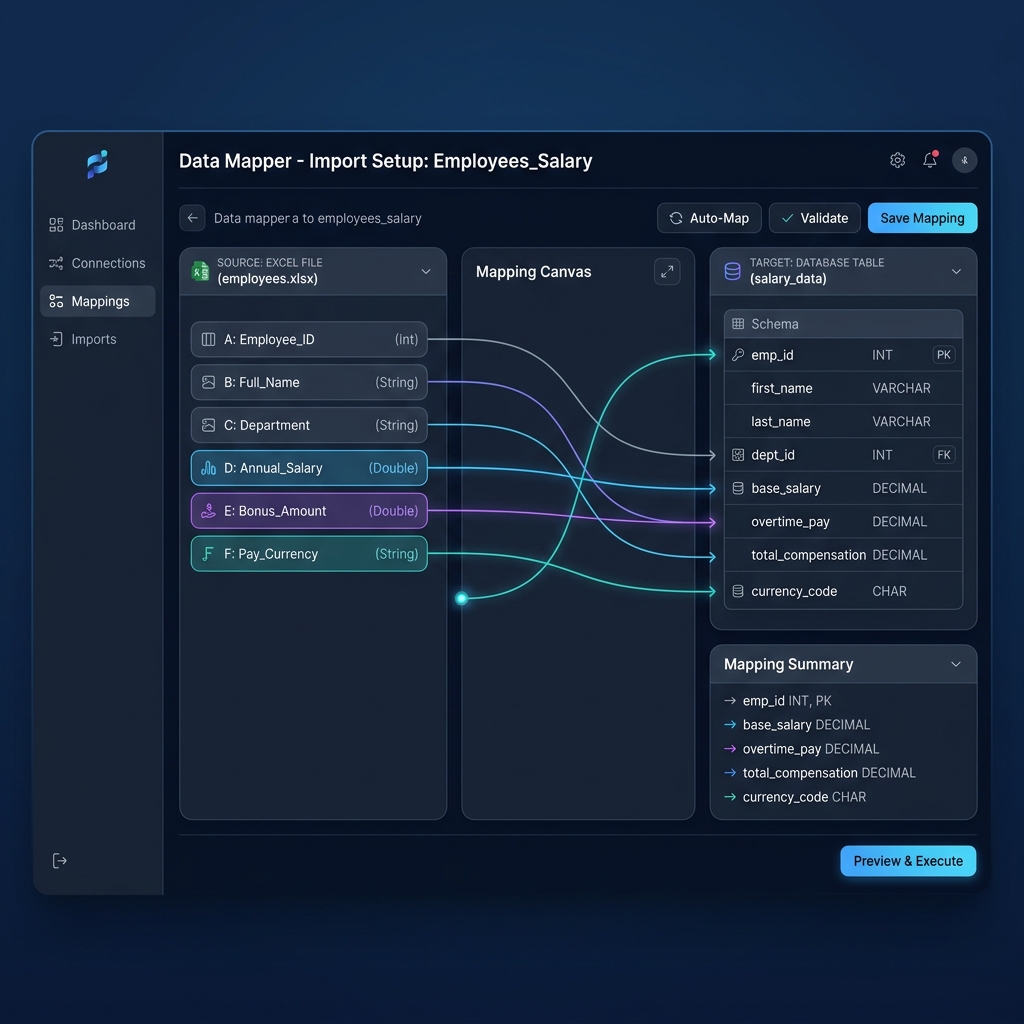
Drag your .xlsx or .csvfile into PayslipGen's local desktop window. The smart auto-detector will scan your header row and align your spreadsheet columns with the corresponding payslip fields. Because PayslipGen saves your column mapping profile permanently, you never have to re-map fields for future pay dates.
Step 4: Enable Bank-Grade AES-256 PDF Password Encryption
Under the Family Educational Rights and Privacy Act (FERPA) and general fiduciary confidentiality guidelines, sending unencrypted payroll documents containing Social Security Numbers or compensation data over email is an intolerable security hazard.
In PayslipGen, check the Enable Password Protection box and select your security key:
- The teacher's Employee ID Number (e.g.,
TCH-1042), or - The last 4 digits of their Social Security Number, or
- Their Date of Birth in
YYYYMMDDformat.
PayslipGen applies native military-grade AES-256 encryption to every PDF before generation, ensuring only the individual educator can open and view their paystub.
Step 5: One-Click Batch Generation & Automated Email Dispatch
Click "Generate All Payslips."
PayslipGen's local turbo-rendering engine processes 35 to 100 faculty payslips in less than 4 seconds. You can export all PDFs directly into a structured local archive (e.g., /Bursar/Payroll_2026/Period_04_Oct15/) or use the integrated SMTP mailer to dispatch encrypted PDF attachments directly to teachers' school email addresses via your existing Google Workspace or Microsoft 365 tenant.
Frequently Asked Questions (FAQs)
What happens under Section 409A if a teacher resigns or takes maternity leave mid-year in February?
Under Treasury Regulation § 1.409A-1(b)(4), a bona fide "separation from service" allows the school to accelerate and pay out all accumulated escrow reserves without violating Section 409A. For example, if a teacher resigns on February 1 after 12 pay periods, the school owes them the accumulated escrow withheld from their earned salary ($623.08 × 12 = $7,476.96). This amount must be disbursed on their final separation paycheck, subject to standard income tax and FICA withholding. For approved leaves of absence (such as FMLA or short-term disability), the teacher continues on the payroll schedule as governed by the school's formal employee handbook and leave policies.
Can a teacher choose 10-month pay vs. 12-month pay midway through the school year?
Absolutely not. This is the most dangerous compliance mistake school business officers make. Under the IRS Section 409A Recurring Part-Year Safe Harbor (IRS Notice 2008-62), an employee's election to defer compensation across 12 months must be executed in writing prior to the start of the performance period and is strictly irrevocable once the first working day begins. Allowing a teacher to switch between 10-month and 12-month pay mid-year invalidates the safe harbor and triggers the 20% federal excise tax penalty on all deferred pay.
How do summer escrow paystubs affect year-end Form W-2 Box 1 reporting?
Because safe-harbor recurring part-year compensation is taxed on a cash basis, Box 1 of Form W-2 reflects the actual taxable compensation disbursed to the teacher between January 1 and December 31of that calendar year. It does not reflect their contract salary for the academic school year. For example, a teacher's 2026 W-2 will contain the spring paychecks from the 2025–2026 contract, the summer 2026 escrow disbursements, and the fall paychecks from the 2026–2027 contract. Maintaining cumulative year-to-date (YTD) columns in your Excel workbook ensures your year-end W-2 reconciliations match Form 941 filings to the penny.
Does PayslipGen store faculty Social Security numbers or compensation records in the cloud?
No. PayslipGen is a 100% offline desktop application. It runs locally on your Windows, macOS, or Linux workstation. Zero teacher names, compensation figures, banking details, or Social Security numbers are ever uploaded, transmitted, or hosted on external servers. This complete air-gapped architecture guarantees total data sovereignty, shielding your school from third-party data breaches and simplifying compliance with federal student and employee privacy standards.
How do we handle substitute teachers and hourly paraprofessionals alongside salaried faculty?
Hourly paraprofessionals, substitute teachers, and athletic coaches are paid under standard hourly wage rules based on recorded timesheets (FLSA non-exempt). They are not eligible for 10-over-12 deferred salary arrangements. In your master Excel workbook, you can maintain an "Hourly_Staff" tab alongside your "Contract_Faculty" tab. PayslipGen can process both hourly paystubs (with hours worked, overtime rates, and shift differentials) and salaried escrow paystubs seamlessly within the same school profile.
Is the $49 PayslipGen license an annual subscription or truly lifetime for our school?
It is truly a one-time payment of $49 for lifetime access. There are no recurring monthly seat fees, no annual maintenance renewals, and no per-employee generation tolls. Your school owns the software permanently, allowing you to generate unlimited paystubs for 10, 50, or 200 faculty and staff members year after year.
Professional School Payroll Without Enterprise ERP Fees
Generate Section 409A-compliant, password-protected PDF paystubs for your entire faculty directly from Excel. One-time payment of $49, lifetime access, zero monthly subscriptions.
Get PayslipGen for $49 (Lifetime Access)Conclusion: Operational Excellence and Financial Stewardship in School Payroll
School business officers carry a profound fiduciary duty: protecting the financial solvency of the educational institution while ensuring that teachers—the intellectual heart of the academy—receive accurate, predictable compensation without regulatory risk.
By mastering the mechanics of IRC § 409A safe harbors, enforcing strict pre-service written election deadlines, and structuring your master payroll spreadsheets with transparent escrow formulas, you eliminate compliance vulnerabilities and build deep trust with your faculty.
And by replacing bloated, five-figure enterprise ERP contracts with the local precision of PayslipGen, you reclaim tens of thousands of dollars each year—reinvesting those critical community funds right where they belong: in the classroom.
(Looking to optimize other specialized payroll workflows? Read our comprehensive guides on Bulk Payslip Generation for Bookkeepers, S-Corp Owner Salary Paystubs, or how to Protect Sensitive Employee Data with Air-Gapped Offline Payroll.)