
Cloud Payroll vs Offline Payroll Software: Which Is More Secure?
Key Takeaways
- ✓Cloud payroll platforms expose sensitive employee PII and banking data to multi-tenant vulnerabilities, public internet attacks, and vendor data breaches.
- ✓Offline desktop payroll software ensures full data sovereignty by storing all records locally on an isolated, air-gapped hard drive without external server sync.
- ✓Local desktop processing eliminates primary cloud attack vectors including Man-in-the-Middle (MitM) interception, credential theft, and remote session hijacking.
- ✓Using self-hosted tools like PayslipGen guarantees 100% payroll operational uptime during internet outages and simplifies GDPR and CCPA data residency compliance.
In the contemporary landscape of human resources and financial administration, the methodology by which an organization processes, stores, and transmits its payroll data represents one of the most critical infrastructural decisions a company can make. As digital transformation initiatives push aggressively towards cloud-centric paradigms across nearly every business vertical, an essential, uncompromising conversation regarding the fundamental security implications of where this highly sensitive data physically resides has never been more urgent.
Payroll data is not merely a collection of numerical values or operational metrics; it is a meticulously detailed, deeply personal repository of your employees' most sensitive personally identifiable information (PII). This comprehensive dataset encompasses full legal names, historical and current residential addresses, national insurance or social security numbers, comprehensive banking details including routing and precise account numbers, historical salary trajectories, performance bonuses, and occasionally even highly confidential medical or tax-related deductions. In the hands of malicious cyber actors, this consolidated dataset is exceptionally lucrative, facilitating devastating identity theft, highly targeted spear-phishing campaigns, direct financial fraud, and profound institutional reputational damage that can take years to repair. Therefore, evaluating with extreme prejudice whether a cloud-based Software-as-a-Service (SaaS) platform or a traditional, locally-hosted offline desktop application provides the superior security posture is paramount for responsible organizational governance.
Try Our Interactive Demo Instantly
Want to see how an offline-capable, client-side payslip generator works in practice? Try our brand-new interactive demo right in your browser. Upload a sample CSV, map your columns, and generate beautifully designed PDF payslips—with zero data ever being transmitted to our servers.
Launch Free Demo NowThe Allure and The Architectural Illusion of the Cloud
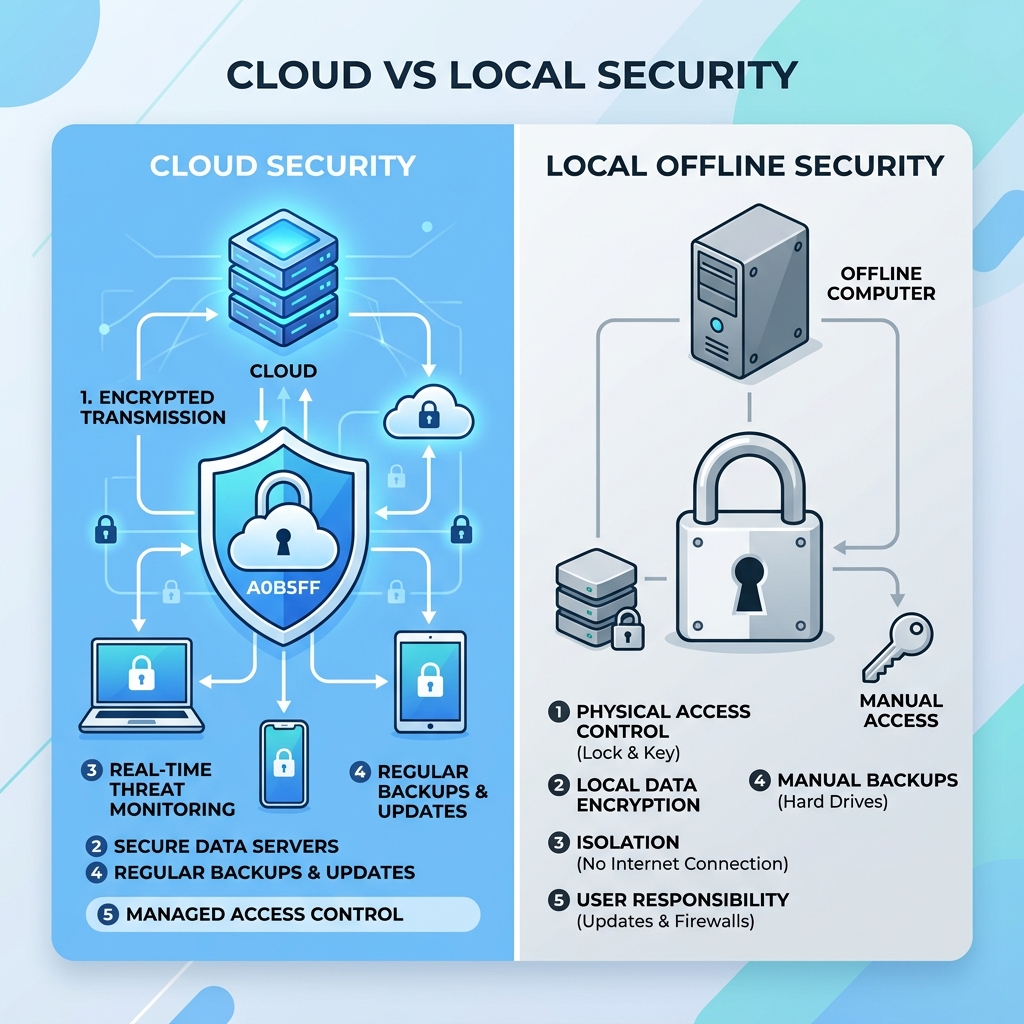
Over the past decade, the software industry has forcefully and successfully directed consumers and enterprises alike toward subscription-based, remote cloud models. The marketing narrative surrounding this migration is undeniably compelling, frequently emphasizing ubiquitous accessibility from any device, automatic background software updates, seamless collaborative workflows across geographically distributed teams, and the complete offloading of on-premise hardware maintenance responsibilities. However, this undeniable operational convenience necessitates a fundamental, often vastly underappreciated compromise: the complete and absolute relinquishment of physical data sovereignty.
When an organization transitions its payroll operations to a third-party cloud provider, they are, in essence, transferring the physical custody and ultimate control of their employees' most sensitive financial information to external servers located in geographically dispersed, highly centralized data centers. This modern architecture inherently introduces a massive, complex attack surface that simply does not exist in traditional local computing. Cloud applications inherently operate on complex multi-tenant architectures, meaning your organization's extraordinarily sensitive payroll database is hosted on the exact same physical server infrastructure and accessed through the same application programming interfaces (APIs) as potentially thousands of other companies. While software-defined logical partitions, sophisticated containerization strategies, and robust database sharding are rigorously implemented to keep this data ostensibly segregated, history has repeatedly demonstrated that this approach is far from infallible. Hypervisor escapes, zero-day vulnerabilities in tenant isolation protocols, and subtly misconfigured access control lists have historically led to catastrophic, cross-tenant data exposures where one customer's compromised environment inadvertently compromises the entire platform.
Furthermore, the very nature of a cloud application dictates that it must be inherently exposed to the public internet to function correctly and facilitate remote access. This omnipresent, 24/7 internet connectivity means that the cloud platform is subjected to an unceasing, automated barrage of brute-force login attempts, sophisticated distributed denial-of-service (DDoS) attacks, and relentless probing for unpatched vulnerabilities by global threat actors operating continuously. You are no longer just defending your local office perimeter; you are implicitly and entirely relying on the competency, vigilance, funding, and operational transparency of your vendor's external cybersecurity team to repel these continuous external assaults. If their defense fails, your employees' data is stolen, regardless of your internal security practices.
Offline Payroll Software: The Uncompromising Fortress of Data Sovereignty
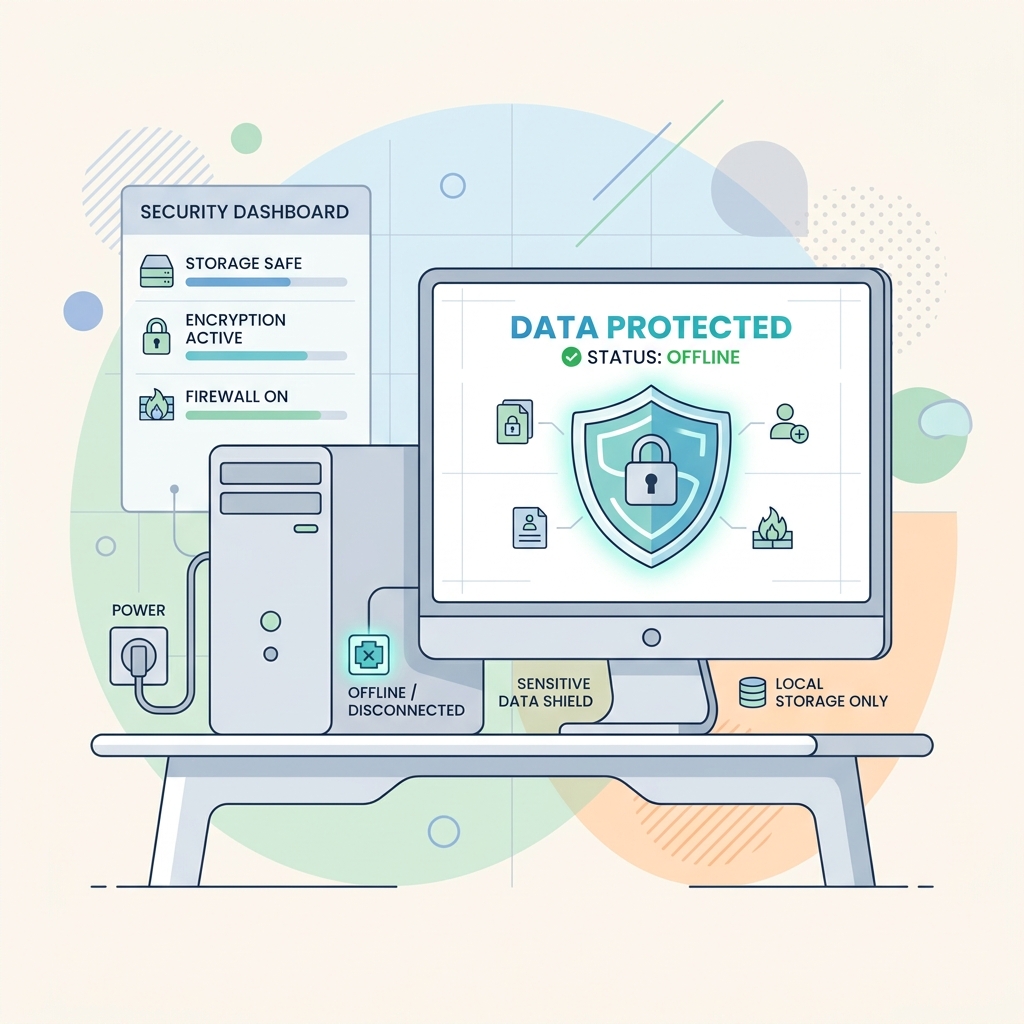
In stark, uncompromising contrast to the sprawling, globally distributed, and inherently vulnerable nature of cloud infrastructure, offline desktop payroll software champions a philosophy of radical containment, deliberate technological limitation, and unequivocal data sovereignty. By its very design, offline software is installed directly and exclusively onto a specific, tangible physical computer located securely within the organization's premises. The underlying database containing the incredibly sensitive employee PII, the historical salary records, and the generated payslips resides exclusively on the localized hard drive of that specifically designated machine. It fundamentally does not synchronize continuously with external third-party servers, it does not passively broadcast operational telemetry across the public web, and crucially, it fundamentally does not require an active internet connection to execute its core computational functions or access historical data.
This deliberate return to localized computing might initially seem counter-intuitive in a modern business era that is culturally obsessed with perpetual connectivity, but from a purely cryptographic and security-focused perspective, it represents a massive, unassailable strategic advantage. The most sophisticated, well-funded, nation-state level cyber attack deployed across the internet is entirely neutralized and rendered comprehensively impotent if the target system is physically disconnected from the network infrastructure. This foundational security concept, known as "air-gapping" when strictly and rigorously applied, represents the absolute gold standard for securing classified military intelligence, managing critical national infrastructure, and operating highly sensitive industrial control systems. These exact same uncompromising principles are directly and flawlessly applicable to safeguarding the most sensitive administrative data a company possesses: its payroll records.
The Undeniable Power of Physical Isolation
When sensitive data never transverses the public internet infrastructure, it fundamentally cannot be intercepted in transit by malicious actors. When a comprehensive database is not hosted on a publicly addressable IP address, it cannot be discovered, probed, or exploited by automated vulnerability scanners endlessly searching for weaknesses. Offline software elegantly transforms a tremendously complex, global cybersecurity challenge into a remarkably straightforward matter of physical access control and disciplined administration within your own secure office environment.
Analyzing the Attack Vectors: A Comprehensive Side-by-Side Architectural Comparison
To truly appreciate and deeply comprehend the vastly disparate security profiles of these two diametrically opposed approaches, we must systematically deconstruct the primary attack vectors frequently exploited by modern cybercriminals and rigorously evaluate how each distinct architecture withstands the assault.
1. Network Interception and Man-in-the-Middle (MitM) Attacks
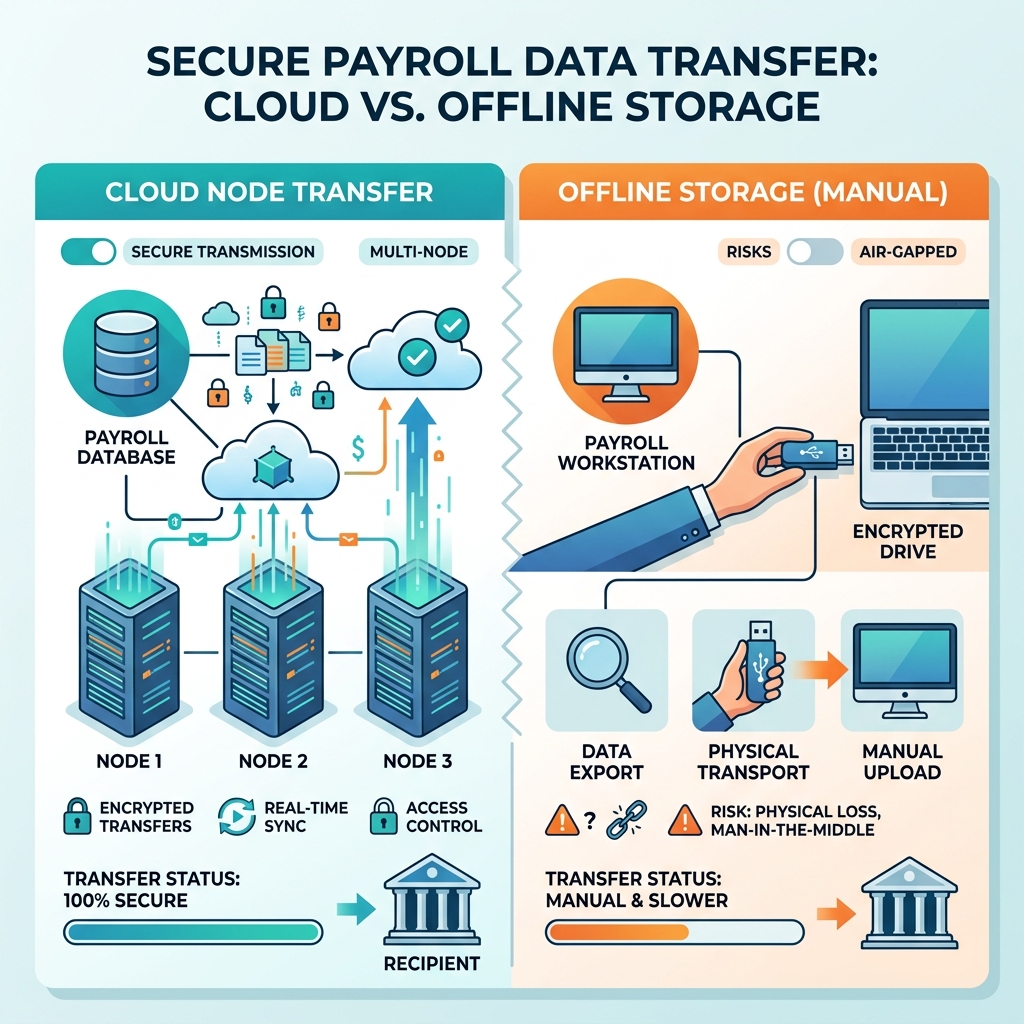
Cloud Software: Every single time an HR administrator logs into a remote cloud portal, inputs a new employee's updated banking details, or clicks 'generate' on a massive batch of monthly payslips, that highly sensitive data must travel from the local web browser, through potentially compromised local area networks, across the vast public internet via numerous intermediary routing nodes, and finally arrive securely at the vendor's remote data center. While modern Transport Layer Security (TLS) encryption strongly mitigates the immediate risk of casual interception, vulnerabilities such as compromised certificate authorities, sophisticated downgrade attacks, rogue wireless access points, or misconfigured corporate proxy servers can theoretically allow highly sophisticated actors to intercept, decrypt, and manipulate this data in transit. The risk, however minimal it might appear when optimally configured, remains mathematically non-zero and introduces an uncontrollable variable into the security equation.
Offline Software: Because the complex computational processing and the comprehensive data storage occur entirely on the local machine's physical CPU and localized hard drive respectively, the sensitive data never transverses external, uncontrolled networks during the critical creation or calculation phases. There is simply no transit vector available for a remote attacker to intercept. The data remains hermetically sealed and cryptographically secure within the physical confines of the workstation until the authorized administrator explicitly and intentionally chooses to export or distribute the finalized, securely encrypted documents.
2. Credential Compromise and Identity Access Management (IAM) Vulnerabilities
Cloud Software: The notorious Achilles heel of any cloud-based platform is the internet-facing authentication gateway. If an overworked HR administrator falls victim to a highly sophisticated spear-phishing campaign and unknowingly surrenders their login credentials to a malicious site, the attacker instantly gains unfettered, remote access to the entire organizational payroll database from literally anywhere on the planet. While robust Multi-Factor Authentication (MFA) significantly reduces this risk, organized attackers have increasingly developed sophisticated "MFA fatigue" techniques, advanced session token hijacking methodologies, and adversary-in-the-middle (AiTM) phishing proxy frameworks designed specifically to seamlessly bypass these modern protections.
Offline Software: Successfully compromising a localized desktop application requires significantly more effort, risk, and proximity than merely stealing a password via an email link. Even if a remote malicious actor miraculously obtained the local login credentials specifically designated for the offline payroll software, those credentials are fundamentally and entirely useless unless the attacker also possesses physical access to the specific physical computer sitting securely in the locked HR department's office, or has managed to somehow successfully install a highly persistent remote access trojan (RAT) on that specific, isolated device. The absolute necessity of physical proximity or highly targeted, localized endpoint compromise exponentially increases the difficulty, financial cost, and operational risk for the attacker, effectively deterring the vast majority of cyber threats.
The Compliance, Regulatory, and Data Residency Advantages of Localization
Beyond the immediate and obvious technical vulnerabilities, the physical geographical location of your data—commonly known in legal spheres as data residency—has profound legal, ethical, and regulatory implications. Comprehensive legislative frameworks such as the European Union's stringent General Data Protection Regulation (GDPR), the California Consumer Privacy Act (CCPA), and numerous other highly localized employee data protection mandates impose incredibly severe financial penalties, intense regulatory scrutiny, and massive operational friction for the mishandling, unauthorized international transfer, or accidental breach of Personally Identifiable Information (PII).
When heavily utilizing commercial cloud services, successfully navigating complex data residency requirements can quickly become exceptionally complicated and legally perilous. Major cloud vendors frequently, seamlessly, and automatically replicate massive databases across multiple global regions to confidently ensure high availability, load balancing, and comprehensive disaster recovery capabilities. Consequently, your employees' highly sensitive data might be primarily hosted in a server farm in Frankfurt, continuously backed up to an archival facility in Dublin, and inadvertently processed by a secondary, specialized application server located in the United States. Establishing a definitive, legally binding chain of custody and definitively guaranteeing that sensitive data never inadvertently crosses restricted geopolitical boundaries requires extensive, continuous auditing, highly specialized legal counsel, and extremely complex enterprise-tier service level agreements.
Offline desktop payroll software elegantly and completely circumvents this entire regulatory labyrinth. By maintaining the critical data exclusively on a tangible local hard drive, the organization retains absolute, unambiguous, and verifiable control over its physical geographical location. Proving strict compliance with the most stringent data residency laws becomes a trivial, undeniable matter; the data physically resides exactly where the computer is situated, immensely simplifying regulatory audits and significantly reducing the organization's overarching legal liability profile in the unfortunate event of a formal inquiry.
The Hidden Complexities and Exhausting Demands of Cloud Security Posture Management
It is an incredibly common, yet highly dangerous misconception that adopting a modern cloud platform absolves the utilizing organization of its fundamental security responsibilities. In reality, cloud security operates strictly on a formalized "Shared Responsibility Model." While the cloud vendor is undeniably responsible for securing the underlying physical infrastructure—the massive server racks, the virtualization hypervisors, and the physical security of the data centers themselves—the customer remains entirely, legally, and operationally responsible for securely configuring their specific environment, rigorously managing access policies, enforcing strong authentication protocols across all users, and protecting the myriad of endpoint devices remotely accessing the portal.
Actively managing this complex shared responsibility requires highly specialized, incredibly expensive cybersecurity expertise. Dedicated administrators must continuously navigate complex Identity Access Management (IAM) roles, properly configure conditional access policies based on strict IP whitelisting or endpoint device compliance, continuously monitor massive volumes of audit logs for subtly anomalous remote login behavior, and ensure that programmatic API keys are strictly rotated and never inadvertently exposed. For small to medium-sized enterprises (SMEs) lacking dedicated, full-time cybersecurity personnel, this represents a daunting, continuous, and exhausting operational burden that is incredibly easy to misconfigure, often leading to devastating, silent security loopholes.
Conversely, offline software presents a dramatically simplified, significantly flatter, and vastly more comprehensible security model that is fundamentally more intuitive for traditional businesses to manage effectively without requiring specialized external consultants. The security perimeter is tangible, physical, and easily understood: securely lock the physical room containing the computer, aggressively encrypt the local hard drive using standard, robust full-disk encryption protocols like Microsoft BitLocker or Apple FileVault, and diligently ensure the host operating system receives regular, scheduled security patches. This pragmatic approach demands significantly less specialized cybersecurity acumen while simultaneously providing a demonstrably more robust defense against external, internet-borne threats.
Operational Resilience: The Critical, Non-Negotiable Element of Availability
In the professional domain of information security, the foundational triad governing all architectural decisions consists of Confidentiality, Integrity, and Availability (CIA). While a significant portion of this comprehensive discussion has rightly focused on confidentiality (the act of actively preventing unauthorized data access), availability is an equally critical, non-negotiable metric. Payroll is an unforgiving, absolute operational necessity; employees must be paid accurately, comprehensively, and punctually, regardless of external circumstances, minor operational inconveniences, or global technological outages.
Cloud-based payroll systems inherently introduce an entirely new layer of complex dependency and frustrating fragility into this otherwise straightforward critical workflow: the absolute prerequisite of an uninterrupted, high-speed internet connection and the continuous operational stability of a distant third-party vendor. If the local internet service provider experiences a major routing failure, if a vital submarine communications cable is unexpectedly severed, or if the cloud vendor's primary data center suffers a catastrophic, cascade-failure outage—events that happen with alarming, documented regularity across the industry—the organization's ability to process payroll is instantaneously and completely paralyzed. In this scenario, you are entirely at the mercy of technical factors far beyond your organizational control.
Offline payroll software guarantees absolute operational resilience and continuous availability against any and all external network failures. Because the core application logic and the entire comprehensive database reside locally, authorized HR administrators can effortlessly run complex payroll calculations, securely generate all required tax documentation, and rapidly export the finalized payslip PDFs to encrypted physical media even if the entire regional internet infrastructure completely collapses. This uninterrupted continuity definitively ensures that the foundational, deeply psychological contract between employer and employee—timely and accurate compensation—is never jeopardized by unpredictable, external technological dependencies.
The Psychological and Reputational Toll of a Data Breach
When discussing data security, it is often easy to become lost in the technical jargon of encryption algorithms, network topologies, and hypervisor architectures. However, the true cost of a compromised payroll system extends far beyond the immediate technical remediation efforts. The profound psychological impact on a workforce that learns their deeply personal financial details have been exposed to unknown cybercriminals cannot be overstated. A breach of this magnitude instantly shatters the foundational trust that employees place in their employer to protect them. The aftermath involves humiliating public disclosures, the frantic purchasing of reactive credit monitoring services for affected staff, plummeting employee morale, and devastating reputational damage in the wider industry that can severely cripple future talent acquisition efforts. By actively choosing a completely localized, offline software solution, an organization demonstrates a profound, uncompromising commitment to employee privacy, actively preventing this devastating scenario before it can even theoretically occur.
Fortify Your Most Sensitive Financial Data
Eliminate third-party vulnerabilities, bypass complex cloud security configurations, and guarantee operational continuity. Experience the unrivaled peace of mind that comes with absolute data sovereignty.
Your employee data never leaves your computer.Conclusion: Re-evaluating the Fundamental Priorities of Payroll Administration
The global technology industry's relentless, highly incentivized push toward cloud computing has successfully conditioned many organizations to blindly accept the outsourcing of critical infrastructure as an inevitable, universal improvement. While modern cloud architectures undeniably offer significant collaborative advantages and unprecedented scalability for many general business applications—such as customer relationship management, generic internal communication, or collaborative document editing—the uniquely sensitive, highly targeted nature of administrative payroll data demands a much more rigorous, skeptical, and profoundly defensive evaluation of underlying security architectures.
When we meticulously strip away the polished marketing rhetoric and objectively analyze the cold, hard realities of modern attack vectors, it becomes undeniably clear that deliberately introducing an internet-connected, complex multi-tenant intermediary into the critical payroll process inherently and dramatically multiplies the organizational risk profile. The theoretical, often marginal convenience of checking a high-level payslip dashboard from a remote mobile device simply does not rationally justify the existential risk of exposing a company's entire dedicated workforce to life-altering identity theft and severe financial compromise due to an unforeseen third-party server breach.
By strategically opting for a robust, offline desktop payroll software solution, organizations are not regressing technologically; rather, they are making a highly conscious, incredibly sophisticated, and profoundly defensive security decision to actively prioritize unequivocal data sovereignty, robust physical containment, and guaranteed operational resilience over superfluous connectivity. In a modern era defined by increasingly pervasive, highly sophisticated, and financially catastrophic cyberattacks, recognizing that the unequivocally most secure server in existence is the one that is never connected to the internet is the ultimate hallmark of responsible, mature, and deeply protective organizational leadership.