
Desktop Payroll Software Guide
Desktop-based payroll software gives your organization direct ownership of payroll data, installment settings, and delivery infrastructure instead of relying on shared SaaS environments.
Quick Jump
Tired of doing this the hard way?
You are reading about manual workflows that waste hours. PayslipGen automates this entire process securely offline in just 3 clicks. No subscriptions.
Automate Instantly for $49What It Is
Desktop-based payroll software is installed on infrastructure you control, so employee payroll data, generated payslips, and delivery workflows stay under your own governance and security practices.
Who It's For
Organizations with strict internal data-control requirements.
Teams that prefer one-time software ownership over recurring SaaS fees.
Businesses needing local policy-driven retention and backup controls.
Operators who want configurable email and installment architecture.
Exact Steps
Step 1
Prepare installation environment
Set up Desktop environment, environment variables, and secure computer access for payroll operations.
Expected output: Server is reachable with required runtime and secure admin access.
Step 2
install and initialize app
Install dependencies, start the application, and verify database/session initialization.
Expected output: Application boots successfully with working admin dashboard.
Step 3
Configure mail and security settings
Set SMTP/Resend credentials, enforce credential hygiene, and validate outbound email settings.
Expected output: Test mail succeeds and secure auth flow is operational.
Step 4
Run payroll batch with internal controls
Process spreadsheet, generate payslips, and distribute while preserving internal audit and retention rules.
Expected output: Completed payroll batch with local control over records and outputs.
Common Mistakes
Treating desktop-based as set-and-forget installment.
Fix: Apply regular updates, backups, and operational checks as part of monthly routine.
Weak admin credentials or shared accounts.
Fix: Use strong unique credentials and role-based operational access.
No documented backup/restore plan.
Fix: Create tested backup schedule for database and generated document storage.
Skipping mail provider domain verification.
Fix: Complete SPF/DKIM/domain setup before production batch sends.
Troubleshooting
If installment works locally but fails on computer
Do this: Validate env variables, computer permissions, and port/network configuration.
If emails are blocked or marked as spam
Do this: Check sender domain authentication and provider reputation requirements.
If admin session keeps expiring unexpectedly
Do this: Review session cookie settings and computer time/config consistency.
If database or file access errors occur
Do this: Audit file permissions, ownership, and disk space for storage paths.
Cloud SaaS vs Self-Hosted Payroll Model
| Topic | Cloud SaaS Model | Self-Hosted with PayslipGen |
|---|---|---|
| Data location control | Stored in provider-managed cloud stack. | Stored in your own controlled environment. |
| Cost structure | Recurring subscription model. | One-time software ownership model. |
| Configuration flexibility | Limited by provider feature boundaries. | High flexibility in installment and workflows. |
| Operational responsibility | More provider-managed operations. | You manage installation, backup, and hardening. |
Deep Dive
Data Ownership and Operational Control
With desktop-based architecture, payroll records stay on your own machine or computer. You decide how backups, access control, and retention are managed.
When Self-Hosted Is the Better Fit
Teams with stricter privacy requirements, internal IT support, or fixed monthly payroll flows often prefer self-installation for predictability and lower long-term cost.
How PayslipGen Fits This Model
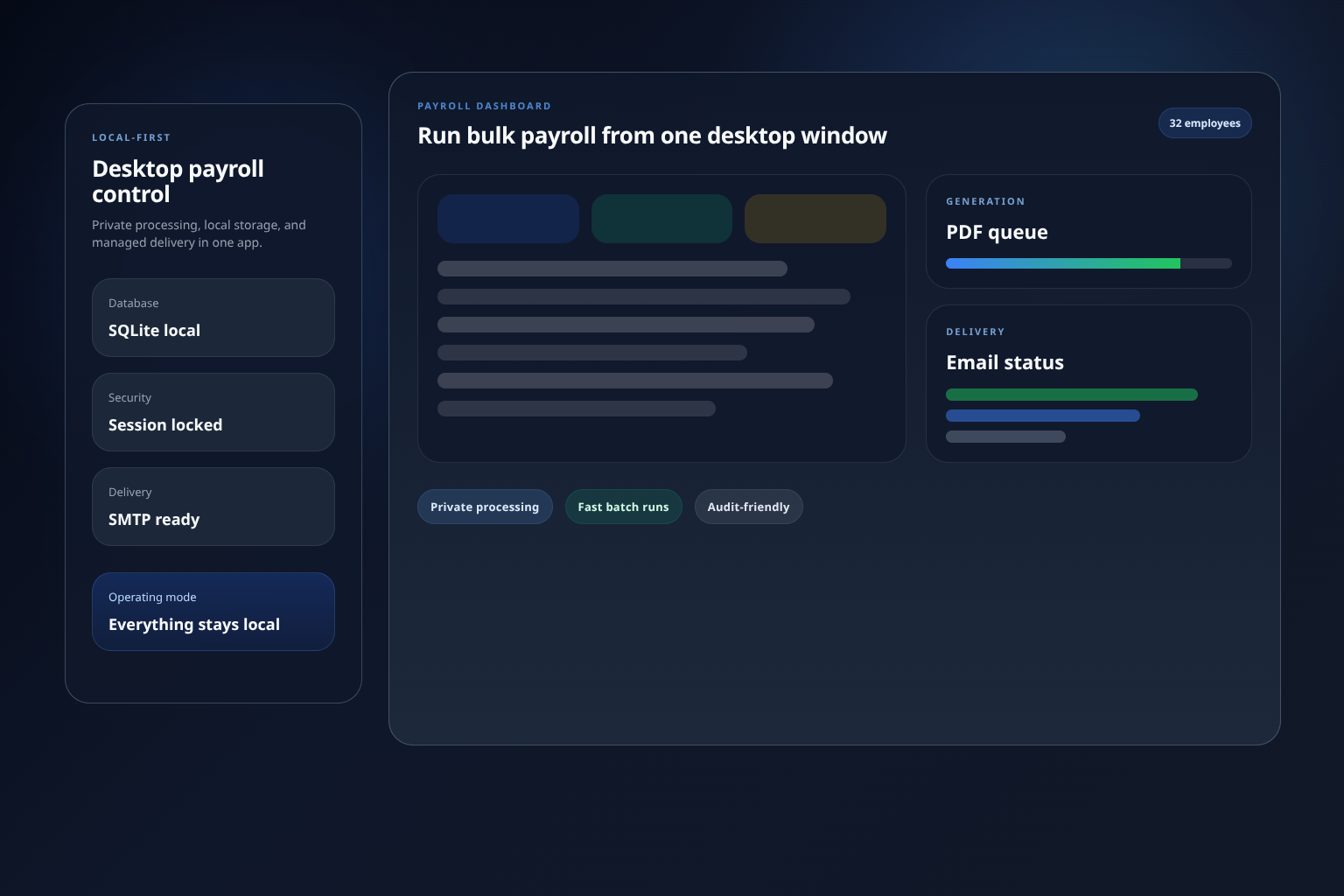
PayslipGen is designed for direct installation. It combines spreadsheet import, calculation, PDF generation, and bulk delivery while keeping your payroll process under your own infrastructure.
Final Checklist
Runtime and environment variables are correctly configured.
Admin login and session flow are stable.
Mail provider integration is verified in production context.
Backup and restore workflow is documented and tested.
Access control and credential rotation policy is active.
Payroll batch run is validated end-to-end before monthly rollout.
FAQ
Resources & Internal Links
Want the fastest path to production?
PayslipGen gives you spreadsheet upload, automatic calculations, PDF generation, and bulk email delivery in one self-hosted workflow.