
How to Create Password-Protected Payslips Automatically
Key Takeaways
- ✓Sending unencrypted payslips via email exposes sensitive financial and personal data once stored in recipient inboxes.
- ✓Automated document encryption applies AES-256 bit file-level protection programmatically during batch generation.
- ✓Dynamic passwords combining unique attributes (like Employee ID and Date of Birth) ensure high cryptographic entropy without administrative friction.
- ✓Using tools like PayslipGen enables automated generation and encryption directly from Excel or CSV spreadsheets in minutes.
- ✓Document-level encryption ensures strict compliance with global privacy regulations, including GDPR, by protecting PII at rest.
In the dynamically evolving corporate environment, the intersection of operational efficiency and uncompromising data security represents the paramount challenge for modern Human Resources and Financial administration departments. One of the most glaring vulnerabilities in traditional payroll workflows remains the insecure distribution of highly sensitive compensation documents. This comprehensive treatise explores the profound necessity, the intricate technical methodologies, and the transformative operational benefits of automatically generating and distributing inherently secure, password-protected payslips.
The fundamental concept of the payslip has undergone a radical transformation over the past two decades. What was once a physically printed, tangibly sealed document handed directly to an employee has now predominantly transitioned into a purely digital artifact. However, this digitalization has frequently, and alarmingly, outpaced the corresponding implementation of proportional security measures. Across thousands of organizations globally, critically sensitive payroll information—encompassing exhaustive personal identification details, comprehensive historical banking routing numbers, meticulous tax bracket classifications, and exact salary figures—is routinely disseminated via unencrypted, entirely plaintext emails. This deeply entrenched operational negligence exposes the organization and its workforce to a staggering array of catastrophic cyber threats, ranging from opportunistic local network sniffing to highly coordinated, socially engineered phishing campaigns designed specifically to intercept unencrypted internal communications. The transition to fully automated, mathematically robust cryptographic protection is no longer merely a sophisticated technological luxury; it is an absolute, non-negotiable operational imperative.
Try Our Interactive Demo Instantly
Want to see how an offline-capable, client-side payslip generator works in practice? Try our brand-new interactive demo right in your browser. Upload a sample CSV, map your columns, and generate beautifully designed PDF payslips—with zero data ever being transmitted to our servers.
Launch Free Demo NowUnderstanding the true depth of this vulnerability requires acknowledging the sophisticated, highly commoditized nature of modern cybercrime. When a seemingly innocuous PDF document containing an employee's comprehensive financial profile is transmitted across a standard corporate network or the public internet without an applied layer of cryptographic defense, it fundamentally relies exclusively on the transient security of the transport protocol itself. While Transport Layer Security (TLS) provides a commendable baseline of protection during the active transmission phase, it fundamentally fails to protect the document at rest. Once the unencrypted PDF resides in an employee's often vulnerable personal email inbox, locally synchronized desktop mail client, or inadvertently exposed mobile device, it becomes an exceptionally lucrative, easily accessible target for any malicious actor who manages to compromise those secondary, significantly less secure environments. Consequently, embedding the security directly into the document itself—specifically through rigorous, file-level password protection and AES-256 encryption—becomes the only mathematically sound defense mechanism capable of ensuring persistent, uncompromising confidentiality.

The Intricate Architecture of Automated Document Encryption
To fully appreciate the transformative power of automated password-protected payslips, one must systematically deconstruct the complex technical architecture that underpins this seemingly straightforward process. Traditional, manual encryption is an incredibly labor-intensive, error-prone ordeal. Historically, an HR administrator would be required to individually open specialized PDF authoring software, manually select an individual employee's document, invent or reference a supposedly secure password, manually type that password into the encryption configuration dialog, verify the input, and finally export the secured file. When successfully extrapolated across a typical mid-sized organization consisting of hundreds or potentially thousands of employees, this manual methodology rapidly degenerates into an unsustainable, psychologically exhausting, and logistically impossible administrative nightmare that inherently invites critical human error.
The modern, automated paradigm fundamentally revolutionizes this deeply flawed process by elegantly synthesizing structured data extraction with programmatic cryptographic application. At the core of this sophisticated operation is a specialized software engine designed specifically to parse massive, complex datasets—typically exported from comprehensive Enterprise Resource Planning (ERP) systems or dedicated payroll calculation engines in standardized formats such as Comma Separated Values (CSV) or sophisticated Excel spreadsheets. This centralized data repository does not merely contain the numerical financial values; crucially, it must also include specific, unique, and predictable personal attributes that will serve as the foundational entropy for the dynamically generated passwords.
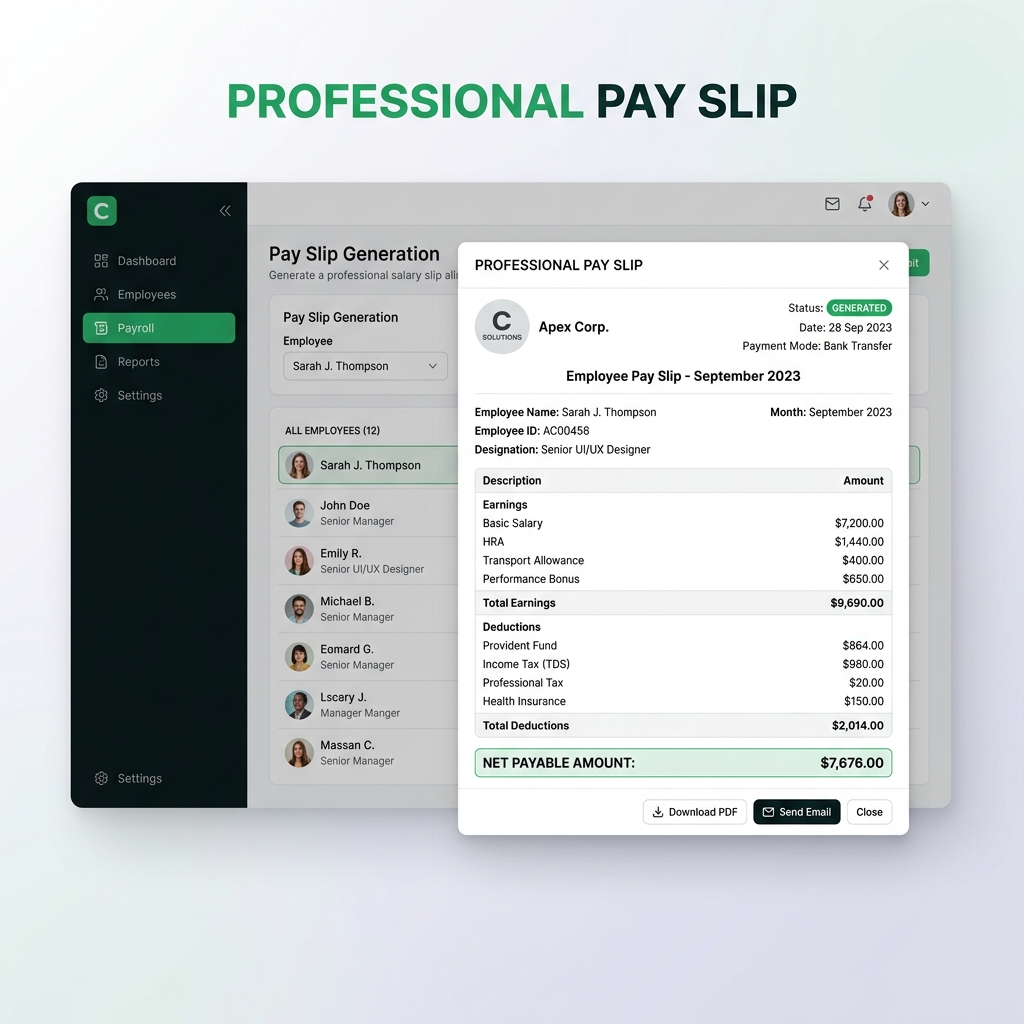
During the automated generation cycle, the software engine systematically iterates through each individual employee record. Simultaneously as it algorithmically renders the beautifully formatted, visually distinct visual representation of the payslip, it simultaneously extracts designated data fields—such as the employee's unique national identification number, their precisely formatted date of birth, their uniquely assigned employee ID, or an explicitly designated, highly secure custom password string. The engine then programmatically applies an industry-standard encryption algorithm, utilizing the extracted, uniquely personal data string as the cryptographic key, effectively sealing the document in milliseconds without requiring any human intervention or oversight. This seamless synthesis of data processing and high-speed encryption is the defining characteristic of a truly modern, secure payroll operation.
The Absolute Necessity of High-Entropy Dynamic Passwords
A critical consideration in this automated process is the mathematical complexity, or entropy, of the chosen password format. Utilizing easily guessable, universal passwords (such as the company name or the current month) provides merely a superficial illusion of security that will be instantaneously defeated by even the most rudimentary automated brute-force attacks. The true power of automation lies in its ability to dynamically assign highly unique, unpredictable passwords based on non-public employee attributes, exponentially increasing the cryptographic difficulty and effectively neutralizing unauthorized access attempts.
Step-by-Step Implementation: Transitioning to Automated Security
Successfully transitioning an established organizational workflow from an insecure, manual process to a highly automated, cryptographically secure paradigm requires strategic planning, meticulous data preparation, and the careful selection of an appropriate software solution. While the initial setup phase demands a deliberate, focused effort, the resulting long-term operational dividends in terms of drastically reduced administrative overhead and profoundly enhanced security posture are overwhelmingly positive and rapidly amortize the initial investment. Let us systematically detail the required steps to achieve this transformation.
Phase 1: Comprehensive Data Standardization and Preparation
The foundational prerequisite for any successful automated process is the absolute, uncompromising accuracy and rigorous standardization of the underlying source data. Before attempting to implement an automated encryption solution, the human resources department must conduct a comprehensive audit of their core payroll database. If the chosen password strategy relies on a combination of the employee's Date of Birth and their unique Employee ID, it is absolutely critical that these specific data fields are populated correctly, formatted consistently (e.g., exclusively utilizing the DDMMYYYY format without exception), and free from subtle typographical errors or trailing whitespace. An automated software engine cannot intrinsically discern human intent; if an employee's date of birth is incorrectly recorded in the source database, the software will flawlessly generate an inaccessible document secured by an incorrect password, leading to widespread employee frustration and an immediate influx of administrative support tickets.
Phase 2: Evaluating and Procuring the Optimal Software Engine
The software market is currently saturated with myriad tools claiming to offer automated PDF generation capabilities, but discerning the specific tools that genuinely prioritize uncompromising security and seamless operational workflow requires careful, informed evaluation. When procuring a solution specifically designed for automated password-protected payslips, several non-negotiable features must be rigorously verified. Firstly, the software must explicitly support strong, modern encryption standards, specifically AES-256 bit encryption. Anything less represents a significant compromise in security posture. Secondly, the software must offer highly granular, flexible column-mapping capabilities, allowing the administrator to intuitively and easily designate precisely which specific data columns from the imported CSV or Excel file should dynamically dictate the password for each corresponding generated document. Finally, for organizations prioritizing absolute data sovereignty, exploring robust, locally installed offline desktop applications is often highly preferable to relying on inherently vulnerable, multi-tenant cloud-based SaaS platforms, as offline software fundamentally ensures that the sensitive data never transverses the public internet during the highly sensitive processing and encryption phase.

Phase 3: Configuration, Stringent Testing, and Controlled Deployment
Once the optimized software solution has been successfully procured and the source data meticulously standardized, the actual configuration process is typically remarkably straightforward. The administrator imports the prepared data file, visually maps the relevant columns (such as mapping the "Net Pay" column to the designated display area on the payslip template), and crucially, configures the specific password generation rule. For instance, instructing the software to synthesize the password by concatenating the first four letters of the employee's surname with the last four digits of their government identification number.
Before executing the process across the entire organization, conducting a rigorous, highly controlled testing phase is absolutely mandatory. Generating a small, isolated batch of test documents using synthetic or anonymized dummy data allows the administrator to definitively verify the visual integrity of the generated payslip, confirm that the complex data mapping is functioning flawlessly, and most importantly, physically test the generated passwords to ensure the encryption logic is applying the specific, dynamic ruleset exactly as intended. Once this comprehensive verification is successfully completed, the organization is ready to fully deploy the automated solution, instantaneously transforming a complex, multi-day manual ordeal into a streamlined, highly secure process that fundamentally executes in a matter of minutes.
The Compounding Benefits of Automation and Encryption
The profound organizational impact of implementing automated password-protected payslips extends significantly beyond the immediate, obvious benefit of enhanced document security. This transformative modernization effort fundamentally recalibrates the entire operational efficiency profile of the human resources and financial administrative departments, unlocking substantial, measurable value across multiple distinct operational domains.
1. Drastic Reduction in Administrative Overhead and Financial Cost
The most immediate and quantifiable benefit is the sheer, overwhelming reduction in the thousands of cumulative hours historically dedicated to highly repetitive, manual administrative tasks. The agonizing process of manually creating, individually reviewing, slowly encrypting, and meticulously distributing hundreds of individual documents is entirely eradicated. What previously consumed a dedicated team of administrators for several consecutive days at the conclusion of every single financial cycle is effectively condensed into a streamlined, largely automated process requiring merely a few minutes of high-level oversight. This massive recovery of incredibly valuable, highly skilled human capital allows an organization to strategically redirect those resources away from mind-numbing administrative drudgery and toward significantly higher-value, strategically impactful initiatives such as sophisticated employee engagement programs, complex proactive compliance auditing, or deep-dive strategic financial forecasting and analysis.
2. Complete Elimination of Critical Human Error
Human beings, regardless of their intense dedication or rigorous training, are fundamentally and inescapably prone to fatigue-induced errors, especially when forcibly subjected to highly monotonous, heavily repetitive data processing tasks over extended durations. In the uniquely sensitive context of manual payroll administration, a momentary lapse in concentration can easily result in catastrophic consequences, such as inadvertently applying an incorrect encryption password to a document, or vastly more damaging, accidentally sending an unencrypted, highly detailed payslip intended for the Chief Executive Officer directly to a junior, entry-level employee. Automated software systems, conversely, do not suffer from cognitive fatigue, they are never distracted, and they execute their meticulously programmed algorithmic logic with absolute, unyielding, mathematical precision every single time. By systematically removing the fragile human element from the actual critical generation and encryption phase, organizations fundamentally eradicate the inherent, omnipresent risk of manual data mishandling, ensuring consistent, flawless execution across every single payroll cycle.
3. Fortifying Regulatory Compliance and Strategic Risk Mitigation
In our increasingly regulated global business environment, demonstrating a proactive, uncompromising commitment to stringent data protection is no longer merely an ethical aspiration; it is a rigid, heavily enforced legal requirement. Comprehensive legislative frameworks such as the formidable General Data Protection Regulation (GDPR) in the European Union strictly mandate that organizations must actively implement highly robust, state-of-the-art technical and organizational measures to comprehensively protect the deeply sensitive personally identifiable information (PII) of their employees. Utilizing automated, AES-256 bit encrypted, heavily password-protected payslips provides an undeniable, easily auditable demonstration of profound, proactive compliance with these incredibly stringent regulations. In the unfortunate event of a widespread corporate network breach or a targeted malicious attack, securely encrypted documents represent a fundamentally unyielding, impenetrable secondary line of cryptographic defense, actively preventing the sensitive data from being meaningfully accessed, widely exploited, or publicly weaponized, thereby significantly mitigating the organization's overarching legal, financial, and reputational liability.
Addressing the Delivery Mechanism: The Final Security Frontier
While generating a robustly encrypted, password-protected PDF file represents a massive leap forward in operational security, the holistic, end-to-end security architecture is only as strong as its weakest, most vulnerable link. How these newly secured documents are ultimately distributed to the end-user remains a critical, frequently overlooked consideration that must be addressed with equal technical rigor. While transmitting an encrypted file via a standard, unencrypted SMTP email protocol is undeniably and vastly superior to sending a plaintext, completely unprotected document, forward-thinking organizations are increasingly exploring significantly more resilient, highly integrated distribution mechanisms to further solidify their defensive posture.
Ideally, an advanced, highly capable automated payroll system should elegantly integrate directly into the organization's established, secure internal infrastructure. Instead of relying on potentially interceptable external email gateways, the system can be configured to automatically and securely deposit the encrypted payslips directly into a highly secure, authenticated internal employee portal, seamlessly integrate with an encrypted corporate intranet infrastructure, or systematically distribute the files through robust, securely authenticated internal messaging platforms. Furthermore, utilizing highly specialized, dedicated software that leverages explicitly authenticated, securely established SMTP connections with modern TLS 1.3 enforcement ensures that even if the delivery mechanism fundamentally relies on email architecture, the transmission pathway itself remains as highly resilient, rigorously defended, and structurally sound as the encrypted document it is transporting.
Automate Your Security, Reclaim Your Time
Stop wasting countless administrative hours on highly insecure, vulnerable manual processes. Automatically generate, deeply encrypt, and securely distribute thousands of robustly protected payslips in mere minutes with absolute confidence and precision.
Experience Automated Cryptographic SecurityConclusion: The Inevitable Standard of Modern Administration
The comprehensive automation of password-protected payslips is not merely a fleeting technological trend or an optional, luxurious administrative upgrade; it represents the inevitable, fundamental evolution of responsible organizational management and deeply ethical employee data stewardship. In an era defined by incredibly sophisticated, highly lucrative cybercrime and fiercely aggressive regulatory enforcement, relying on antiquated, highly manual, and fundamentally insecure distribution methods is an unacceptable abdication of basic corporate responsibility.
By aggressively embracing the powerful capabilities of modern automation to systematically enforce robust cryptographic standards across all sensitive financial documentation, an organization achieves a profound, multifaceted victory. They completely eradicate a massive administrative burden that consumes valuable human capital, entirely eliminate the omnipresent risk of catastrophic human error during the critical data handling phase, definitively guarantee strict compliance with stringent global privacy regulations, and most crucially, unmistakably demonstrate an unyielding, profound respect for their employees' most deeply sensitive and uniquely personal information. The transition to fully automated, highly secure payroll processing is ultimately not merely a technical software upgrade; it is a declarative, strategic statement of an organization's maturity, defensive sophistication, and unwavering commitment to absolute operational excellence and data sovereignty.