
Real Estate Brokerage Agent Commission Settlement Generator: How to Itemize Desk Fees, Franchise Royalty Splits & E&O in Excel
Key Takeaways
- ✓The Commission Disbursement Authorization (CDA): In residential and commercial real estate transactions, commissions never flow directly from buyers or sellers to sales agents. By law, escrow and title companies disburse funds only to the licensed managing broker, who must issue a comprehensive, line-by-line settlement statement detailing Gross Commission Income (GCI), company dollar splits, and statutory fee deductions.
- ✓IRC § 3508 Statutory Non-Employee Status: Licensed real estate agents occupy a unique statutory safe harbor under federal tax law. Under Internal Revenue Code § 3508, agents are classified as self-employed for federal tax withholding, FICA, and FUTA purposes—requiring annual Form 1099-NEC reporting rather than W-2 forms—provided their contract explicitly conditions compensation on sales volume rather than hours worked.
- ✓Multi-Tiered Settlement Math: A professional commission settlement statement must mathematically reconcile: (1) national franchise royalty fees (5% to 8% off-the-top up to annual caps), (2) graduated broker splits (e.g., 70/30 until the agent hits a $25,000 company dollar cap, then shifting to 100%), (3) per-transaction Errors & Omissions (E&O) risk management fees ($35 to $150), (4) transaction coordinator fees ($350 to $500), and (5) recurring monthly desk and tech platform deductions.
- ✓Air-Gapped Brokerage Efficiency: Generic cloud accounting systems (QuickBooks Online, Brokermint, Lone Wolf) charge hefty monthly per-agent SaaS tolls and expose confidential transaction details. Managing brokers who run commission spreadsheets in Excel can generate encrypted, audit-proof PDF settlement statements locally using PayslipGen for a one-time $49 lifetime fee.
When a $750,000 residential escrow closes at the title company, the listing and selling agents celebrate a successful transaction. But inside the managing broker's back office, the closing wire triggers an intricate accounting waterfall known as the Commission Disbursement Settlement.
A gross commission check of $22,500 cannot simply be handed over to the producing agent. Before a disbursement check or ACH transfer can clear, the brokerage must itemize multiple contractual deductions: the national franchise royalty fee (such as Keller Williams, RE/MAX, or Coldwell Banker), the graduated brokerage company dollar split, the transaction coordinator fee, the per-closing Errors & Omissions (E&O) insurance risk reserve, and any unpaid monthly office desk rent or MLS tech platform dues.
For managing brokers, team leaders, and real estate bookkeepers, generating these settlement sheets is both a legal safeguard and a vital agent retention tool. Top-producing agents scrutinize every closing statement. If their annual split cap isn't tracked accurately, or if administrative fees are miscalculated, disputes ignite and agents take their listings to a competing brokerage.
In this comprehensive guide, we dissect the statutory tax rules governing real estate agents under IRC § 3508, unpack the step-by-step arithmetic of graduated commission caps and franchise royalties, provide a battle-tested Excel blueprint, and demonstrate how brokerages use PayslipGen to generate vector-crisp, password-protected PDF commission settlement statements completely offline.

Try Our Interactive Demo Instantly
Want to see how an offline-capable, client-side payslip generator works in practice? Try our brand-new interactive demo right in your browser. Upload a sample CSV, map your columns, and generate beautifully designed PDF payslips—with zero data ever being transmitted to our servers.
Launch Free Demo NowChapter 1: The Legal Framework: Escrow Closings, CDAs & IRC § 3508
Real estate brokerage accounting is strictly controlled by state real estate licensing commissions and federal tax statutes. To maintain legal compliance, brokerages must observe two fundamental structural rules:
1. The Commission Disbursement Authorization (CDA)
Under real estate license law across all 50 states, an individual sales agent or associate broker has no legal authority to receive commission payments directly from a principal (homebuyer, seller, or builder).
All compensation for licensed real estate activity must be paid to the employing managing broker. When an escrow closes:
- The title or settlement attorney receives the escrow funds.
- The brokerage submits a formal Commission Disbursement Authorization (CDA) directing title how to wire proceeds.
- Title wires the gross commission to the brokerage's operating or commission escrow account.
- The managing broker calculates the agent's net split, deducts contractual fees, and issues an itemized commission settlement statement alongside the net payout.
2. Internal Revenue Code § 3508: Statutory Non-Employees
Unlike standard gig-economy workers whose classification is subject to ambiguous common-law tests or restrictive state ABC statutes, licensed real estate agents enjoy explicit statutory protection under Internal Revenue Code (IRC) § 3508.
Under IRC § 3508, a real estate agent is classified as a statutory non-employee (treated as self-employed for federal income tax, Social Security, Medicare, and unemployment tax purposes) if three strict statutory conditions are met:
The 3-Prong Statutory Test of IRC § 3508(b)(1)
- State Licensing: The individual must be a licensed real estate sales agent, broker, or real estate appraiser.
- Direct Sales Remuneration: Substantially all remuneration (whether paid in cash or other property) for the performance of services must be directly related to sales or other output (including transaction volume) rather than to the number of hours worked.
- Written Independent Contractor Agreement: The services must be performed pursuant to a written contract between the agent and the employing broker, and the contract must explicitly state that the agent will not be treated as an employee with respect to such services for federal tax purposes.
Because of IRC § 3508, real estate brokerages do not withhold federal income tax (FITW) or FICA taxes from commission payouts. Instead, annual gross commissions are reported in Box 1 (Nonemployee compensation) of Form 1099-NEC. The agent is solely responsible for quarterly estimated tax payments and Schedule SE self-employment taxes (15.3%).
Chapter 2: Anatomy of a Real Estate Commission Split Waterfall
A modern commission settlement statement is not a simple percentage calculation. It is a prioritized waterfall where deductions occur in a specific mathematical sequence:
// Commission Disbursement Waterfall Order
1. Contract Sale Price × Agreed Commission Rate % = Gross Commission Income (GCI)
2. GCI - National Franchise Royalty (5%-8%, subject to cap) = Adjusted Gross Commission (AGCI)
3. AGCI × Brokerage Split % (e.g., 30% Company Dollar) = Brokerage Share
4. AGCI × Agent Split % (e.g., 70% Base Split) = Agent Gross Split
5. Agent Gross Split - E&O Risk Fee - Transaction Coordinator - Monthly Desk Fees = Net Payout
1. National Franchise Royalties & Royalty Caps
If the brokerage is affiliated with a major national brand (Keller Williams, RE/MAX, Century 21, Berkshire Hathaway HomeServices), a franchise royalty fee is deducted "off-the-top" from Gross Commission Income.
Typically ranging between 5% and 8%, franchise fees are remitted to national headquarters to fund global branding, marketing, and proprietary tech stacks. However, most franchise agreements feature a Royalty Cap (e.g., $3,000 to $4,500 per anniversary year). Once an agent contributes that cumulative amount in royalties, further franchise deductions drop to 0% for the remainder of their contract year.
2. Graduated Brokerage Splits & Company Dollar Caps
To attract high-producing agents, modern brokerages use graduated split plans. In a graduated plan, the agent's split increases as their annual production rises:
| Cumulative Company Dollar | Agent Split % | Brokerage Split % | Post-Cap Transaction Fee |
|---|---|---|---|
| $0.00 – $25,000.00 (Pre-Cap) | 70.0% | 30.0% | $0.00 |
| Over $25,000.00 (Capped) | 100.0% | 0.0% | $250.00 flat fee per closing |
The managing broker must accurately track each agent's Cumulative Company Dollar across the calendar or anniversary year. When a closing pushes an agent over the $25,000 cap mid-transaction, the broker must execute a split transaction calculation: applying the 70/30 split only up to the exact remaining cap balance, and awarding 100% on the remainder.
Chapter 3: Itemizing Desk Fees, E&O Reserves & Coordinator Charges
In addition to commission splits, a real estate settlement statement serves as the brokerage's primary mechanism to reconcile operational reimbursements and shared service costs:
1. Errors & Omissions (E&O) Risk Management Fees
Real estate litigation over undisclosed property defects, boundary disputes, or dual-agency conflicts is common. Brokerages carry comprehensive commercial Errors & Omissions insurance policies.
Rather than absorbing the massive policy premium as general overhead, brokerages pass through an E&O Risk Fee on every closed transaction:
- Flat Fee Model: A flat charge of $40 to $150 deducted per transaction side (listing side and selling side itemized separately).
- Tiered Legal Defense Reserve: New agents pay $150 per deal until contributing $1,500 into an individual deductible escrow reserve, after which the per-deal charge drops to a nominal maintenance fee.
2. Transaction Coordinator (TC) Invoicing
Managing disclosures, escrow compliance checklists, HOA documents, termite reports, and municipal transfer certificates requires extensive paperwork. Many producing agents hire the brokerage's in-house Transaction Coordinator.
The TC fee ($350 to $500 per closed deal) is itemized on the settlement sheet as an administrative deduction from the agent's gross split and paid directly to the coordinator.
3. Recurring Monthly Desk & Tech Platform Deductions
Most traditional and boutique brokerages charge monthly platform fees:
- Private Office / Desk Rent: $250 to $800/month for dedicated office space.
- Brokerage Tech & CRM Fee: $75 to $150/month for KvCORE, Chime, DocuSign, and digital marketing tools.
- Local MLS & Board Dues: Reimbursable association dues paid on behalf of the agent.
When an agent closes a deal, the brokerage accounting office reconciles any outstanding monthly desk fees directly against the commission check. Itemizing these offsets on the settlement statement eliminates the administrative headache of pursuing agents for overdue credit card payments.
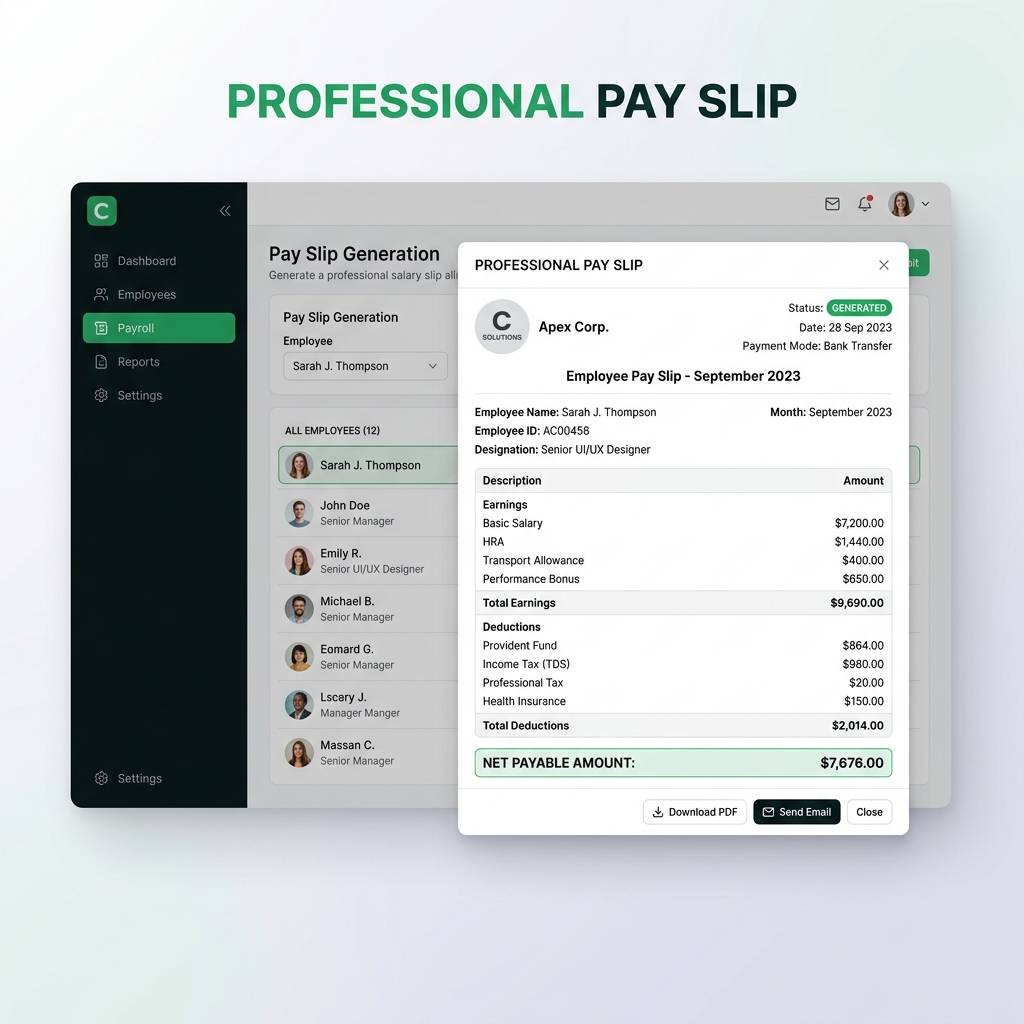
Chapter 4: Master Excel Real Estate Commission Settlement Blueprint (With Real Formulas)
To eliminate calculation errors and disputes, managing brokers and transaction managers should standardize on a structured settlement workbook. Below is the production formula architecture for a closing at 742 Evergreen Terrace ($685,000 sale price at 3.0% commission):
| Line # | Accounting Category | Transaction Detail | Value / Amount | Excel Formula Specification |
|---|---|---|---|---|
| 01 | Property Contract | Sale Price (742 Evergreen Terr) | $685,000.00 | Raw sales contract input |
| 02 | Commission Agreement | Agreed Commission Rate | 3.00% | Listing / buyer representation rate |
| 03 | GROSS COMMISSION (GCI) | Total Wire from Title Escrow | $20,550.00 | =D1*D2 |
| 04 | Off-the-Top Franchise | National Franchise Fee (6.0%) | -$1,233.00 | =-MIN(D3*0.06, MAX(0, 3000 - Prior_Royalty_YTD)) |
| 05 | Adjusted Gross (AGCI) | Commission Subject to Split | $19,317.00 | =D3+D4 |
| 06 | Brokerage Retention | Company Dollar Split (30.0%) | -$5,795.10 | =-MIN(D5*0.30, MAX(0, 25000 - Prior_CoDollar_YTD)) |
| 07 | AGENT GROSS COMM | Agent Base Split (70.0%) | $13,521.90 | =D5+D6 |
| 08 | Risk Management | Errors & Omissions (E&O) Fee | -$65.00 | Brokerage policy schedule |
| 09 | Admin Service | In-House Transaction Coordinator | -$425.00 | TC file closing invoice |
| 10 | Monthly Platform Offset | Desk Rent & CRM Platform Dues | -$350.00 | Monthly ledger deduction |
| 11 | NET AGENT DISBURSEMENT | Direct Deposit / Wire Amount | $12,681.90 | =D7+SUM(D8:D10) |
Chapter 5: Why Cloud Real Estate Platforms Drain Brokerage Profits
Many growing brokerages adopt vertical real estate back-office platforms such as Lone Wolf (Back Office / brokermint), Dotloop, or SkySlope. While these systems provide digital document signing, their transaction accounting and commission modules introduce severe headaches:
1. The Monthly Per-Agent SaaS Extortion
Real estate has notoriously cyclical roster turnover. In a 40-agent boutique brokerage, 10 agents might produce 80% of the volume, while 15 newer or part-time agents close only 1 or 2 transactions per year.
Yet cloud platforms charge $15 to $35 per licensed agent per month regardless of whether the agent closed a transaction that month! You are forced to pay ongoing software seats for inactive agents just to retain their historical transaction archives and licensing records.
2. Escalating Cloud Subscription Overhead
Let's evaluate the total financial cost of ownership for a 25-agent independent real estate brokerage over a 3-year operating period:
| Expense Item | Lone Wolf / Brokermint Cloud | QuickBooks Online Advanced | PayslipGen Desktop Application |
|---|---|---|---|
| Monthly Platform Toll | $250.00 / month | $200.00 / month | $0.00 (Forever) |
| Per-Agent Monthly Fee | $20.00 / agent / mo ($500/mo) | Included up to user limit | $0.00 (Unlimited agents) |
| Commission Split Flexibility | Rigid template structure | Extremely poor (Manual journal entries) | 100% Excel Formula Freedom |
| Document Data Sovereignty | Locked behind subscription paywall | Cloud dependent | Stored 100% Locally on Broker's PC |
| 3-Year Cumulative Cost (25 Agents) | $27,000.00 | $7,200.00 | $49.00 (One-Time) |
By decoupling commission disbursement document generation from bloated cloud SaaS platforms, an independent brokerage saves between $7,000 and $27,000 every three years. That capital is far better spent on local brokerage billboards, luxury staging allowances, or agent recruitment incentives.
Chapter 6: Step-by-Step Brokerage Settlement Generation in PayslipGen
With PayslipGen, managing brokers and transaction managers convert complex deal sheets into polished, institutional-grade PDF settlement statements in seconds:
Step 1: Track Deal Closings in Excel
Record your closed escrows in your master brokerage workbook. Include columns for Property Address, Escrow Number, Agent Name, Agent Tax ID / SSN, Gross Commission Income, Franchise Royalty, Broker Company Dollar, TC Fee, E&O Fee, Desk Rent Offset, and Net Check.
Step 2: Configure Your Brokerage Profile in PayslipGen
Launch PayslipGen on your office Mac or PC. Under Brokerage Profile, upload your high-resolution brokerage logo and specify:
- Brokerage Legal Entity Name: (e.g., Heritage Realty Group LLC)
- Corporate Broker License Number: (Required on all real estate financial disclosures)
- Broker of Record Name & Contact Info
- Federal Tax EIN: (For year-end 1099-NEC reconciliation)
Step 3: Map Spreadsheet Headers Visually
Drop your closing workbook into PayslipGen. The desktop mapper aligns your custom columns instantly:
Agent_Name→ Contractor NameProperty_Address→ Memo / Project ReferenceGCI_Total→ Gross Contract RevenueBroker_Company_Dollar→ Commission Split OffsetFranchise_Royalty→ Royalty DeductionEO_Insurance_Fee→ Risk Fee DeductionMonthly_Desk_Dues→ Administrative ChargeNET_DISBURSEMENT→ Net Nonemployee Payout
Step 4: Enable AES-256 PDF Security & Custom File Naming
Commissions are sensitive financial disclosures. Top agents do not want their earnings visible to administrative interns or colleagues. Check "Password Protect PDFs" and select the agent's Date of Birth or the last four digits of their SSN. Set the output file naming convention to [Property_Address]_[Agent_Lastname]_Settlement.pdf.
Step 5: Export Vector PDFs and Dispatch via Private SMTP
Click "Generate Settlement Documents". Within 2 seconds, PayslipGen generates professional, print-ready PDF settlement statements formatted with clear itemized transaction ledgers, YTD company dollar progression, and brokerage sign-off blocks. Distribute them instantly via your brokerage's private email server or save them directly to the escrow archive folder on your local secure drive.
Frequently Asked Questions (FAQs)
What is the difference between a CDA and an agent settlement statement?
A Commission Disbursement Authorization (CDA) is an instruction letter sent by the managing broker to the closing title or escrow company directing how gross closing proceeds should be wired (e.g., wiring the brokerage split to the company operating account and the agent split to their business bank). An Agent Settlement Statement(or commission paystub) is the internal, itemized financial statement provided by the broker to the agent, detailing Gross Commission Income, company dollar retentions, E&O fees, transaction coordinator charges, and monthly desk fee deductions.
Why do real estate agents receive Form 1099-NEC instead of Form W-2?
Under IRC § 3508, licensed real estate agents are statutory non-employees for federal tax purposes, provided their compensation is directly linked to sales volume rather than hours worked and they have a signed written independent contractor agreement. Because they are legally classified as self-employed individuals, brokerages report annual earnings in Box 1 of Form 1099-NEC and do not withhold payroll taxes.
How do we handle a transaction that splits across an agent's cap threshold?
When an agent is close to hitting their annual company dollar cap (e.g., $25,000) and closes a large deal, the broker calculates a bifurcated split. The portion of the commission required to reach the remaining cap balance is split at the standard rate (e.g., 70/30). Any remaining commission above that threshold is awarded to the agent at 100% (minus applicable post-cap transaction fees). The settlement statement must clearly show both calculation steps.
Can a brokerage deduct past-due desk rent from an agent's commission check?
Yes, provided the written independent contractor agreement and brokerage policy manual explicitly grant the broker the right of offset. Because licensed real estate agents operate as 1099 independent contractors under IRC § 3508 rather than statutory W-2 wage employees, the restrictive wage deduction laws governing employee paychecks (such as California Labor Code § 221) do not restrict contractual business fee setoffs agreed upon between commercial parties.
Can PayslipGen generate year-to-date (YTD) company dollar tracking?
Yes. By maintaining running YTD totals in your Excel closing ledger, you can map YTD Company Dollar, YTD Gross Commission Income, and YTD Franchise Royalties directly onto the generated PDF statement, giving agents instant visibility into their cap progress.
Streamline Real Estate Commission Settlements Without SaaS Subscriptions
Generate professional, audit-proof real estate commission disbursement statements (CDA) directly from Excel. Calculate graduated broker splits, E&O reserves, and desk fee offsets offline for a one-time payment of $49.
Get PayslipGen for $49 (Lifetime License)Conclusion: Operational Precision Protects Brokerage Relationships
In real estate, your agents are your clients. Providing timely, transparent, and mathematically immaculate commission settlement statements demonstrates professional stewardship and builds the trust required to retain high-producing talent.
By leveraging Excel's unlimited formula flexibility to calculate graduated company dollar caps, national franchise fees, and E&O reserves—and packaging them into elegant, password-protected PDF settlement sheets using PayslipGen—managing brokers eliminate back-office friction, protect proprietary closing data, and eliminate thousands in recurring software subscription waste.
(Looking to streamline other complex contractor settlements and commission workflows? Explore our dedicated guides on 1099 Contractor Paystubs, Commission Draw Against Commission Calculations, or how to Manage Multiple Client Companies Without Per-Client SaaS Fees.)