
Offshore Oil Rig Worker Paystub Generator: How to Manage 14/14 & 28/28 Hitch Pay, Safety Bonuses & Hazard Differentials from Excel
Key Takeaways
- ✓The 84-Hour Hitch Workweek: Offshore rotational schedules (14 days on / 14 days off or 28/28) demand rigorous FLSA overtime calculations. Working standard 12-hour daily tours yields 84 hours per active hitch week—triggering 40 regular base hours and 44 statutory overtime hours at 1.5× the regular rate.
- ✓OCSLA & Maritime Tax Jurisdiction: Under the Outer Continental Shelf Lands Act (43 U.S.C. § 1331 et seq.), federal law governs operations beyond territorial waters, adopting the laws of the adjacent coastal state (Louisiana, Texas, Mississippi, Alabama) as surrogate federal law. Correct state tax withholding depends on platform location coordinates and worker residency.
- ✓Compensable Standby & Safety Incentives: Rig workers delayed by fog, tropical storms, or mechanical shut-ins remain "engaged to wait" under 29 CFR § 785.17 and are legally entitled to guaranteed standby rates. Non-discretionary safety milestone dividends (e.g. BOP zero-spill bonuses) must be factored into the regular rate for overtime.
- ✓Zero-Internet Rig Superintendent Sovereignty: Drilling contractors and marine superintendents operating deepwater drillships 100 miles offshore face Starlink bandwidth throttles and 2FA authentication timeouts. With PayslipGen, rig administrators generate password-protected, audit-proof PDF paystubs locally from Excel for a one-time $49 fee with zero cloud SaaS overhead.
Eighty miles off the Louisiana coastline in the deepwater Gulf of Mexico, the rotary table on a semi-submersible drilling rig turns 24 hours a day through thunderous swells and relentless humidity. When a 14-day or 28-day hitch concludes and the Sikorsky S-92 crew-change helicopter approaches the helideck, rig workers expect complete transparency in their earnings.
Offshore energy compensation is among the most demanding payroll disciplines in global commerce. Roughnecks, derrickhands, motormen, and toolpushers routinely work punishing 12-hour tours under extreme physical conditions. Their bi-weekly settlement is not a standard 40-hour office paycheck: it encompasses intense regular rate overtime, deepwater hazard differentials, standby weather delays, Blowout Preventer (BOP) safety milestone incentives, and complex state tax allocation rules dictated by the Outer Continental Shelf Lands Act (OCSLA).
When drilling contractors attempt to process offshore hitch settlements through conventional cloud payroll platforms like ADP, Gusto, or QuickBooks Online, the process routinely breaks down. Satellite latency, rigid bi-weekly pay period templates that fail to accommodate rotational 14/14 cycles, and mandatory two-factor authentication render cloud tools unusable in remote offshore wheelhouses.
Try Our Interactive Demo Instantly
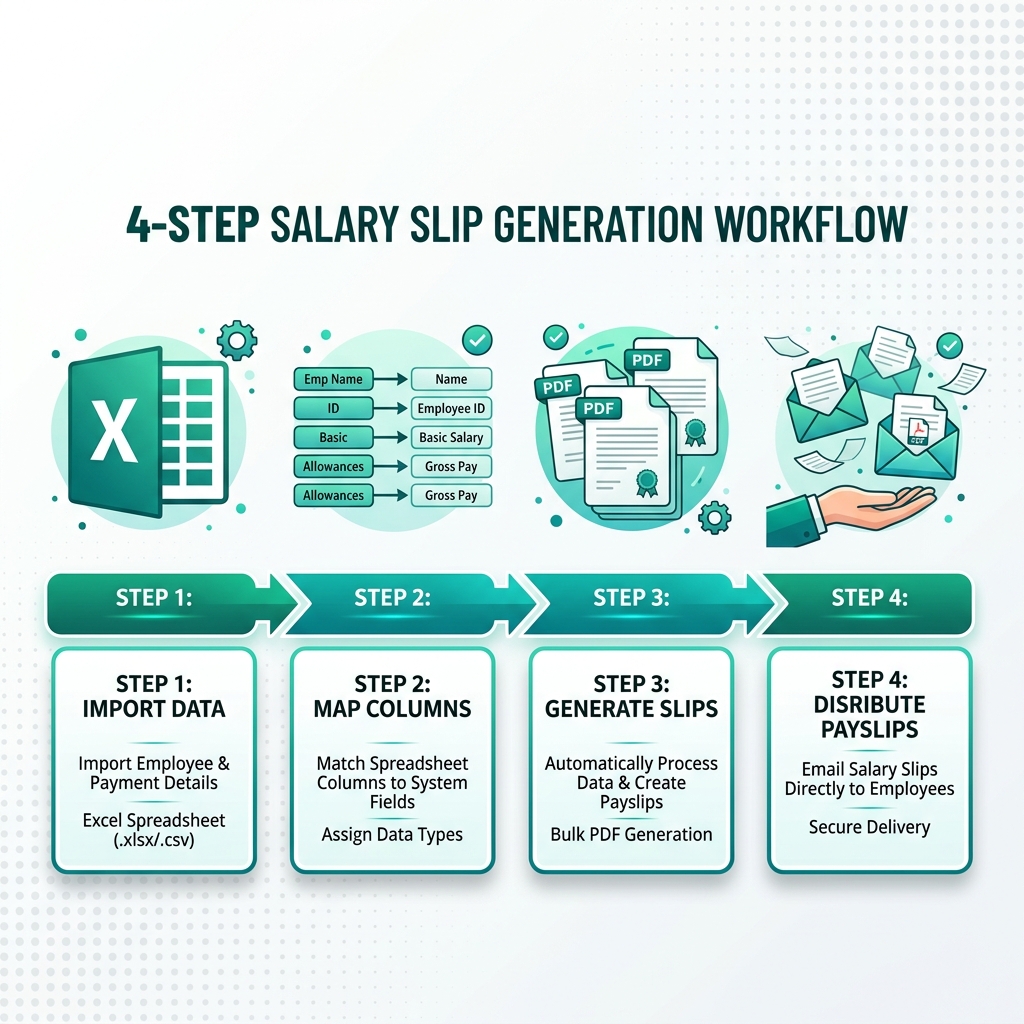
Want to see how an offline-capable, client-side payslip generator works in practice? Try our brand-new interactive demo right in your browser. Upload a sample CSV, map your columns, and generate beautifully designed PDF payslips—with zero data ever being transmitted to our servers.
Launch Free Demo NowChapter 1: The Offshore Hitch Operating Reality: 14/14 & 28/28 Rotations
Offshore drilling operations function on continuous 24/7 cycles structured around rotational hitches. The two primary staffing models across North American waters, the North Sea, and offshore West Africa are:
- 14/14 Rotation (Gulf of Mexico Standard): Crew members work 14 consecutive calendar days offshore followed by 14 consecutive days of rest onshore. During the active hitch, workers complete a mandatory 12-hour tour shift every single day.
- 28/28 Rotation (Deepwater & International Waters): Crew members complete 28 consecutive days on the platform (typically two consecutive 14-day drilling legs) followed by 28 days off hitch.
The 84-Hour Workweek & FLSA Overtime Mathematics
Under the federal Fair Labor Standards Act (FLSA, 29 U.S.C. § 207), non-exempt employees must receive overtime compensation at not less than one and one-half times their regular rate of pay for all hours worked in excess of 40 hours in a single 7-day workweek.
Because an offshore tour requires 12 hours of active deck duty per day, a rig worker accumulates 84 hours per 7-day workweek:
Statutory Breakdown = 40 Base Straight-Time Hours + 44 Overtime Hours (1.5× Regular Rate)
Over a standard 14-day hitch spanning two consecutive workweeks, a roughneck logs exactly 168 total hours: 80 straight-time hours and 88 statutory overtime hours. In the alternating two-week off-hitch period, the worker logs 0 hours.
Compliance Trap: The "Day Rate" Overtime Violation
Many independent energy service contractors pay drillers or inspection technicians a flat "day rate" (e.g., $650/day). The U.S. Supreme Court's landmark decision in Helix Energy Solutions Group, Inc. v. Hewitt (598 U.S. 39, 2023) confirmed that paying an offshore toolpusher a daily rate does not satisfy the salary-basis test for FLSA white-collar exemptions. Daily-rate offshore workers are non-exempt and legally entitled to retroactive overtime unless guaranteed a weekly salary meeting statutory requirements regardless of days worked.
Chapter 2: Jurisdictional Tax Law: OCSLA & State Income Tax Withholding
One of the most complex legal questions facing offshore drilling payroll administrators is determining which taxing authority has legal jurisdiction over wages earned on platforms anchored miles out to sea.
The Outer Continental Shelf Lands Act (43 U.S.C. § 1331 et seq.)
Enacted by Congress in 1953, the Outer Continental Shelf Lands Act (OCSLA)defines the subsoil and seabed of the Outer Continental Shelf (OCS) beyond state territorial boundaries (typically 3 nautical miles offshore, or 3 marine leagues / 9 nautical miles for Texas and Florida's Gulf coast) as under exclusive federal jurisdiction.
Under 43 U.S.C. § 1333(a)(2)(A), OCSLA declares that the civil and criminal laws of each adjacent coastal state are adopted as surrogate federal law for platforms affixed to the OCS, provided state laws are not inconsistent with federal regulations:
| Platform Location | Legal Jurisdiction | State Income Tax Rules | Resident vs Non-Resident Impact |
|---|---|---|---|
| Inside Territorial Waters (< 3 miles) | Direct Coastal State Jurisdiction | Governed by state tax code (e.g. Louisiana Dept of Revenue) | Withhold state tax for hours physically worked in state waters |
| Outer Continental Shelf (Adjacent to TX) | Federal OCSLA (Surrogate Texas Law) | Zero State Income Tax | No withholding unless worker resides in an income-taxing home state |
| Outer Continental Shelf (Adjacent to LA) | Federal OCSLA (Surrogate Louisiana Law) | Louisiana non-resident tax rules apply to OCS employment | Withhold Louisiana individual income tax on OCS source income |
| Deepwater Drillship in Transit | Federal Maritime Admiralty / Jones Act | 46 U.S.C. § 11108 (Seaman Tax Withholding Exemption) | Tax withheld solely based on worker's legal state of residence |
Drilling payroll managers must cleanly distinguish between crew members on stationary fixed platforms (governed by OCSLA state allocation) and mariners on dynamically positioned drillships operating under federal maritime admiralty law.
Chapter 3: Offshore Compensation Components: Hazard Pay, Storm Standby & Safety Incentives
An offshore oil rig paystub features specific operational line items rarely seen in onshore corporate payroll:
1. Deepwater Hazard & Environment Differentials
Working in open ocean environments characterized by high-pressure gas zones, hydrogen sulfide (H2S) toxic gas hazards, heavy drill pipe manipulation, and severe offshore weather commands premium hazard compensation. Drilling contractors implement this either as a percentage markup (e.g. +15% to +25% on base hourly rates) or a fixed daily offshore allowance ($60 to $120 per active tour day).
2. Standby Weather Delay & Tropical Storm Evacuation Pay
Gulf of Mexico hurricane seasons (June through November) and North Sea winter gales regularly interrupt drilling operations. When fog halts helicopter crew transfers or an approaching category 3 hurricane triggers platform evacuations, crew members are placed on Standby Status.
Under 29 CFR § 785.17, when employees are confined to shore-based hotels, heliports, or platform living quarters awaiting dispatch, they are legally "engaged to wait." Drilling agreements guarantee workers a baseline of 8 to 12 hours of straight-time standby pay per day while awaiting mobilization.
3. Blowout Preventer (BOP) & Safety Milestone Dividends
In modern offshore drilling, catastrophic environmental and personal safety risks are governed by strict safety management systems (SEMS). Drilling operators reward crews with substantial quarterly or hitch bonuses tied to zero-recordable injury milestones, successful pressure-test cycles on the subsea Blowout Preventer (BOP) stack, and current HUET (Helicopter Underwater Escape Training) certifications.
FLSA Overtime Alert: Under 29 CFR § 778.208, non-discretionary safety bonuses promised in advance to incentivize performance must be added to total straight-time earnings when calculating the regular rate of pay for overtime during the bonus earning period!
Chapter 4: Master Excel Offshore Rig Payroll Blueprint (With Real Formulas)
To maintain error-free hitch accounting across drill floor crews, rig superintendents and onshore accountants structure their spreadsheets around 14-day tour blocks.
Below is the exact production architecture for an offshore drilling crew member on a 14/14 rotation (two 84-hour workweeks), itemizing tour hours, statutory overtime, hazard premiums, and post-tax deductions:
| Line # | Pay Element Category | Offshore Item Description | Tour Values | Excel Formula Specification |
|---|---|---|---|---|
| 01 | Regular Base Pay | Straight-Time Tour Hours (Weeks 1 & 2) | 80.0 hrs @ $36.00/hr | =B10*C10 ($2,880.00) |
| 02 | FLSA Overtime Pay | Statutory Tour Overtime (44 hrs/wk × 2) | 88.0 hrs @ $54.00/hr (1.5×) | =B11*C11 ($4,752.00) |
| 03 | Hazard Premium | Deepwater Drill Floor Hazard Allowance | 14 active days @ $75.00/day | =B12*C12 ($1,050.00) |
| 04 | Standby Weather Pay | Fog Helicopter Delay in Houma Heliport | 12.0 hrs @ $36.00/hr | =B13*C13 ($432.00) |
| 05 | Safety Incentive | Quarterly BOP Zero-Spill Dividend | Hitch Safety Discretionary Bonus | $750.00 |
| 06 | GROSS HITCH EARNINGS | Total Taxable Compensation | $9,864.00 | =SUM(E1:E5) |
| 07 | Statutory Withholding | FICA Social Security (6.2%) | Standard federal payroll tax | =E6*0.062 ($611.57) |
| 08 | Statutory Withholding | FICA Medicare (1.45%) | Standard federal payroll tax | =E6*0.0145 ($143.03) |
| 09 | Tax Withholding | Federal Income Tax Withholding (FITW) | IRS Pub 15-T Bracket Tables | $1,450.00 |
| 10 | Tax Withholding | Louisiana State Income Tax (OCSLA) | Non-resident tax allocation | $394.56 |
| 11 | Voluntary Deduction | FRC Coveralls & Impact Gloves Advance | Rig safety locker supply draw | -$185.00 |
| 12 | NET HITCH DISBURSEMENT | Direct Deposit to Crew Account | $7,079.84 | =E6-SUM(E7:E11) |
Full Rig Crew Hitch Disbursement Roster
On a modern deepwater drilling unit, different billets carry varying responsibility levels, hourly wages, and hazard ratings:
| Rig Billet / Role | Crew Member Name | Base Rate | Tour Hours | Gross Hitch Pay | Taxes & Deductions | Net Pay |
|---|---|---|---|---|---|---|
| Toolpusher (Day) | Garrett Sterling | $58.00/hr | 168 hrs | $16,240.00 | -$4,466.00 | $11,774.00 |
| Driller | Colton Broussard | $46.00/hr | 168 hrs | $12,880.00 | -$3,542.00 | $9,338.00 |
| Derrickhand | Austin McAllister | $38.50/hr | 168 hrs | $10,780.00 | -$2,964.50 | $7,815.50 |
| Floorhand / Roughneck | Dustin Landry | $34.00/hr | 168 hrs | $9,520.00 | -$2,618.00 | $6,902.00 |
| Roustabout Lead | Hunter Thibodeaux | $29.00/hr | 168 hrs | $8,120.00 | -$2,233.00 | $5,887.00 |
| HITCH DECK TOTALS | 840 hrs | $57,540.00 | -$15,823.50 | $41,716.50 | ||
Chapter 5: Why Offshore Drilling Superintendents Need Zero-Internet Software
Marine drilling contractors and offshore payroll administrators operate in environments where reliance on the public cloud is an operational liability:
1. The Zero-Internet Realities of Remote Offshore Drilling
Drillships and production platforms operate tens to hundreds of miles beyond terrestrial cellular towers. While rigs maintain VSAT or low-earth-orbit Starlink Maritime links, satellite bandwidth is prioritized for real-time well telemetry, drilling control systems (SCADA), and emergency communications.
During tropical storms or intense cloud cover, satellite links degrade or disconnect entirely. Cloud payroll platforms (such as Gusto, Rippling, or Workday) enforce massive JavaScript web bundles, constant API keep-alives, and mandatory two-factor authentication (SMS push or authenticator apps). If a superintendent is locked out of 2FA because there is zero cell service on the platform, crew paystubs cannot be generated.
2. Complete Data Sovereignty & Rig Air-Gapping
Offshore energy payroll contains critical commercial and operational data: daily tour rosters, high-value day rates negotiated with major operators (Shell, Chevron, BP, ExxonMobil), Social Security numbers, and direct deposit banking coordinates. Uploading this information to multi-tenant cloud HR platforms introduces unnecessary attack surfaces.
PayslipGenoperates 100% locally on the rig superintendent's laptop (Windows, Mac, or Linux). Not a single byte of payroll data ever leaves the rig. You can calculate hitch settlements and output individual encrypted PDF paystubs in the middle of a Category 2 hurricane with zero internet access.
3. Zero Off-Season or Stacked-Rig Subscription Bleed
Offshore drilling is cyclical. When day rates soften or a platform enters a shipyard for dry-dock inspection or cold stacking, payroll stops for months. Cloud SaaS software companies continue billing $50 to $200 per month just to let you view your historical records. With PayslipGen's $49 one-time license, you own your software forever with zero recurring tolls.
Chapter 6: 5-Year Financial Analysis: $49 Lifetime vs. Cloud SaaS Subscriptions
Let's calculate the 5-year total cost of ownership for an offshore drilling contractor operating two platform drilling packages with 30 rotational crew members:
| Expense Category | ADP Workforce Now | Gusto / QuickBooks Online | PayslipGen (One-Time Desktop License) |
|---|---|---|---|
| Monthly Base Platform Charge | $190.00 / mo ($2,280/yr) | $80.00 / mo ($960/yr) | $0.00 (Lifetime) |
| Per-Employee Monthly Seat Fee | $22.00 / man / mo ($7,920/yr) | $12.00 / man / mo ($4,320/yr) | $0.00 (Unlimited workers) |
| Rig Stack / Downtime Fees | Full subscription required to retain data | Full subscription required to retain data | $0.00 (Data stored locally) |
| Zero-Internet Wheelhouse Execution | Impossible (Cloud Only) | Impossible (Cloud Only) | 100% Fully Functional Offline |
| Year 1 Cumulative Cost | $10,200.00 | $5,280.00 | $49.00 total |
| Year 3 Cumulative Cost | $30,600.00 | $15,840.00 | $49.00 total |
| Year 5 Cumulative Cost | $51,000.00 | $26,400.00 | $49.00 (Lifetime) |
Over 5 years, utilizing PayslipGen saves an offshore drilling contractor between $26,000 and $51,000—eliminating costly SaaS bloat and protecting the operating bottom line.
Chapter 7: Step-by-Step Workflow: Generating Rig Paystubs in PayslipGen
Here is the standard operating procedure for offshore superintendents generating crew hitch paystubs from Excel:
Step 1: Log Daily Hitch Tours in Excel
Maintain your daily tour sheets in Microsoft Excel. Record each crew member's straight-time hours, overtime hours (hours over 40 in each workweek), hazard days, standby delay hours, and safety dividend milestones.
Step 2: Initialize Your Drilling Rig Profile
Open PayslipGen. Under the Company Profile tab, input your drilling company legal name, OCS block coordinates (e.g. Mississippi Canyon Block 252), onshore headquarters address, and federal tax EIN.
Step 3: Drag and Drop the Hitch Workbook
Drag your .xlsx or .csv spreadsheet directly into PayslipGen. The desktop application parses all tour data in milliseconds without needing an internet connection.
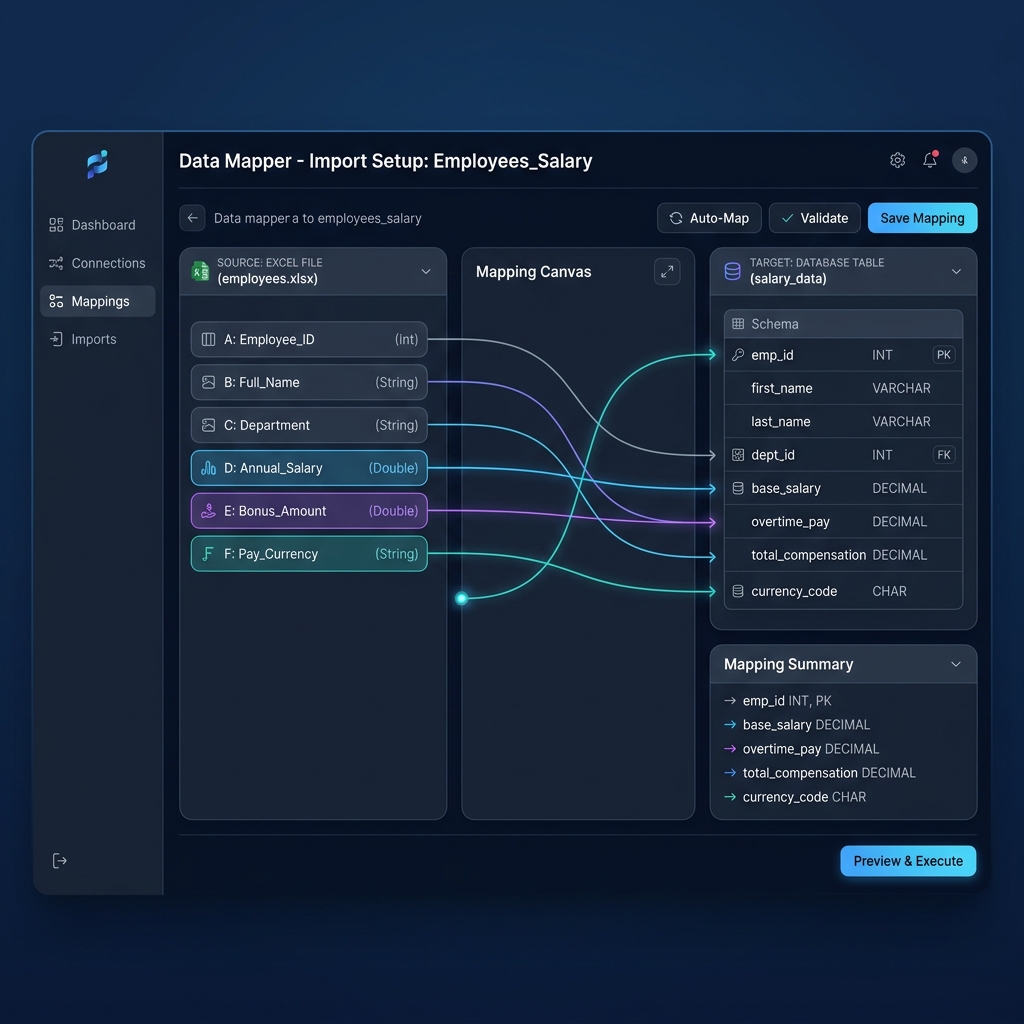
Step 4: Confirm Custom Offshore Column Mappings
Match your tour headers to PayslipGen's itemized payroll slots:
Tour_Straight_Hours→ Regular HoursTour_Overtime_Hours→ Overtime Hours (1.5×)Hazard_Environment_Pay→ Other Allowance 1Standby_Delay_Pay→ Other Allowance 2BOP_Safety_Bonus→ Bonus / IncentiveFRC_Gear_Advance→ Post-Tax DeductionNet_Disbursement→ Net Pay
Step 5: Apply AES-256 PDF Passwords & Export
Ensure crew financial confidentiality by configuring password encryption based on the worker's Date of Birth or the last 4 digits of their SSN. Click "Generate Payslips". Within seconds, PayslipGen renders vector-grade, print-ready PDF payslips ready to distribute via USB drive or print directly to the superintendency office printer before helicopter crew change.
Frequently Asked Questions (FAQs)
How is overtime calculated for a 14/14 hitch under the Fair Labor Standards Act?
Under the FLSA, overtime is calculated on a strict 7-day workweek basis, not averaged over the 14-day hitch. When a worker logs 12 hours a day for 14 days, they complete two separate 84-hour workweeks. In each workweek, the first 40 hours are paid at the regular base rate, and the remaining 44 hours must be paid at time-and-a-half (1.5× regular rate). Averaging the active hitch with the off-hitch unworked weeks to avoid overtime violates federal law.
What state tax is withheld for workers on Outer Continental Shelf platforms?
Under OCSLA (43 U.S.C. § 1333), the laws of the adjacent coastal state apply to stationary platforms on the OCS. For platforms off the coast of Louisiana, Louisiana income tax withholding generally applies to earnings on that platform, even for non-residents. For platforms adjacent to Texas, there is zero state income tax. However, workers are still responsible for income tax obligations in their home domicile state, and employers must comply with reciprocal state credits.
Are standby hours caused by hurricane evacuations compensable as working time?
Yes. Under 29 CFR § 785.17, if workers are required to remain at a designated heliport, shore hotel, or rig living quarters ready to mobilize as soon as weather clears, they are considered "engaged to wait" and must be compensated for those standby hours. Most offshore contracts provide a guaranteed 8-hour or 12-hour daily standby rate during weather delays.
Must safety milestone and BOP bonuses be included in overtime calculations?
Yes, if the bonuses are non-discretionary. Under 29 CFR § 778.208, bonuses promised to employees for achieving specific metrics (such as completing a hitch without a lost-time incident or executing BOP pressure tests) are non-discretionary incentives. They must be apportioned back across the hours worked in the bonus period to increase the regular rate of pay and trigger additional overtime payments.
Can PayslipGen run completely offline on an offshore rig without internet?
Yes, 100%. PayslipGen is an air-gapped desktop application engineered to run entirely on your local machine with zero external network connectivity. You do not need internet access, browser plugins, or cloud logins. Rig superintendents can generate 200 password-protected PDF payslips directly from Excel while tied up at a deepwater well location with zero satellite connection.
Command Offshore Rig Payroll Without Cloud SaaS Tolls
Calculate 14/14 hitch pay, statutory overtime, and hazard differentials directly from Excel in the rig office. 100% offline, zero internet needed, one-time payment of $49 for lifetime access.
Get PayslipGen for $49 (Lifetime Access)Conclusion: Ensure Rig Precision with Local Payroll Sovereignty
Offshore drilling demands absolute operational and mathematical discipline. Rig crews who endure 12-hour shifts in harsh ocean environments deserve complete transparency on their hitch settlement sheets.
By structuring clean 14-day tour calculations in Excel and generating audit-ready, password-protected PDF payslips with PayslipGen, energy contractors protect their crews, maintain full compliance with FLSA and OCSLA regulations, and eliminate thousands of dollars in wasteful cloud subscription overhead.
(Managing other specialized or industrial payroll workflows? Explore our dedicated guides on Commercial Fishing Crew Lay Settlements, Blended Overtime Weighted Averages, or how to Password Protect PDF Payslips with Date of Birth.)