
Logging & Timber Crew Paystub Generator: How to Calculate Cut-to-Length Piece Rates, Rigging Pay & Equipment Allowances in Excel
Key Takeaways
- ✓Timber Piece-Rate Metrics (MBF vs. Tonnage): Timber harvesting compensation is historically tied to production metrics: Thousand Board Feet (MBF) using the Scribner Decimal C scale, Doyle scale, or green tons delivered to the pulp mill. Understanding cut-to-length (CTL) harvester and manual faller rates is essential for accurate settlement accounting.
- ✓Mandatory Compensation for Non-Productive Time: Under federal FLSA standards and state labor rulings (such as Washington's landmark Demetrio v. Sakuma Brothers doctrine and Oregon BOLI rules), piece-rate loggers cannot have their downtime uncompensated. Equipment breakdowns, road rigging changes, mandatory fire watch, and safety tailgate meetings must be paid at an agreed hourly downtime rate separate from piece-rate earnings.
- ✓IRC § 62 Accountable Plan Tool & Saw Allowances: When fallers provide their own professional chainsaws, guide bars, chains, and personal safety chaps, reimbursing them under an IRS Accountable Plan keeps stipends 100% tax-free, exempt from FICA and income withholding, saving both the contractor and the logger substantial tax dollars.
- ✓Zero-Internet Deep Woods Payroll: Timber tracts and landing shacks are located in remote national forests and mountain ridges 30 miles outside cellular range. With PayslipGen, logging contractors generate compliant, password-protected PDF paystubs and settlement sheets completely offline on a field laptop for a one-time $49 fee, avoiding SaaS subscription drains during spring mud-breakup shutdowns.
Deep in the towering Douglas fir forests of the Pacific Northwest, the loblolly pine plantations of Georgia, or the rugged hardwood hills of Maine, a logging crew works against time, terrain, and weather. Feller bunchers drop timber on steep mountain slopes, cable yarders haul logs up canyons on skyline rigging, and choker setters hook chokers amidst muddy underbrush and slash.
Timber harvesting is one of North America's most hazardous and physically demanding industries. It is also one of the most intricate payroll environments in commercial enterprise. Logging contractors, cutting foremen, and timber bookkeepers must navigate complex compensation variables:
- Piece-Rate Volume Calculations: Paying manual fallers and mechanical operators based on Thousand Board Feet (MBF) or net delivered mill tonnage.
- The Non-Productive Time Legal Trap: Complying with aggressive state and federal labor laws requiring separate hourly pay for mechanical breakdowns, yarder moves, and mandatory fire watch duties.
- Chainsaw & Equipment Stipends: Structuring tax-free accountable plan reimbursements for fallers who bring $2,500 pro saws and safety gear to the landing.
- Seasonal Spring "Breakup" Layoffs: Navigating 8 to 12 weeks of zero harvesting when heavy mud and thawed logging roads force government-mandated seasonal road closures.
- Air-Gapped Forest Locations: Generating settlements and pay statements on a crew truck dashboard or landing shack without cellular reception or Wi-Fi.
Conventional cloud SaaS payroll platforms like Gusto or QuickBooks Online fail logging outfits. They demand continuous web connectivity, lock contractors out of past records when subscriptions are paused during spring breakup, and charge recurring monthly per-worker fees even when crews are sidelined by deep snow.
In this comprehensive guide, we examine the legal and mathematical foundations of timber piece-rate settlements, explore Department of Labor downtime rules, provide a master production Excel blueprint, and demonstrate how logging outfits use PayslipGen to generate audit-proof, password-protected PDF logger paystubs 100% offline.

Try Our Interactive Demo Instantly
Want to see how an offline-capable, client-side payslip generator works in practice? Try our brand-new interactive demo right in your browser. Upload a sample CSV, map your columns, and generate beautifully designed PDF payslips—with zero data ever being transmitted to our servers.
Launch Free Demo NowChapter 1: The Mechanics of Forestry Compensation: Scaling, MBF & Tonnage
Unlike manufacturing or retail payroll, where compensation is tied to standard timecards, timber harvesting compensation is rooted in timber scaling metrics that date back over a century:
1. The Thousand Board Foot (MBF) Standard
In western and northern softwood sawtimber markets, timber volume is measured in Board Feet (a unit of lumber measuring 1 foot wide, 1 foot long, and 1 inch thick). Because a single mature tree contains hundreds of board feet, industry settlement accounting measures production in Thousand Board Feet (MBF).
Logs are scaled using established mathematical scale rules:
- Scribner Decimal C Log Rule: The predominant scale in the Pacific Northwest and northern Rockies. It estimates the net yield of one-inch lumber from a log of given small-end diameter and length after accounting for saw kerf and taper.
- Doyle Rule: Commonly used for southern pine and central hardwoods. It tends to underestimate volume on small logs and overestimate on large logs.
- International 1/4-Inch Rule: The most mathematically precise log rule, calculating lumber volume with a 1/4-inch saw kerf allowance.
2. Weight Scaling (Tonnage-Based Harvesting)
In southern pine and pulpwood operations, mechanical Cut-to-Length (CTL) harvesters and processors process thousands of smaller-diameter trees per shift. Scale yards use certified truck scales at the mill entrance to weigh loaded log trucks, subtracting the tare weight of the empty rig. Fallers and equipment operators are compensated at a fixed rate per green ton (e.g., $4.25 per ton harvested).
3. Modern Cut-to-Length (CTL) vs. Conventional Rigging Crews
Compensation models vary sharply depending on the crew's harvesting method:
| Harvesting System | Crew Roles Involved | Primary Pay Basis | Payroll Complexity Factor |
|---|---|---|---|
| Manual Hand Fallers | Timber Faller, Bucker | Piece-rate ($/MBF) + Saw Allowance | Separate tracking of saw stipend (IRC § 62) and downtime. |
| Cable Yarder / Steep Slope | Yarder Engineer, Choker Setter, Rigging Slinger | Hourly base + Production turn bonuses | Choker rigging loss deductions and overtime regular rate blending. |
| Cut-to-Length (CTL) Mechanical | Harvester Operator, Forwarder Operator | Guaranteed hourly + Tonnage bonus | High mechanical downtime requiring distinct non-productive hours. |
Chapter 2: The Legal Trap of Piece-Rate Downtime & FLSA Minimum Wage Floors
In timber logging, piece-rate compensation creates significant exposure under federal and state wage laws if mechanical downtime is uncompensated.
The Demetrio & BOLI Precedents: Non-Productive Time
Historically, logging operators paid fallers strictly on the board footage landed at the mill. If a processor blew an engine hose or a skyline cable parted, requiring 4 hours of repair while fallers sat on the hillside, contractors paid zero dollars for that downtime, assuming the piece rate covered all work.
Today, this practice is strictly illegal. Following landmark court rulings (such as the Washington Supreme Court's Demetrio v. Sakuma Brothers decision, Oregon BOLI administrative rules, and Department of Labor FLSA interpretations), employers paying piece rates must maintain separate accounting for:
- Productive Piece-Rate Time: Hours spent actively falling trees, bucking logs, or operating harvesting equipment.
- Non-Productive Time (Downtime): Time spent on mechanical maintenance, cable rigging changes, changing landing roads, mandatory fire watch, safety tailgate briefings, and weather standbys.
- Rest & Recovery Periods: Statutory paid rest breaks mandated by state labor codes.
Critical Wage Rule: Hourly Downtime Cannot Be Averaged Away
Contractors cannot legally argue that a faller's high piece-rate earnings ($450/day) "average out" to cover unpaid equipment maintenance or travel time. Non-productive time must be paid at a separate, agreed hourly rate that satisfies or exceeds the applicable state minimum wage, and must be itemized distinctly on the worker's pay stub!
FLSA Overtime on Piece Rates: 29 CFR § 778.111
When a piece-rate logger works more than 40 hours in a workweek, overtime cannot be calculated simply as 1.5 times their piece rate. Under 29 CFR § 778.111, the contractor must calculate the employee's regular rate of pay:
Once the regular rate is determined, each overtime hour worked beyond 40 receives an additional half-time premium (Regular Rate × 0.5).
Chapter 3: Chainsaw & Equipment Allowances under IRC § 62 Accountable Plans
Professional timber fallers bring substantial capital assets to the cutting strip. A timber faller typically provides two professional power saws (e.g., Stihl MS 500i or Husqvarna 572 XP), heavy-duty guide bars (28" to 36"), cutting chains, filing tools, wedge packs, safety chaps, and calk boots. The replacement and operating cost of this gear exceeds $3,500 annually.
The Non-Taxable Accountable Plan Rule
To reimburse fallers for equipment wear, fuel, and bar oil, logging contractors pay an Equipment / Saw Allowance (typically $20.00 to $35.00 per cutting day).
Under Internal Revenue Code § 62(a)(2)(A) and Treasury Regulation § 1.62-2, this payment is 100% tax-free to the worker and exempt from employer payroll taxes (FICA, FUTA, state unemployment) only if administered under a formal Accountable Plan:
- Business Connection: The allowance reimburses actual tools and fuel required for tree felling operations.
- Substantiation: The faller must maintain a log of active cutting days or equipment receipts.
- Return of Excess: Any advance allowance not backed by cutting days worked must be returned to the contractor.
If an operator bundles this saw allowance into the faller's gross piece rate without separate itemization, the IRS treats the entire payment as taxable wages, costing the logger and the contractor thousands in unnecessary income and employment taxes.
Chapter 4: Master Excel Logging Crew Settlement Blueprint (With Real Formulas)
To eliminate woods disputes and maintain compliance with state labor departments, logging contractors should maintain a standardized weekly production spreadsheet.
Below is the production formula architecture for an active timber crew operating on a national forest timber sale:
| Line # | Column Header | Sample Value | Classification | Excel Formula Specification |
|---|---|---|---|---|
| 01 | Logger_Name | Garrett Sterling | Crew Roster | Text string |
| 02 | Crew_Role | Lead Timber Faller | Job Classification | Text entry |
| 03 | Scale_Volume_MBF | 68.50 MBF | Mill Scale Ticket Sum | Volume scaled |
| 04 | Piece_Rate_Per_MBF | $22.00 / MBF | Contract Cutting Rate | Fixed rate |
| 05 | Gross_Piece_Earnings | $1,507.00 | Production Pay | =B3*B4 |
| 06 | Non_Productive_Downtime_Hrs | 6.50 hrs | Maintenance & Fire Watch | Field punch hours |
| 07 | Hourly_Downtime_Rate | $24.00 / hr | Agreed Maintenance Rate | Hourly minimum |
| 08 | Downtime_Compensation | $156.00 | Statutory Hourly Pay | =B6*B7 |
| 09 | Saw_Tool_Allowance_TaxFree | $125.00 | 5 Cutting Days @ $25/day | =Cutting_Days*25.0 |
| 10 | TOTAL_GROSS_DISBURSEMENT | $1,788.00 | Piece + Downtime + Saw Allow | =B5+B8+B9 |
Timber Harvesting Crew Summary Table
Here is how a logging contractor tracks a mixed crew (fallers, rigging crew, loader operators) within the master workbook:
| Crew Member | Position | Production Basis | Gross Piece / Hourly | Downtime Pay | Saw Allowance | Net Settlement |
|---|---|---|---|---|---|---|
| Garrett Sterling | Timber Faller | 68.5 MBF | $1,507.00 | $156.00 | $125.00 | $1,442.20 |
| Wyatt Henderson | Yarder Engineer | 44.0 hrs | $1,260.00 | $0.00 | $0.00 | $1,012.40 |
| Cody Callahan | Choker Setter | 42.5 hrs | $956.25 | $0.00 | $0.00 | $782.10 |
| Brody McAllister | Log Loader Operator | 45.0 hrs | $1,282.50 | $0.00 | $0.00 | $1,034.80 |
| CREW TOTALS | 68.5 MBF / 131.5 hrs | $5,005.75 | $156.00 | $125.00 | $4,271.50 | |
Chapter 5: Why Remote Forest Operations Require 100% Offline Desktop Software
Timber harvesting operations face operational conditions that break conventional cloud SaaS software:
1. Complete Lack of Cellular Coverage
Active timber sales are situated in deep river drainages, steep canyons, and high alpine ridges miles outside commercial cellular range. Satellite equipment is expensive, power-hungry, and prone to failure under dense evergreen canopies. When logging contractors need to print settlement sheets on Friday afternoon at the landing trailer, a cloud application requiring two-factor SMS authentication or active browser connections is useless.
2. The Spring "Breakup" SaaS Cash Drain
In northern and high-elevation forestry regions, the spring thaw (known throughout the industry as "mud breakup") turns unpaved logging roads into impassable quagmires. State departments of transportation and county road commissions enforce mandatory gross vehicle weight restrictions (frost laws), prohibiting loaded log trucks from hauling.
For 6 to 10 weeks between March and May, harvesting equipment is parked in the yard. During this period, the contractor has zero active payroll. Yet cloud payroll platforms continue billing recurring monthly base fees and per-employee retention charges just to keep past scale records accessible!
3. Timber Sale & Log Bid Confidentiality
Contract cutting prices, mill scale ticket summaries, and landowner stumpage payments are sensitive commercial trade secrets. Storing your timber scale ledgers and equipment allowances on multi-tenant cloud servers creates unnecessary competitive and legal vulnerability.
Chapter 6: 5-Year Financial Analysis: $49 Lifetime License vs. Cloud SaaS Tolls
Let's analyze the 5-year total software cost for an independent logging contractor employing an average of 14 woods workers:
| Cost Component | Gusto Plus Payroll | QuickBooks Online + Payroll | PayslipGen (One-Time Desktop License) |
|---|---|---|---|
| Monthly Base Platform Toll | $80.00 / mo ($960/yr) | $95.00 / mo ($1,140/yr) | $0.00 (Zero recurring fees) |
| Per-Logger Monthly Seat Fee (14 Staff) | $12.00 / man / mo ($2,016/yr) | $10.00 / man / mo ($1,680/yr) | $0.00 (Unlimited crew members) |
| Spring Mud Breakup Dormant Billing | Required to retain history | Required to retain history | $0.00 (Stored locally on your laptop) |
| Woods Offline Functionality | Zero (Fails without internet) | Zero (Fails without internet) | 100% Offline Woods Capable |
| Year 1 Net Cost | $2,976.00 | $2,820.00 | $49.00 total |
| Year 3 Cumulative Cost | $8,928.00 | $8,460.00 | $49.00 total |
| Year 5 Cumulative Cost | $14,880.00 | $14,100.00 | $49.00 (Lifetime) |
Over 5 operating seasons, switching from cloud subscription software to PayslipGen preserves over $14,000 in operating cash—funds directly deployed toward replacement skidder tires, hydraulic hose reels, or timber bid deposits.
Chapter 7: Step-by-Step Workflow: Generating Logger Settlement Sheets from Excel
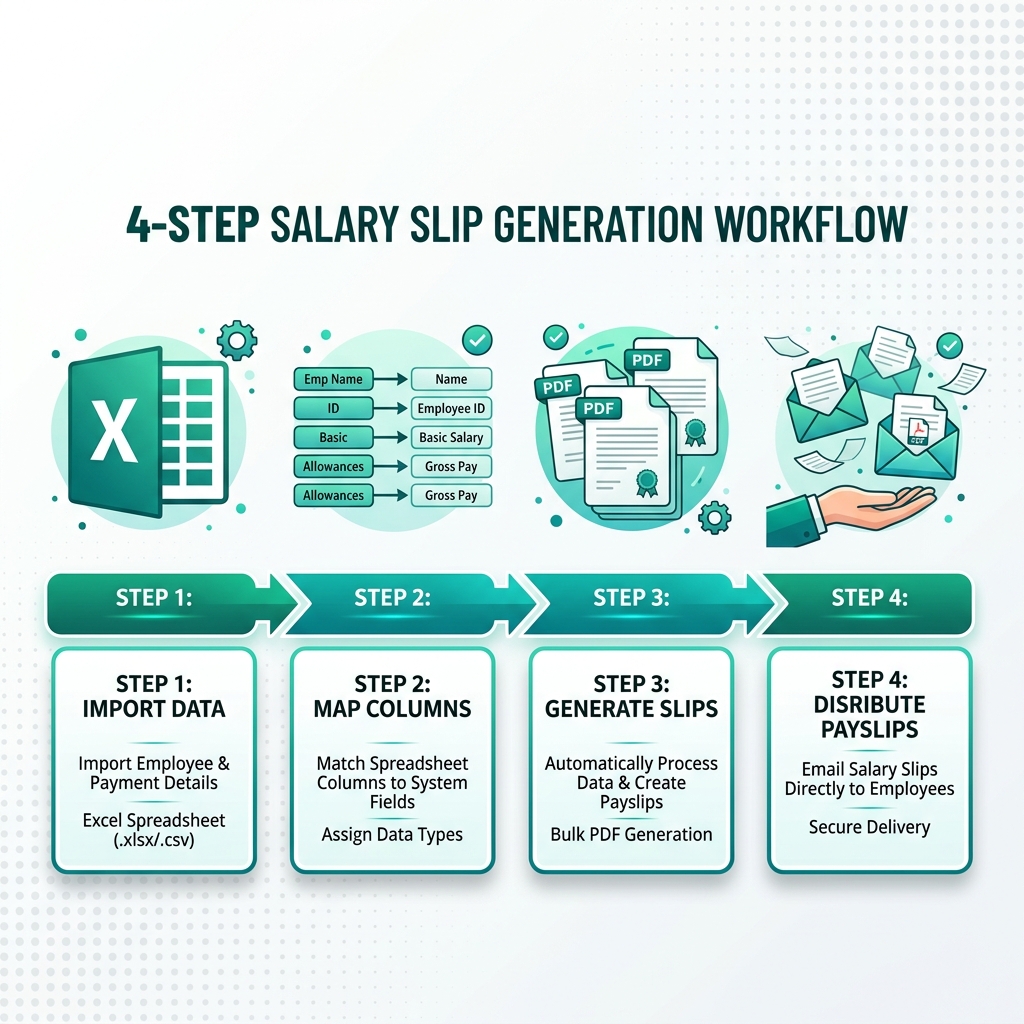
Here is how timber logging contractors use PayslipGen to compile woods scale sheets and print professional PDF pay statements in minutes:
Step 1: Record Mill Scale Tickets & Downtime in Excel
Enter each worker's delivered MBF or green tons, non-productive maintenance hours, and saw allowance days into your weekly Excel spreadsheet (.xlsx or .csv).
Step 2: Launch PayslipGen on Your Woods Laptop
Open PayslipGen on your field computer. Set up your logging company profile: legal harvesting business name, state logging association membership, tax EIN, and company logo.
Step 3: Drag & Drop Your Scale Workbook
Drag your weekly Excel file directly into PayslipGen. The native application parses columns instantly—no data ever leaves your laptop or transmits over external networks.
Step 4: Map Forestry Payroll Fields
Match your spreadsheet headers to PayslipGen's itemized payroll fields:
Gross_Piece_Earnings→ Production / Piece-Rate EarningsDowntime_Compensation→ Non-Productive Hourly PaySaw_Tool_Allowance_TaxFree→ Non-Taxable Tool ReimbursementMandatory_Taxes_FICA_FITW→ Statutory DeductionsLogger_Email→ Employee Email (for local SMTP delivery)
Step 5: Apply AES-256 PDF Password Protection & Print
Secure each logger's financial data with AES-256 encryption using the worker's Date of Birth (YYYYMMDD) or last 4 digits of their SSN. Click Generate Paystubs. Within seconds, PayslipGen generates clean, vector PDF paystubs ready to print on an inverter-powered printer at the landing shack or email when returning to town.
Frequently Asked Questions (FAQs)
What is an MBF piece rate, and how is it scaled for logger pay?
MBF stands for Thousand Board Feet. Scalers at the saw timber mill measure log length and small-end diameter under bark using an official scale rule (such as the Scribner Decimal C). The net board footage is divided by 1,000 and multiplied by the agreed contract cutting rate (e.g., $22.00/MBF) to calculate the faller's gross piece-rate earnings for that delivery.
Can logging companies pay fallers strictly on piece rate without tracking hours?
No. Under federal FLSA standards and strict state labor regulations in states like Washington, Oregon, and California, employers must track all hours worked, including non-productive waiting and mechanical maintenance time. Employers must ensure the total weekly earnings divided by total hours worked meets or exceeds statutory minimum wage and overtime standards. Failure to track hours creates severe back-pay liability during Department of Labor wage audits.
How do we keep chainsaw and safety equipment allowances tax-free under IRS rules?
Equipment allowances are non-taxable only if administered under an IRS Accountable Plan (IRC § 62). The allowance must have a clear business purpose (reimbursing saws, bar oil, and chains), must be based on verified working days or actual expense receipts, and any excess unearned allowance must be returned. The allowance must be itemized distinctly on the worker's pay stub as a non-taxable reimbursement.
What happens to payroll during spring breakup or severe fire season shutdowns?
During seasonal shutdowns (mud season road bans or Industrial Fire Precaution Level shutdowns), crews are temporarily laid off. Unlike cloud payroll providers that force you to keep paying monthly subscription fees to retain access to past payroll records, PayslipGen is a one-time desktop license. Your data stays securely on your local hard drive with zero ongoing subscription costs during down months.
Can PayslipGen handle independent contract log haulers alongside company crew?
Yes. PayslipGen allows you to configure multiple payroll profiles or process both statutory W-2 company crew members and 1099 independent contract log truckers within the same software license without paying additional fees.
Command Your Timber Payroll Without Monthly Software Fees
Generate compliant, itemized logging and forestry settlement sheets directly from your Excel scale sheets. 100% offline field operation, zero monthly SaaS tolls, one-time payment of $49 for lifetime access.
Get PayslipGen for $49 (Lifetime Access)Conclusion: Protect Your Logging Enterprise with Transparent Settlement Sheets
Timber harvesting has built communities across North America for generations. The men and women who fall timber, rig yarders, and haul logs perform essential, high-risk work that demands absolute financial clarity. Disorganized handwritten notes and generic paystubs breed woods disputes and invite crushing Department of Labor back-pay audits.
By formalizing your piece-rate scale calculations, properly itemizing non-productive downtime, and producing encrypted, professional PDF settlement sheets with PayslipGen, you protect your logging enterprise, maintain crew loyalty, and eliminate thousands in wasted software fees.
(Looking to streamline payroll across other resource extraction or transportation industries? Check out our guides on Commercial Fishing Lay Shares, Truck Driver Per-Mile Settlement Sheets, and How to Split Excel Sheets into Separate PDF Payslips.)