
Landscaping & Snow Removal Paystub Generator: How Contractors Itemize Storm Standby, Salting Rates & Per-Push Billing in Excel
Key Takeaways
- ✓Winter Storm Standby Retainers: Commercial snow management contracts require immediate zero-tolerance mobilization (hospitals, industrial distribution centers, retail malls). Contractors pay operators guaranteed standby stipends ($150 to $350 per weekend or storm watch) to remain sober, accessible, and ready to deploy—regardless of whether snowfall reaches plowable accumulation.
- ✓Bifurcated Event Compensation: Snow payroll blends multiple pay mechanisms: piece-rate per-push route fees ($35 to $65 per commercial lot sweep), hourly blizzard operating rates ($28 to $45/hr for heavy accumulation), night-shift storm differentials ($3 to $6/hr premium for 10 PM to 6 AM operations), and spreader bonuses for bulk rock salt and calcium chloride application.
- ✓Strict Equipment Damage Deduction Rules: Deducting broken plow cutting edges, busted trip springs, or bent curb guides from a driver's paycheck is heavily restricted. Under FLSA Section 3(m) and state wage protection acts, employers cannot deduct equipment damage if it reduces the driver's effective hourly wage below statutory minimum wage, and many states prohibit equipment deductions entirely absent written employee consent and gross negligence.
- ✓Eliminating Seasonal SaaS Tolls: Grounds maintenance and snow operations experience dramatic dormant shoulder months (April and October) with zero active payroll runs. Cloud payroll providers (Gusto, QuickBooks, Paychex) continue charging monthly base fees year-round. Using PayslipGen, contractors generate bulk password-protected PDF paystubs offline for a one-time $49 lifetime license with zero off-season subscription drain.
At 1:30 AM on a freezing January morning in Minneapolis, Cleveland, or Boston, the weather radar turns dark purple. While the city sleeps, a commercial landscape and snow management contractor mobilizes a fleet of 4x4 plow trucks, skid steers with box containment plows, and bulk salt spreaders to clear 45 commercial accounts before morning delivery trucks arrive.
When the storm clears 36 hours later, the contractor faces an intense administrative reckoning. Unlike standard businesses with predictable 9-to-5 bi-weekly hourly payroll, snow and ice management payroll is an operational hybrid:
- Guaranteed Storm Standby Retainers: Operators were put on alert Thursday evening, requiring a guaranteed standby retainer to lock in their availability whether it dropped 2 inches or 14 inches.
- Piece-Rate Route Clearing: Subcontracted plow operators cleared 18 commercial retail bank lots under a fixed "per-push" rate structure ($45 per push per property).
- Blizzard Hourly Overtime: Heavy equipment operators pushed snowdrifts for 22 consecutive hours in skid steers and wheel loaders, triggering statutory FLSA overtime and nocturnal shift differentials.
- Chemical Spreader Premiums: Salt truck drivers applied 18 tons of bulk rock salt and treated magnesium chloride, earning per-ton or hourly spreader hazard bonuses.
When summer returns, that exact same crew transitions to weekly lawn mowing route piece rates, mulch blowing day rates, and hardscape construction. Attempting to fit this wildly fluctuating, highly seasonal business into generic cloud payroll software like Gusto or QuickBooks Online results in constant frustration, rigid calculation blocks, and thousands of dollars in wasted off-season SaaS subscription fees.
In this comprehensive technical guide, we break down the legal and operational mechanics of commercial snow and landscape payroll, examine FLSA equipment damage deduction rules, provide a complete Excel blueprint, and demonstrate how contractors use PayslipGen to generate audit-proof, password-protected PDF paystubs completely offline on any shop computer.

Try Our Interactive Demo Instantly
Want to see how an offline-capable, client-side payslip generator works in practice? Try our brand-new interactive demo right in your browser. Upload a sample CSV, map your columns, and generate beautifully designed PDF payslips—with zero data ever being transmitted to our servers.
Launch Free Demo NowChapter 1: The Seasonal Operating Cycle: Summer Grounds Care vs. Winter Snow Management
Commercial grounds contractors operate in two distinct financial realities across the calendar year:
1. The Summer Maintenance Season (April – October)
During warm weather, revenue is relatively predictable. Commercial contracts are structured as monthly recurring billing for turf mowing, edging, weed control, aeration, and landscape enhancement.
Labor compensation typically follows:
- Hourly Crew Labor: Entry-level laborers paid $18.00 to $22.00/hour for standard 40-hour maintenance routes.
- Piece-Rate Property Incentives: Lead mow crew operators paid a base hourly rate plus a piece-rate bonus (e.g., $8.00 per completed residential lawn or $25.00 per commercial property) to incentivize rapid route completion.
- Hardscape Day Rates: Skilled masonry and retaining wall installers paid $250.00 to $350.00 day rates for specialized patio and irrigation installations.
2. The Winter Snow & Ice Season (November – March)
In winter, predictability vanishes. A contractor may experience three consecutive weeks with zero precipitation, followed by a 4-day nor'easter that drops 24 inches of snow and requires 60 continuous hours of emergency operations.
To survive this volatility and retain qualified CDL drivers and heavy machinery operators, contractors implement specialized pay structures:
- Storm Standby Retainers (On-Call Pay)
- Per-Push Route Piece Rates
- Hourly Snow Fighting Wages with Night Shift Differentials
- Bulk De-Icing & Salting Spreader Premiums
Chapter 2: The Mechanics of Storm Standby Retainers
In commercial snow management, meeting contract service-level agreements (SLAs) is critical. Commercial clients—such as regional trauma centers, FedEx/UPS distribution sorting hubs, and major supermarket plazas—enforce zero-tolerance contracts: lots must be plowed down to bare wet pavement before 6:00 AM, regardless of when snowfall commences.
Why Guaranteed Standby Stipends Are Mandatory
If a contractor pays plow drivers only when their truck tires are rolling on snow, operators will refuse to sit waiting by the phone. They will seek other winter jobs, leaving the contractor with 30 unattended commercial lots during an unexpected 3:00 AM squall.
Contractors solve this with Storm Standby Retainers:
- Weekend On-Call Retainer: A guaranteed $150.00 to $300.00 flat stipend paid to the driver for remaining on standby from 5:00 PM Friday through 6:00 AM Monday.
- The Standby Condition: In exchange for the retainer, the driver agrees to remain within a 30-minute radius of the shop, abstain from alcohol/substances, keep their cellular phone fully charged, and report to the equipment yard within 45 minutes of a storm mobilization call.
- Snow vs. No-Snow Execution: If zero snow falls, the driver keeps 100% of the standby retainer for reserving their availability. If a storm hits, the standby retainer is either paid in addition to their operational hours or serves as a guaranteed earnings floor for the event.
FLSA On-Call Waiting Time Doctrine
Under federal wage law (29 C.F.R. § 785.17), whether "on-call" time is considered compensable working hours depends on whether the employee is waiting to be engaged or engaged to wait. If an employer restricts an employee's personal freedom so severely that they cannot effectively use the time for personal pursuits (e.g., forcing them to sit inside the shop breakroom during a storm watch), that time must be compensated at full statutory minimum wage or higher for every elapsed hour, not just a nominal flat retainer.
Chapter 3: Per-Push Route Rates vs. Hourly Event Billing
When plows hit the streets, contractors structure operator pay based on vehicle ownership and route characteristics:
1. The Per-Push Route Compensation Model
For regional route drivers clearing standard commercial strip malls, fast food pads, and medical clinics, contractors frequently pay on a per-push basis:
- Contract Trigger Depths: Commercial property contracts specify service trigger depths—commonly a 2-inch trigger. Every time snow accumulates to 2 inches, the property must be plowed.
- Piece-Rate Operator Payout: The operator receives a fixed rate per property cleared (e.g., $35.00 for a small bank branch, $65.00 for a 2-acre retail center).
- Multi-Push Storm Cycles: In an 8-inch snowfall event, an operator may complete three separate sweeps of their 12-property route, earning 36 total pushes. At an average of $45.00/push, the driver earns $1,620.00 for the storm event.
2. Hourly Storm Operations with Night Shift Differentials
For heavy equipment operators operating wheel loaders, high-lift front-end loaders with containment pushers, and sidewalk snow blowers, work is paid hourly.
Because over 70% of commercial snow fighting occurs under black ice conditions in sub-zero darkness between 10:00 PM and 6:00 AM, contractors provide a Nocturnal Storm Differential:
3. Bulk De-Icing & Salting Spreader Premiums
Applying chemical de-icers (bulk sodium chloride rock salt, magnesium chloride, or treated blue salt) is heavy, hazardous work. Spreader drivers must load bulk salt hoppers via tractor bucket, calibrate gate feed rates, and manage high-traffic parking lots. Contractors pay a spreader premium of $15.00 to $25.00 per ton of salt applied, or an additional $4.00/hr equipment bonus.
Chapter 4: Equipment Damage Deductions: What Is Legally Permitted?
Winter snow operations take an immense toll on machinery. Hidden concrete curbs, buried manhole covers, frozen wheel stops, and black ice hazards lead to broken plow cutting edges, sheared A-frames, shattered hydraulic lines, and bent truck tailgates.
When an operator shears off a $650 carbide cutting edge by striking a raised sewer drain at 25 mph, frustrated business owners often attempt to deduct the repair cost from the driver's paycheck.
The Strict Legal Guardrails on Damage Deductions
Deducting equipment damage from an employee's wages is heavily regulated under federal and state wage statutes:
- The Federal FLSA Minimum Wage Floor:Under FLSA 29 C.F.R. § 531.35 (the "free and clear" wage payment doctrine), payroll deductions for broken tools, vehicle damage, or cash register shortages cannot reduce an employee's net earnings below the statutory federal minimum wage ($7.25/hr) in any workweek. If a driver works 40 hours and earns $1,000, deducting $800 in truck damage leaves $200 ($5.00/hr), resulting in a direct federal minimum wage violation!
- Strict State Prohibitions: In states like California (Labor Code § 221 & § 2802), New York (Labor Law § 193), Massachusetts, and Washington, employers are strictly prohibited from docking wages for equipment damage or broken tools, even with employee consent, unless the employer proves in court that the damage was the result of the employee's willful, intentional, or grossly negligent criminal conduct. Ordinary accidents, icy skids, and equipment wear-and-tear must be absorbed as the employer's cost of doing business.
- Written Pre-Authorization Requirement: In states where damage deductions are permissible (such as Texas or Florida), the employer must have a signed written agreement executed prior to the incident specifying the exact deductible schedule, and deductions must be capped per pay period.
Chapter 5: Master Excel Snow Removal & Landscaping Payroll Blueprint (With Formulas)
Below is the production-tested Excel payroll blueprint for a commercial snow and landscape contractor managing a 10-person crew during an active winter storm week:
| Col | Header Name | Sample Value | Excel Formula Specification | Description |
|---|---|---|---|---|
| A | Operator_Name | Cody McAllister | Text input | Senior Plow / Spreader Driver |
| B | Storm_Standby_Stipend | $250.00 | Flat retainer schedule | Weekend standby guarantee |
| C | Per_Push_Count | 18 | Route log tally | Total commercial pushes |
| D | Per_Push_Rate | $45.00 | Contract route rate | Rate per commercial sweep |
| E | Push_Route_Earnings | $810.00 | =C2*D2 | Piece-rate route compensation |
| F | Hourly_Storm_Hours | 16.5 | GPS / timecard hours | Emergency loader operation |
| G | Base_Hourly_Rate | $28.00 | Standard operator wage | Daytime loader wage |
| H | Night_Shift_Differential | $5.00 | Nocturnal storm schedule | 10 PM – 6 AM whiteout premium |
| I | Hourly_Storm_Pay | $544.50 | =F2*(G2+H2) | Hourly blizzard compensation |
| J | Salt_Tons_Spread | 12.0 | Scale ticket receipt | Bulk rock salt applied |
| K | Salt_Spreader_Bonus | $180.00 | =J2*15.00 | $15.00/ton de-icing bonus |
| L | TOTAL_GROSS_EARNINGS | $1,784.50 | =B2+E2+I2+K2 | Subject to FICA/FITW |
Chapter 6: Why Subscription Payroll Software Fails Seasonal Contractors
Landscape and snow management contractors face an acute payroll software problem: extreme seasonality.
1. The Shoulder Season SaaS Tax
In April, May, October, and November—the shoulder transition months between summer mowing contracts and winter snow response—a contractor may have zero active field employees or run only occasional emergency cleanups.
Yet cloud platforms like Gusto ($45/mo + $6/worker) or QuickBooks Online Advanced ($200/mo) charge full monthly base fees year-round! If you freeze or cancel your subscription during the off-season, your historical worker records, tax filing archives, and previous W-2 logs are permanently locked behind an inaccessible paywall.
| Cost Factor | Gusto / ADP Run | QuickBooks Online Payroll | PayslipGen Desktop Application |
|---|---|---|---|
| Monthly Platform Toll | $45.00 – $90.00 / month | $95.00 – $180.00 / month | $0.00 (Forever) |
| Off-Season Dormant Fees | Mandatory to retain records | Mandatory to retain records | $0.00 (Files stored locally) |
| Per-Push & Standby Support | Difficult workarounds | Forces generic bonus line | 100% Native Excel Support |
| Offline Operation in Snow Yard | Impossible (Cloud only) | Impossible (Cloud only) | 100% Offline on Shop Laptop |
| 3-Year Cumulative Cost (15 Operators) | $4,860.00 | $6,660.00 | $49.00 (One-Time) |
Chapter 7: Step-by-Step Snow & Landscape Paystub Generation with PayslipGen
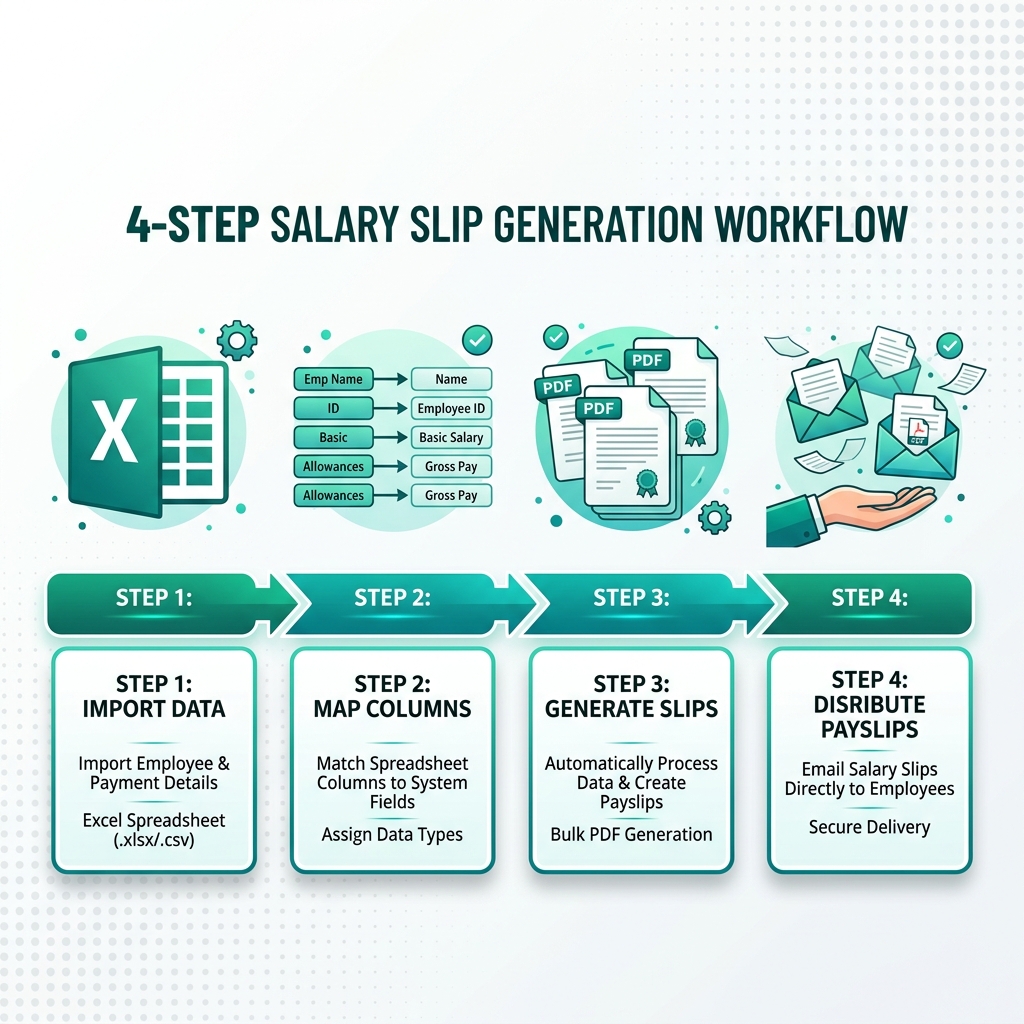
By pairing your spreadsheet with PayslipGen, you can produce professional, audit-proof paystubs right from the maintenance shop in under two minutes:
Step 1: Maintain Your Route & Storm Log in Excel
After a winter storm event or bi-weekly summer mowing cycle, enter driver tallies into your master workbook. Include columns for Operator Name, Standby Retainer, Push Count, Hourly Storm Hours, Night Shift Differential, Salt Tons Applied, and Total Gross Earnings.
Step 2: Launch PayslipGen on Your Computer
Open the PayslipGen desktop application on your Windows or Mac PC. Because PayslipGen is completely offline, you can run payroll inside your equipment yard trailer without waiting for cellular hotspot connections or enduring cloud 2FA authentication timeouts.
Step 3: Map Columns Instantly
Drop your .xlsx or .csv file into PayslipGen. The visual mapper pairs your headers to clear payslip items:
Operator_Name→ Employee NameStorm_Standby_Stipend→ Other Allowance 1 (Standby Guarantee)Push_Route_Earnings→ Piece-Rate Route EarningsHourly_Storm_Pay→ Overtime / Equipment WagesSalt_Spreader_Bonus→ Production BonusTOTAL_GROSS_EARNINGS→ Gross Earnings
Step 4: Enable AES-256 PDF Password Encryption
Equipment operators and subcontractors discuss money constantly. Eliminate friction by checking "Password Protect PDFs". PayslipGen encrypts each paystub using the operator's Date of Birth or the last 4 digits of their Social Security Number.
Step 5: Batch Generate and Email via Private SMTP
Click "Generate Payslips". Within 3 seconds, PayslipGen generates print-ready PDF paystubs complete with your company logo and business address. Print them for physical envelope distribution or email them directly to operators via your company's Google Workspace or Microsoft 365 SMTP account with zero per-email fees.
Frequently Asked Questions (FAQs)
Are winter storm standby retainers considered taxable wages?
Yes. Standby stipends and on-call retainers paid to employees are considered supplemental wages under IRS regulations. They are subject to standard federal income tax withholding (FITW), FICA (Social Security and Medicare), and state unemployment taxes (FUTA/SUTA). If paid to independent 1099 subcontractors, the standby retainer is included in Box 1 (Nonemployee compensation) of Form 1099-NEC.
Can a contractor deduct a broken plow blade from an operator's paycheck?
Generally, NO. Under FLSA Section 3(m), deductions for broken equipment or truck damage cannot reduce an employee's effective hourly wage below the statutory minimum wage in that workweek. Furthermore, strict state labor laws (such as California Labor Code § 221 and New York Labor Law § 193) completely prohibit employers from deducting cash shortages or equipment damage from employee wages, holding that tool breakage is an ordinary cost of business.
How do we handle overtime for drivers paid both per-push and hourly?
When an employee works under multiple pay rates (e.g., piece-rate per-push fees plus hourly storm operations), the contractor must calculate overtime using the FLSA blended weighted average regular rate. Total weekly earnings (pushes + standby + hourly pay) are divided by total actual hours worked in the workweek. The employee is then owed an additional 0.5 times that weighted regular rate for all hours worked over 40.
What is the difference between a plow subcontractor and a W-2 employee?
A genuine 1099 subcontractor typically provides their own commercial plow truck, carries their own commercial auto and general liability insurance, pays for their own diesel fuel, and negotiates independent per-push or per-hour contractor terms. If a driver operates a company-owned truck, wears company apparel, follows mandatory shop schedules, and has no capital investment in machinery, they must be classified as a W-2 employee.
Can PayslipGen handle both summer mowing and winter snow payroll under one license?
Yes. A single PayslipGen lifetime license supports unlimited employees, unlimited company profiles, and completely customizable column templates. You can switch between summer lawn maintenance templates and winter snow event templates instantly without paying extra fees.
Master Snow & Landscape Payroll Without Monthly SaaS Fees
Itemize storm standby stipends, per-push route rates, nocturnal whiteout differentials, and salt bonuses directly in Excel. Generate bulk password-protected PDF paystubs offline for a one-time payment of $49.
Get PayslipGen for $49 (Lifetime Access)Conclusion: Operational Transparency Retains Top Snow Fighting Talent
When a blizzard hits at 2:00 AM, the survival of your commercial snow contracts depends on reliable operators who answer the call and navigate freezing whiteouts safely. Providing clear, transparent paystubs that honor standby retainers, per-push counts, and salting bonuses builds the loyalty required to weather the winter season.
By managing your complex seasonal compensation formulas in Excel and generating professional, encrypted PDF paystubs using PayslipGen, you maintain total payroll sovereignty, protect your business from wage disputes, and eliminate thousands of dollars in wasteful off-season cloud software subscriptions.
(Looking to streamline other complex hourly and contractor settlement workflows? Explore our dedicated guides on Piece-Rate Paystubs & Non-Productive Time, Blended Overtime Weighted Average Paystubs, or how to Generate 1099 Contractor Paystubs.)