
HVAC & Plumbing Tech Paystub Generator: How to Itemize Equipment Spiffs, On-Call Standby & Billable Hours in Excel
Key Takeaways
- ✓The FLSA Spiff Regular Rate Mandate: Under 29 CFR § 778.208, non-discretionary manufacturer equipment spiffs (sales incentive bonuses on heat pumps, mini-splits, and water heaters) must be factored into the employee's regular rate of pay when calculating weekly overtime. Failure to recalculate is the single most common Department of Labor wage violation in mechanical trades.
- ✓On-Call Standby Compensability: Under 29 CFR § 785.17, the distinction between "waiting to be engaged" (uncompensated standby where tech retains personal freedom) and "engaged to wait" (compensable standby with short 15–20 minute response requirements) dictates whether flat on-call stipends satisfy minimum wage and overtime laws.
- ✓FLSA Tool Deduction Floor (29 U.S.C. § 206): Payroll advances and deductions for diagnostic gauges, vacuum pumps, and press tools cannot legally reduce a technician's effective straight-time hourly wage below the statutory federal or state minimum wage floor in any single pay period.
- ✓Zero-Subscription Trade Shop Autonomy: Mechanical contractors managing 5 to 30 technicians lose thousands annually to cloud software tolls ($150–$300/mo on ServiceTitan or Gusto). Using PayslipGen, dispatch managers generate password-protected, audit-proof PDF paystubs directly from Excel for a one-time $49 payment.
At 5:30 PM on a sweltering July Friday, the dispatch board at a residential HVAC and plumbing contractor is flashing red. Emergency compressor lockouts, burst main lines, and failed rooftop package units across the county have pushed service technicians into their 50th hour of the week.
In the mechanical trades, compensation is far more dynamic than a flat hourly rate. A top-performing service tech or journeyman plumber earns a multi-tiered package: hourly base pay, emergency overtime, weekend on-call standby stipends, portal-to-portal drive time, and lucrative equipment sales incentives—widely known as spiffs—paid for converting old furnaces to high-efficiency inverter heat pumps or installing tankless water heaters.
For HVAC and plumbing business owners, managing this payroll complexity is a legal minefield. Federal labor regulations strictly dictate how equipment commissions affect overtime calculations, how on-call waiting time is compensated, and how tool payroll deductions must be structured. Yet many contractor offices attempt to force these calculations into rigid cloud payroll tools or fragile spreadsheets, inadvertently racking up devastating Department of Labor wage-and-hour liabilities.
Try Our Interactive Demo Instantly
Want to see how an offline-capable, client-side payslip generator works in practice? Try our brand-new interactive demo right in your browser. Upload a sample CSV, map your columns, and generate beautifully designed PDF payslips—with zero data ever being transmitted to our servers.
Launch Free Demo NowChapter 1: The Modern Mechanical Trade Pay Package
To retain skilled journeymen and master technicians in an intensely competitive labor market, HVAC and plumbing contractors offer structured incentive programs. Understanding each pay component is critical for payroll accuracy:
1. Base Hourly Pay vs. Flat-Rate Billable Hours
Technicians are compensated under one of two primary wage structures:
- Hourly Wage: Technicians receive an established hourly rate (e.g., $32.00 to $45.00/hr) for all clock hours logged, from shop arrival to the end of the shift.
- Flat-Rate Performance Pay: Technicians earn a predetermined "book rate" for each completed task regardless of actual time spent (e.g., 2.5 flat-rate hours for replacing a blower motor). However, under the Fair Labor Standards Act, total weekly pay divided by total actual hours worked must never fall below minimum wage, and statutory overtime remains mandatory.
2. Equipment Sales Incentives (Spiffs)
A spiff (Special Performance Incentive Fund) is a cash commission or bonus paid to a technician when a customer purchases replacement equipment, indoor air quality (IAQ) packages, water filtration systems, or annual maintenance service agreements:
- Equipment Upgrade Spiffs: $150 to $300 for identifying cracked heat exchangers and closing high-efficiency heat pump or dual-fuel system sales.
- Indoor Air Quality Spiffs: $50 to $100 for installing UV germicidal lamps, whole-home dehumidifiers, or HEPA filtration systems.
- Service Agreement Spiffs: $25 to $50 for enrolling homeowners in recurring maintenance clubs.
3. On-Call Standby Stipends & Emergency Dispatch Guarantees
Mechanical emergencies don't observe business hours. Technicians rotate on-call duty across evenings, weekends, and holidays. Standard contractor packages include:
- Standby Availability Stipend: A flat weekly fee (e.g., $250/week or $50/day) paid merely for carrying the emergency phone and remaining ready to respond.
- Emergency Call-Out Minimum: A guaranteed minimum pay block (typically 2 to 3 hours at 1.5× overtime rate) whenever the technician is dispatched from home to an emergency call.
Chapter 2: The FLSA Regular Rate Trap: 29 CFR § 778.208 & Equipment Spiffs
The single largest financial liability facing mechanical service contractors is the improper calculation of overtime when technicians earn spiff commissions.
The Law: Non-Discretionary Bonuses Increase the Overtime Base
Under 29 CFR § 778.208 of the Fair Labor Standards Act regulations:
"Where a bonus payment is considered a part of the regular rate at which an employee is employed, it must be included in computing his regular hourly rate of pay and overtime compensation. No particular method of allocating the bonus is required, but it must be based on a reasonable and equitable method."
Because equipment spiffs are non-discretionary—technicians know in advance that closing a furnace or heat pump sale earns a predetermined cash bonus—they cannot be legally excluded from the overtime base rate.
Audit Hazard: The Generic Overtime Formula Error
If an HVAC tech works 48 hours in a week at a base rate of $35.00/hr, and earns a $400.00 equipment spiff, many bookkeepers incorrectly calculate overtime as: 8 hrs × ($35.00 × 1.5) = $420.00. This is a direct federal labor violation! The $400 spiff must be included in the regular rate, resulting in an additional half-time overtime premium owed across all 8 overtime hours.
The Correct FLSA Mathematical Formula
To calculate regular rate overtime correctly when spiffs and standby stipends are awarded:
Step 2: Regular Rate of Pay (RRP) = Total Straight-Time Earnings / Total Hours Worked
Step 3: Additional Overtime Premium = Overtime Hours (Hours over 40) × (0.5 × Regular Rate of Pay)
Step 4: Total Gross Compensation = Total Straight-Time Earnings + Additional Overtime Premium
Notice that the technician has already received straight-time pay for all hours worked in Step 1. Therefore, in Step 3, the employer pays an additional 0.5× the adjusted regular rate for each overtime hour.
Chapter 3: Travel Time, On-Call Rules & Tool Account Deductions
In addition to spiff overtime calculations, mechanical contractors must navigate three critical wage-and-hour compliance areas:
1. Compensable Travel Time & The Portal-to-Portal Act (29 U.S.C. § 254)
Technicians drive heavily outfitted company service vans carrying expensive recovery machines, nitrogen tanks, and copper fittings. Under the Portal-to-Portal Act and Department of Labor regulations:
- Ordinary Home-to-Work Commute: Normal travel from home to the first job site is generally non-compensable, provided the employee uses the company vehicle for commuting voluntarily within the normal commuting area.
- Emergency Call-Out Travel: When an on-call technician is dispatched from home in the evening or weekend to an emergency call, travel time from the technician's home to the customer site is 100% compensable working time.
- Inter-Job Travel: Travel between job sites throughout the workday is always compensable working time under 29 CFR § 785.38.
2. On-Call Waiting Time: 29 CFR § 785.17
Whether an on-call technician must be paid for standby hours depends on the degree of restriction:
- Waiting to be Engaged (Non-Compensable): If the tech carries a smartphone, is free to go shopping, watch their children's soccer game, and has a reasonable response window (e.g., 45 to 60 minutes), the hours spent on standby are not compensable working hours (though the employer often pays a flat stipend).
- Engaged to Wait (Compensable): If the contractor enforces severe restrictions (e.g., must remain in uniform in the vehicle, respond within 15 minutes, cannot consume alcohol, cannot leave a 5-mile radius), federal courts deem the worker "engaged to wait," requiring every standby hour to be paid at least minimum wage plus overtime.
3. Tool Payroll Deductions & The Minimum Wage Floor (29 U.S.C. § 206)
HVAC technicians and plumbers invest heavily in specialized tools: digital digital manifold gauges ($400), refrigerant leak detectors ($350), cordless press tools ($2,500), and sewer inspection cameras ($4,000). Many contractors purchase tools on behalf of technicians and deduct weekly installments from their paychecks.
The FLSA Minimum Wage Rule: Under 29 CFR § 531.35 ("Free and clear" wage payment rules), tools required for the performance of the job are considered primarily for the benefit of the employer. Therefore, tool deductions cannot reduce the employee's effective straight-time hourly wage below the statutory minimum wage ($7.25 federal, or higher state minimum wage like $16.00/hr in California) in any single workweek!
Chapter 4: Master Excel HVAC Payroll Blueprint (With Real Formulas)
Below is the exact production spreadsheet architecture for a journeyman HVAC service technician who worked 48 clock hours, earned two equipment replacement spiffs, received an on-call standby stipend, and has a $50 weekly tool loan deduction:
| Line # | Payroll Item Category | Service Work Description | Week Values | Excel Formula Specification |
|---|---|---|---|---|
| 01 | Clock Hours | Total Hours Worked in Workweek | 48.0 total hours | 48.00 |
| 02 | Base Hourly Wage | Journeyman Service Base Rate | $35.00 / hour | 35.00 |
| 03 | Base Hourly Earnings | Straight Time on All Hours Worked | 48.0 hrs × $35.00/hr | =B10*B11 ($1,680.00) |
| 04 | Equipment Spiff 1 | 18-SEER Variable Speed Heat Pump Sale | Equipment commission | $250.00 |
| 05 | Equipment Spiff 2 | Ductless Mini-Split Installation Lead | Equipment commission | $150.00 |
| 06 | Standby Stipend | Weekend Emergency On-Call Rotation | Flat on-call allowance | $200.00 |
| 07 | TOTAL STRAIGHT COMPENSATION | Base + Spiffs + Standby | $2,280.00 | =E3+E4+E5+E6 |
| 08 | REGULAR RATE OF PAY (RRP) | FLSA Statutory Overtime Base | $47.50 / hour | =E7/E1 ($2,280 / 48 hrs) |
| 09 | FLSA OVERTIME PREMIUM | 8.0 OT Hours × (0.5 × RRP) | 8.0 hrs × $23.75 | =(E1-40)*(0.5*E8) ($190.00) |
| 10 | GROSS WEEKLY EARNINGS | Total Taxable Compensation | $2,470.00 | =E7+E9 |
| 11 | Statutory Withholding | FICA Social Security & Medicare (7.65%) | Federal payroll taxes | =E10*0.0765 ($188.96) |
| 12 | Tax Withholding | Federal & State Income Tax Withholding | Tax withholding tables | $340.00 |
| 13 | Voluntary Deduction | Tool Account Advance Repayment | Digital manifold gauge loan | -$50.00 |
| 14 | NET PAYCHECK | Direct Deposit to Technician Account | $1,891.04 | =E10-SUM(E11:E13) |
Multi-Technician Weekly Payroll Roster
In a typical service company, technicians hold diverse trade ratings with varying spiff opportunities:
| Technician Name | Trade Role / Specialty | Hours | Spiffs / Bonuses | Gross Earnings | Taxes & Tool Ded. | Net Pay |
|---|---|---|---|---|---|---|
| Cody Henderson | Master HVAC Tech / On-Call | 48.0 | $600.00 | $2,470.00 | -$578.96 | $1,891.04 |
| Brett Miller | Lead Service Plumber | 44.5 | $350.00 | $2,084.25 | -$492.20 | $1,592.05 |
| Jason Ortiz | HVAC Install Specialist | 42.0 | $150.00 | $1,483.50 | -$360.50 | $1,123.00 |
| Tyler Jenkins | Maintenance Apprentice | 40.0 | $50.00 | $930.00 | -$218.60 | $711.40 |
| TRADE SHOP TOTALS | 174.5 | $1,150.00 | $6,967.75 | -$1,650.26 | $5,317.49 | |
Chapter 5: Why Mechanical Contractors Need Offline, Friction-Free Software
Trade contractors who switch from subscription cloud software to offline desktop tooling consistently report dramatic operational improvements:
1. Overcoming Cloud Software Overhead & Complexity
Industry enterprise platforms like ServiceTitan, Housecall Pro, or Jobber charge steep monthly fees ($250 to $800/month) and frequently force contractors into proprietary cloud payroll add-ons that cost an additional $10 to $20 per technician per month. These cloud systems frequently choke on regular rate overtime adjustments when manufacturer spiffs and distributor incentives are entered.
2. Complete Margin & Commission Confidentiality
Equipment spiff rates, gross installation profit margins, and technician performance rankings are highly sensitive business data. Uploading your shop's commission structures and employee Social Security Numbers to cloud databases exposes your competitive operations to security vulnerabilities.
With PayslipGen, all calculations and PDF creations happen locally on the office manager's PC. No cloud telemetry, no data scraping, and zero vulnerability to remote outages.
3. Direct Automated Email Delivery via Custom SMTP
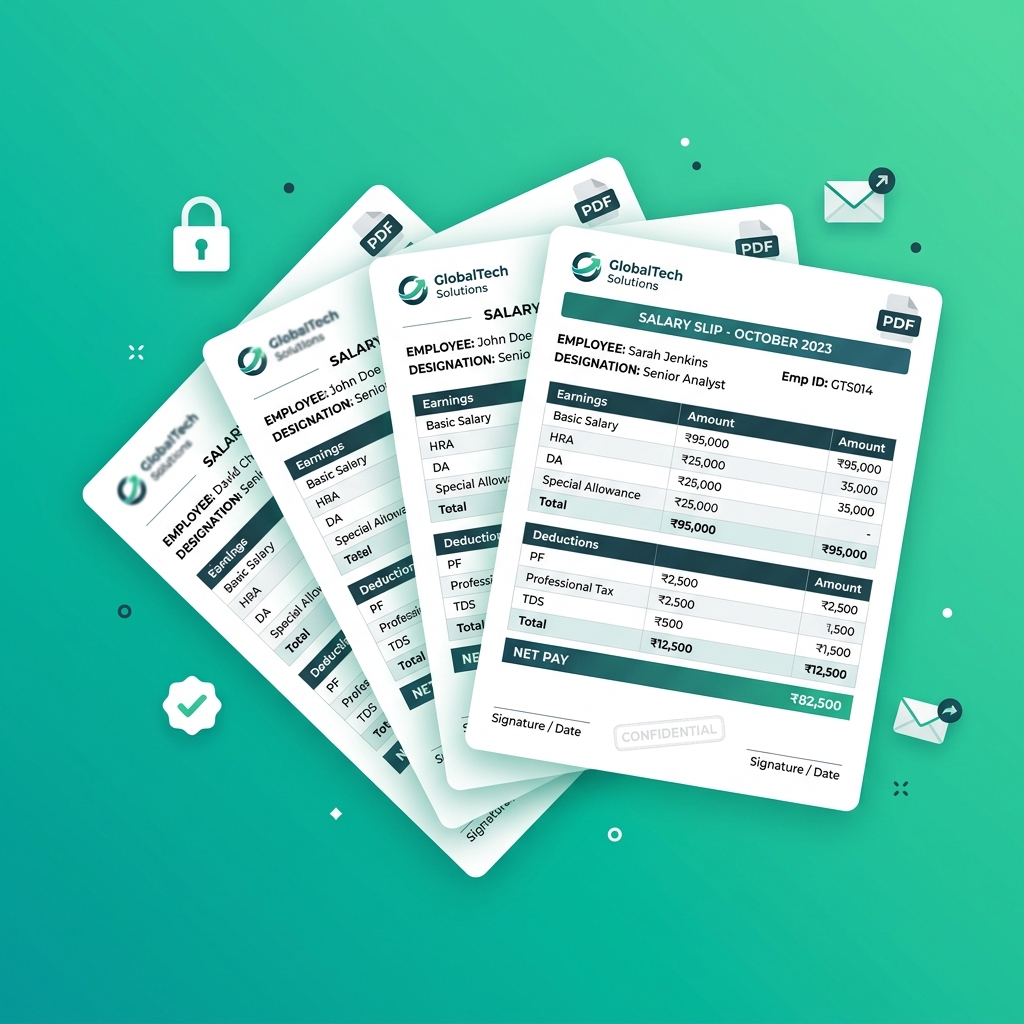
Field technicians rarely visit the physical office to pick up paper checks. PayslipGen includes built-in SMTP email dispatch. You can connect your own Gmail, Microsoft 365, or Amazon SES account to automatically email individual, password-encrypted PDF paystubs directly to technicians' smartphones in a single bulk batch.
Chapter 6: 5-Year Financial Analysis: $49 Lifetime vs. SaaS Subscriptions
Let's examine the 5-year total cost of payroll software for an HVAC and plumbing shop employing 12 technicians:
| Cost Component | ServiceTitan / FieldEdge Payroll | QuickBooks Online Payroll | PayslipGen (One-Time Desktop License) |
|---|---|---|---|
| Monthly Software Base Fee | $180.00 / mo ($2,160/yr) | $85.00 / mo ($1,020/yr) | $0.00 (Forever) |
| Per-Technician Monthly Fee | $15.00 / tech / mo ($2,160/yr) | $6.00 / tech / mo ($864/yr) | $0.00 (Unlimited technicians) |
| FLSA Regular Rate Spiff Math | Requires manual journal override | Prone to calculation errors | Exact Excel Formula Control |
| Data Sovereignty & Offline Mode | Cloud Only (Vendor lock-in) | Cloud Only | 100% Offline Desktop |
| Year 1 Cumulative Cost | $4,320.00 | $1,884.00 | $49.00 total |
| Year 3 Cumulative Cost | $12,960.00 | $5,652.00 | $49.00 total |
| Year 5 Cumulative Cost | $21,600.00 | $9,420.00 | $49.00 (Lifetime) |
Over 5 years, utilizing PayslipGen saves a mechanical contracting company between $9,000 and $21,000 in software fees.
Chapter 7: Step-by-Step Workflow: Excel to Tech Paystubs in PayslipGen
Here is how mechanical trade contractors generate compliant, encrypted paystubs from Excel in under two minutes:
Step 1: Reconcile Your Weekly Timesheets in Excel
In Microsoft Excel, record each technician's clock hours, base hourly rate, equipment spiffs, on-call standby pay, calculated regular rate overtime, and tool loan deductions.
Step 2: Set Up Your Contracting Business Profile
Launch PayslipGen. In the Company Profile section, enter your contracting business name (e.g., Apex Heating & Mechanical Solutions LLC), state contractor license number, business address, and federal tax EIN.
Step 3: Drag and Drop Your Payroll Workbook
Drag your .xlsx or .csv timesheet directly into the PayslipGen window. The local engine loads all rows instantly without transmitting data over the web.
Step 4: Map Custom Trade Payroll Columns
Match your spreadsheet headers to PayslipGen's payroll fields:
Base_Hourly_Earnings→ Regular EarningsFLSA_Overtime_Premium→ Overtime Pay (RRP Adjusted)Equipment_Spiffs→ Commission / Spiff PayOn_Call_Standby→ Other AllowanceTool_Loan_Deduction→ Post-Tax DeductionNet_Paycheck→ Net Pay
Step 5: Apply Password Security & Email Dispatch
Set password encryption based on each technician's Date of Birth (YYYYMMDD) or the last 4 digits of their SSN. Configure your company SMTP email settings, and click "Generate & Dispatch". PayslipGen immediately generates individual encrypted PDF paystubs and delivers them straight to your technicians' inboxes.
Frequently Asked Questions (FAQs)
What happens if an equipment spiff is paid by a third-party manufacturer?
Even when a furnace or heat pump manufacturer (such as Carrier, Trane, or Lennox) directly sends a pre-paid debit card or spiff check to your technician, the Department of Labor requires that the employer include those incentive amounts in the employee's regular rate for overtime calculations if the employer authorized or facilitated the spiff program.
Is travel time in a company van with tools considered paid working time?
Under the Portal-to-Portal Act, driving a company service vehicle between home and the first job site is generally non-compensable if the travel is within the normal commuting area and subject to a voluntary agreement. However, if the technician is required to transport heavy commercial equipment, make mandatory stops at the supply house for parts, or respond to an after-hours emergency call, that transit time is 100% compensable.
Can a contractor deduct the full cost of a lost or broken diagnostic tool from wages?
Only if the deduction does not reduce the technician's effective hourly wage below the statutory minimum wage floor for that workweek (29 CFR § 531.35). Furthermore, several states (such as California, New York, and Washington) strictly prohibit deductions for ordinary breakages or losses unless gross negligence or willful misconduct is legally proven.
How do flat-rate plumbing jobs interact with overtime laws?
Flat-rate technicians who complete jobs based on book hours (e.g. 3 hours for water heater installation) must still track their actual physical clock hours worked. If actual hours exceed 40 in a workweek, total flat-rate earnings are divided by total actual hours worked to establish the regular rate of pay, and an additional half-time overtime premium (0.5× regular rate) must be paid for all actual hours over 40.
Can I customize the paystub layout with my HVAC company license number and logo?
Yes. PayslipGen allows you to upload high-resolution company logos, customize color schemes to match your branding, and include state contractor license numbers, EPA Section 608 certification disclosures, and year-to-date (YTD) tracking blocks directly on every generated PDF.
Master Trade Contractor Payroll Without Cloud SaaS Tolls
Generate compliant, itemized HVAC technician and plumber paystubs directly from Excel. 100% offline, FLSA-compliant regular rate formulas, one-time payment of $49 for lifetime access.
Get PayslipGen for $49 (Lifetime Access)Conclusion: Protect Your Trade Business with Flawless Payroll
The mechanical trades are the backbone of modern infrastructure. Your technicians climb into sweltering attics and brave freezing crawlspaces to keep homes and businesses running. They deserve complete transparency on their earnings, equipment spiffs, and on-call pay.
By structuring mathematically compliant regular rate overtime calculations in Excel and generating professional, password-protected PDF paystubs with PayslipGen, mechanical contractors eliminate Department of Labor audit exposure, protect their business margins, and avoid thousands of dollars in wasteful recurring software fees.
(Managing other contractor, trade, or piece-rate payroll workflows? Explore our dedicated guides on Flat-Rate Auto Mechanic Flag Hours, Piece-Rate Non-Productive Time & Rest Breaks, or how to Send Bulk Payslips via Custom SMTP and Amazon SES.)