
GDPR-Compliant Payslip Email Distribution: The Secure Guide for European Businesses & DPOs
Key Takeaways
- ✓GDPR Article 5 & 32 Mandates: European data protection laws require strict technical and organizational safeguards (TOMs) when processing payroll data; sending unencrypted PDF salary slips via email constitutes an illegal data processing violation.
- ✓Catastrophic Fine Exposure: Supervisory authorities (CNIL, ICO, DPC, BfDI) can levy administrative fines up to €20,000,000 or 4% of total worldwide annual turnover for systemic PII exposure caused by misdirected or intercepted payroll emails.
- ✓Transport Layer (TLS) vs Document Encryption: While STARTTLS encrypts transit, it leaves PDF attachments completely exposed in destination mailboxes. Automated per-file AES-256 bit encryption is mandatory to secure data at rest.
- ✓Zero-Cloud Local Architecture: Using offline desktop tools like PayslipGen eliminates third-party cloud data processors, Schrems II cross-border transfer complications, and vendor leak liabilities.
Under the European Union General Data Protection Regulation (GDPR) and the UK Data Protection Act 2018, payroll documentation occupies one of the highest tiers of data sensitivity in the corporate enterprise. A monthly employee payslip contains an exhaustive profile of Personally Identifiable Information (PII): full legal names, residential addresses, national insurance / tax identification numbers, banking IBAN details, pension contributions, union dues, health insurance deductions, and exact compensation figures.
Despite this extraordinary sensitivity, thousands of businesses across the EU, UK, and European Economic Area (EEA) still distribute monthly payslips by emailing plaintext, unencrypted PDF attachments.
For Data Protection Officers (DPOs), Chief Information Security Officers (CISOs), and HR directors, this practice represents a ticking regulatory timebomb. A single autocompleted email sent to the wrong recipient, or a compromised employee email inbox, transforms an ordinary payroll run into a mandatory 72-hour reportable data breach with potential fines reaching into the tens of millions of euros.
In this comprehensive compliance treatise, we will deconstruct the specific articles of GDPR governing payroll distribution, examine the cryptographic mechanics required for lawful email delivery, and demonstrate how local, zero-cloud software like PayslipGen guarantees 100% compliance without exposing your company to third-party cloud risks.

Try Our Interactive Demo Instantly
Want to see how an offline-capable, client-side payslip generator works in practice? Try our brand-new interactive demo right in your browser. Upload a sample CSV, map your columns, and generate beautifully designed PDF payslips—with zero data ever being transmitted to our servers.
Launch Free Demo NowChapter 1: The Regulatory Framework - What GDPR Demands for Payroll Data
To ensure compliance, organizations must understand the specific statutory provisions enforced by European regulatory authorities such as the CNIL (France), BfDI (Germany), DPC (Ireland), AEPD (Spain), and the ICO (United Kingdom).
1. Article 5(1)(f) - The Integrity and Confidentiality Principle
GDPR Article 5(1)(f) establishes that personal data must be:
"Processed in a manner that ensures appropriate security of the personal data, including protection against unauthorised or unlawful processing and against accidental loss, destruction or damage, using appropriate technical or organisational measures ('integrity and confidentiality')."
Emailing an unencrypted PDF payslip across the open internet directly violates this principle. If the transmission is intercepted, or if the recipient's email account is accessed by an unauthorized third party, the data controller has failed to implement "appropriate technical measures."
2. Article 32 - Security of Processing & Mandatory Encryption
Article 32 explicitly specifies the technical safeguards required when processing sensitive personal data:
- Pseudonymisation and encryption of personal data: Document-level cryptographic protection is recognized as the baseline standard for safeguarding PII.
- Confidentiality, integrity, availability, and resilience: Systems must prevent unauthorized disclosure and resist external compromise.
- Regular testing and evaluation: Data controllers must audit the effectiveness of technical and organizational measures (TOMs).
3. Articles 33 & 34 - Mandatory 72-Hour Breach Notification
If an unencrypted payslip containing banking and tax identifiers is emailed to an incorrect external email address (a classic "autocomplete blunder"), it constitutes a personal data breach under Article 33. The organization is legally obligated to:
- Formally notify the competent supervisory authority within 72 hours of becoming aware of the breach.
- Notify the affected data subject (the employee) without undue delay if the breach is likely to result in a high risk to their rights and freedoms.
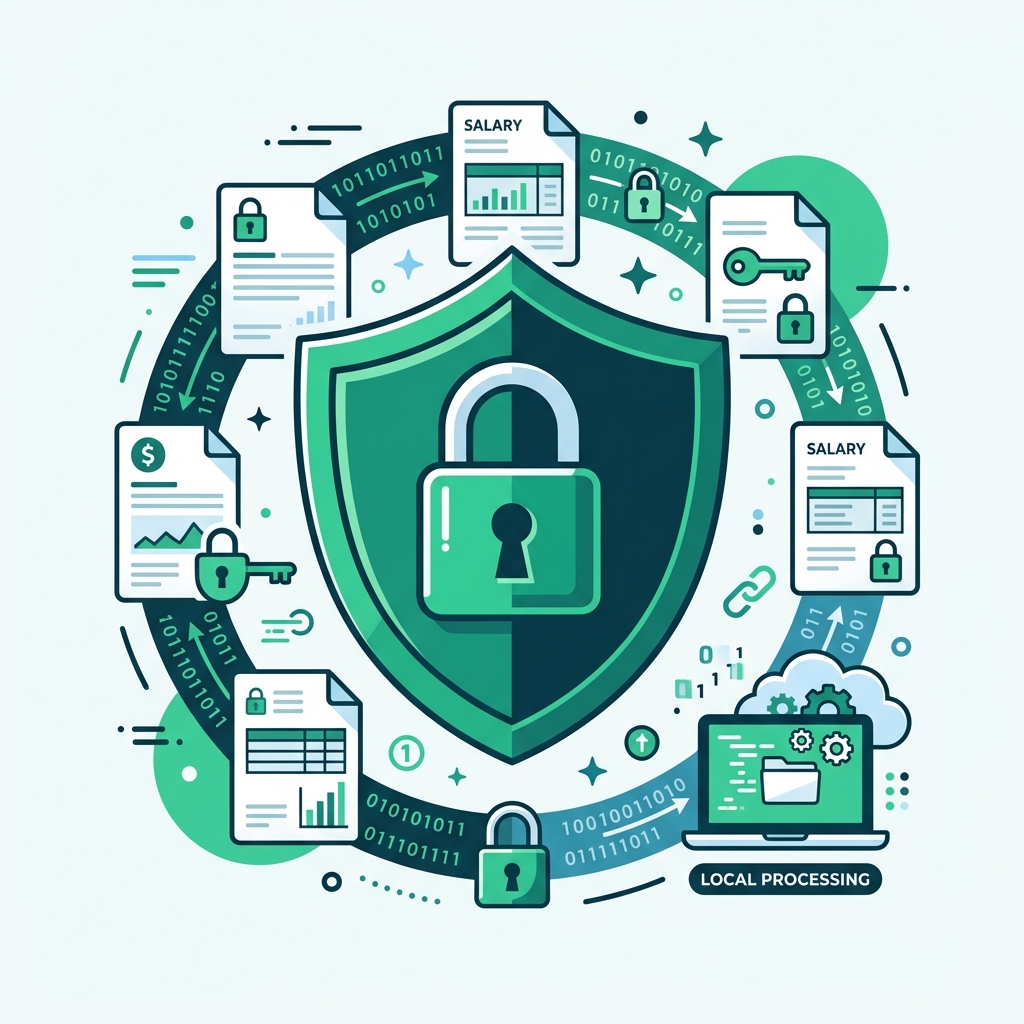
However, under Article 34(3)(a), if the data controller has applied technical protection measures—specifically state-of-the-art encryption that renders the data unintelligible to unauthorized persons—the requirement to communicate the breach to the individual employee is waived. AES-256 encryption acts as an essential legal shield against public disclosure.
Chapter 2: The Fallacy of "TLS is Enough" - Why Transport Encryption Fails
Many IT teams falsely believe that because their mail server supports TLS (Transport Layer Security / STARTTLS), emailing unencrypted PDF payslips is fully compliant. This is a dangerous technical misconception.
The Three Vulnerabilities of Plaintext Attachments:
1. Opportunistic Downgrade Attacks (STARTTLS Stripping)
STARTTLS is opportunistic by default. If an intermediate mail server between your organization and the employee's provider does not support TLS or suffers a Man-In-The-Middle (MITM) downgrade attack, the email and attachment are silently transmitted in clear plaintext across public internet backbones.
2. Zero Protection for Data at Rest
TLS only encrypts data while it is in transit over the network wire. The moment the email arrives on the destination mail server (Gmail, Outlook, iCloud), the PDF attachment is stored unencrypted in the user's mailbox. If the employee logs in on a shared family computer or has an insecure mobile device, the payslip is immediately exposed.
3. The Irreversible Misdirected Recipient Error
If an HR clerk accidentally types david.miller@externalclient.com instead of david.miller@company.com, TLS delivers the unencrypted salary file securely to the unauthorized third party. Because the PDF has no password, the third party can open it immediately.

Chapter 3: The Zero-Cloud Architecture - Eliminating Third-Party Data Processor Risks
When a European company uses cloud-based SaaS payroll platforms (e.g., Gusto, Rippling, Deel, Workday), it introduces significant GDPR compliance overhead:
- Data Processing Agreements (DPAs): Mandatory contracts under GDPR Article 28 specifying how the vendor handles your employee data.
- Sub-Processor Audits: Tracking third-party cloud hosting providers (AWS, Google Cloud, Azure, Twilio, SendGrid) used by the SaaS vendor.
- Schrems II & US Cloud Act Complications: Transferring EU citizen PII to US-headquartered cloud servers creates international data transfer legal risks under Chapter V of GDPR.
The Local Processing Advantage with PayslipGen
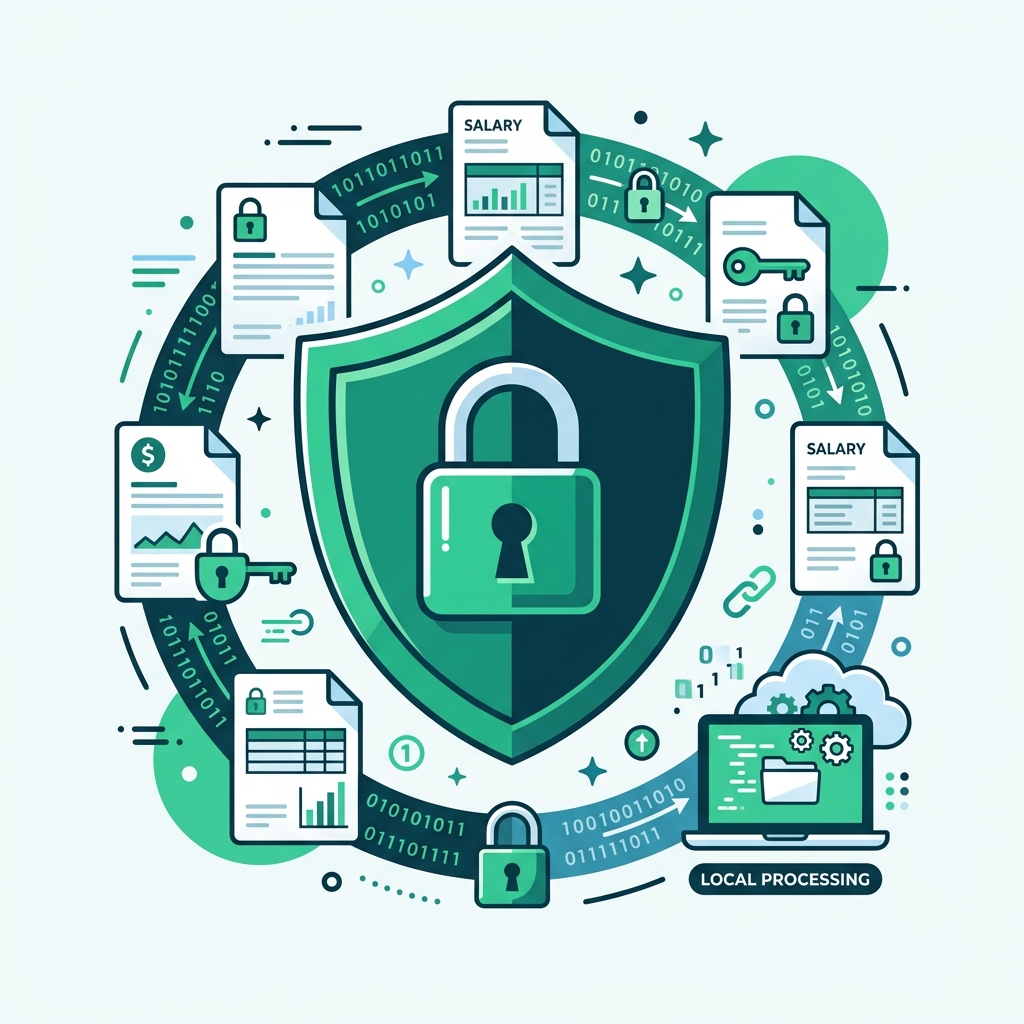
PayslipGen fundamentally bypasses these legal and technical vulnerabilities by utilizing a 100% offline, zero-cloud architecture:
- No Third-Party Data Processor: The software executes directly on your company's secure local workstation or on-premise server. No employee data is ever transmitted to ProxiBite or any cloud database.
- Zero Cross-Border Data Transfers: Your master spreadsheets remain strictly within your organizational perimeter, satisfying European data localization principles.
- Zero Cloud Breach Exposure: Hackers targeting SaaS payroll vendors cannot breach your data because it was never stored in the cloud.
Chapter 4: Designing High-Entropy Dynamic Passwords for Payslips
Applying a generic password (e.g., "Company2026" or the employee's first name) violates GDPR Article 32 by failing to provide adequate cryptographic entropy.
The industry best practice for automated PDF encryption is to construct a dynamic composite key using non-public attributes known only to the individual employee and the HR department:
| Jurisdiction | Recommended Password Formula | Formula Example | Resulting Key |
|---|---|---|---|
| United Kingdom (HMRC) | First 3 of National Insurance No. + Birth Year + Emp ID | QQ12 + 1988 + 402 | QQ121988402 |
| Germany (DSGVO) | First 4 of Steuer-ID + Birth Date (DDMM) + Last 2 of Surname | 8492 + 1406 + SC | 84921406SC |
| France (CNIL) | Last 4 of Numéro de Sécurité Sociale + Birth Year + Zip Code | 5012 + 1993 + 75008 | 5012199375008 |
| International / US | First 2 of First Name (Caps) + Birth Year + Last 4 of SSN/ID | EM + 1990 + 8842 | EM19908842 |
Crucial DPO Rule: Never include the plaintext password key inside the email body itself. Instead, inform employees of the password creation rule during onboarding or include a generic hint in the email template (e.g., "Password Hint: First 3 characters of your National Insurance Number followed by your 4-digit birth year and Employee ID.").
Chapter 5: The 10-Point DPO & HR Compliance Checklist for Payslips
Before conducting your next monthly payroll email distribution, audit your workflow against this checklist:
- 1. Document-Level Encryption: Every PDF is individually encrypted using AES-256 before email dispatch.
- 2. High-Entropy Dynamic Keys: Passwords are unique to each employee and derived from non-public data.
- 3. Out-of-Band Password Communication: Encryption keys are never printed in plaintext within the email body.
- 4. Data Minimization (Article 5(1)(c)): The payslip displays only legally required tax and banking data (e.g., masking full IBAN/SSN to show only last 4 digits).
- 5. Zero-Cloud Processing: Master payroll spreadsheets are processed on local corporate hardware without third-party cloud data ingestion.
- 6. Authenticated TLS Mail Relay: Emails are transmitted via secure SMTP with forced TLS/SSL encryption.
- 7. Local Audit Trails: Local generation logs record timestamps, SHA-256 file hashes, and recipient email addresses for audit defense.
- 8. Access Control: Master payroll spreadsheets are stored on encrypted local disks accessible only to authorized HR personnel.
- 9. Statutory Retention Schedules: Archived payslips are stored in accordance with national tax laws (e.g., 6 years in UK, 10 years in Germany under § 147 AO).
- 10. Right to Rectification (Article 16): A clear procedure exists for employees to query and correct calculation errors promptly.
Chapter 6: Security Architecture Comparison
| Compliance & Security Attribute | Unencrypted Email (Outlook/Gmail) | Cloud SaaS Employee Portals | PayslipGen (Local Encrypted) |
|---|---|---|---|
| GDPR Article 32 Compliance | Non-Compliant (High risk) | Compliant (Vendor dependent) | 100% Compliant (AES-256 at rest) |
| Third-Party Data Processor Risk | Email provider only | High (Multi-tenant SaaS DB) | Zero (No cloud storage) |
| Misdirected Email Liability | Mandatory 72h Breach Notice | Low (Notification only) | Protected (Unreadable without key) |
| Schrems II Cross-Border Transfer | Standard | Complex (US cloud servers) | Zero Transfer (100% On-Premise) |
| Recurring Software Cost | Included in email suite | $3,000 - $15,000/year | One-Time Fee ($49) |
Frequently Asked Questions (FAQs)
Is sending payslips by email strictly illegal under GDPR?
Sending payslips via email is not illegal per se, but sending unencrypted payslips without technical safeguards violates GDPR Article 5(1)(f) and Article 32. To comply with the law, emails containing payroll data must feature file-level encryption (such as AES-256 password protection) and be transmitted over TLS.
What happens if an encrypted payslip is accidentally sent to the wrong person?
Under GDPR Article 34(3)(a), if the personal data is protected by state-of-the-art encryption that renders it unreadable to anyone not authorized to access it (such as a 256-bit AES password-locked PDF), the accidental transmission is not considered a high-risk data breach requiring mandatory employee and public notification.
Why is local software superior to cloud SaaS for GDPR compliance?
Cloud SaaS platforms act as third-party "Data Processors" under GDPR, requiring complex Data Processing Agreements (DPAs), regular security audits, and risk assessments for cross-border data transfers (Schrems II). Local software like PayslipGen runs entirely on your own internal hardware—eliminating third-party processors and guaranteeing complete data sovereignty.
How long are European businesses required to retain archived payslips?
Under national tax and commercial legislation across Europe, payroll records must be retained for statutory periods that override GDPR's Right to Erasure: 6 years in the UK (Taxes Management Act), 6 years in France (Code du Travail), and 10 years in Germany (§ 147 Abgabenordnung). Archived files must remain encrypted during storage.
Does PayslipGen support automated batch encryption for hundreds of employees?
Yes. PayslipGen reads dynamic password values directly from your spreadsheet columns (e.g., National ID + Birth Year) and applies individual AES-256 bit encryption to each PDF during the batch generation process, creating hundreds of secured files in seconds.
Achieve 100% GDPR Payroll Compliance Today
Protect employee financial privacy, eliminate cloud data leak risks, and generate AES-256 encrypted PDF payslips with PayslipGen.
Download PayslipGen NowConclusion
For European organizations and global companies employing EU residents, data protection is not an afterthought—it is a foundational legal requirement. Continuing to distribute unencrypted payroll documents via email exposes your business to catastrophic financial penalties, regulatory investigations, and reputational ruin.
By implementing the zero-cloud architecture and automated AES-256 encryption capabilities of PayslipGen, your organization can achieve uncompromising GDPR compliance, safeguard employee trust, and eliminate recurring SaaS fees forever.
(Need to dive deeper into payroll data governance? Read our technical analysis on Cloud vs Offline Payroll Security and our guide to Archiving Payslips for Audit Season.)