
Archaeologist & Field CRM Technician Paystub Generator: How Environmental Firms Split GSA Per Diems, Shoddy Time & Rig Travel in Excel
Key Takeaways
- ✓Section 106 Field Tour Realities: Cultural Resource Management (CRM) environmental firms operate under Section 106 of the National Historic Preservation Act (NHPA), deploying field archaeologists on 8-to-10-day remote field sessions ("tours"). Managing payroll across irregular multi-day schedules requires precise segregation of regular hours, statutory overtime, and non-work travel windows.
- ✓GSA Per Diem Tax Compliance (IRC § 62): Per diems for lodging and Meals & Incidental Expenses (M&IE) must strictly adhere to US General Services Administration (GSA) federal rates under an IRS Accountable Plan. Paying flat, unitemized per diems without tracking travel days (75% M&IE rule) risks IRS reclassification into fully taxable W-2 wages.
- ✓Shoddy Time & 4WD Rig Allowances: When extreme weather (flash floods, lightning, excessive heat) halts field excavations, firms must compensate technicians under contractual "shoddy time" standby rates. Technicians utilizing personal high-clearance 4WD vehicles on rugged Bureau of Land Management (BLM) roads require non-taxable vehicle wear-and-tear stipends.
- ✓Offline Multi-State Paystub Generation: Traveling field techs ("shovel bums") work across multiple state lines in remote national forests with zero cellular coverage. Using PayslipGen, CRM operations managers generate encrypted, compliant PDF paystubs directly from Excel on field laptops for a one-time $49 fee, bypassing recurring cloud SaaS costs.
Deep in the Great Basin of Nevada, the pine forests of the Pacific Northwest, or the desert scrub of West Texas, a crew of six field archaeologists is excavating shovel test pits (STPs) along a proposed 200-mile electrical transmission corridor. They hike miles each day through rugged terrain carrying 40-pound packs, screening soil through quarter-inch mesh, documenting prehistoric projectile points, and braving rattlesnakes, flash floods, and sub-freezing mornings.
These traveling field professionals—affectionately and historically known throughout the environmental consulting industry as "shovel bums"—form the operational backbone of Cultural Resource Management (CRM). Every major infrastructure initiative in the United States—highway widenings, wind energy farms, natural gas pipelines, and federal mineral leases—must legally conduct archaeological and historic resource surveys before a single bulldozer touches the soil.
Yet back at the regional environmental firm's headquarters, the accounting and HR department faces a dizzying payroll challenge:
- Irregular 8-on/6-off Field Cycles: Crews rarely work conventional Monday-through-Friday 40-hour weeks. Instead, they work concentrated 8-day or 10-day field "sessions" or "tours" that bridge across two standard payroll workweeks, requiring intricate FLSA overtime reconciliation.
- Dual GSA Per Diem Allocations: Technicians traveling away from their tax home receive non-taxable General Services Administration (GSA) per diems for lodging and meals, which must be mathematically segregated from taxable hourly wages under IRS Accountable Plan rules.
- Inclement Weather "Shoddy Time": When severe thunderstorms, mudslides, or high-wind dust events shut down pedestrian survey lines, firms must pay contracted standby minimums.
- Multi-State Tax Allocations: A single linear pipeline survey may traverse three different states within a single two-week pay period, each with distinct income tax withholding formulas.
Off-the-shelf cloud payroll platforms like Gusto or QuickBooks Online fail miserably in this environment. They cannot automatically handle dual GSA per diem splits, confuse travel days with regular production, require constant high-speed internet connections that field trailers lack, and bleed consulting margins with monthly per-technician subscription fees.
In this comprehensive guide, we dissect the federal labor and tax framework governing CRM archaeology payroll, establish an exact Excel formula blueprint, and show how environmental firms generate encrypted, audit-ready PDF paystubs offline using PayslipGen.

Try Our Interactive Demo Instantly
Want to see how an offline-capable, client-side payslip generator works in practice? Try our brand-new interactive demo right in your browser. Upload a sample CSV, map your columns, and generate beautifully designed PDF payslips—with zero data ever being transmitted to our servers.
Launch Free Demo NowChapter 1: Section 106 NHPA Field Surveys & Tour Pay Structures
The Cultural Resource Management industry exists primarily to satisfy federal environmental legislation, specifically Section 106 of the National Historic Preservation Act of 1966 (NHPA), the National Environmental Policy Act (NEPA), and the Archaeological Resources Protection Act (ARPA).
Before federal agencies (such as the Bureau of Land Management [BLM], US Forest Service [USFS], Federal Energy Regulatory Commission [FERC], or Department of Defense [DoD]) issue construction permits, environmental consulting firms execute Phase I cultural resource identification surveys.
The 8-on / 6-off and 10-on / 4-off Session Framework
Because project project areas are situated hours or days away from major metropolitan centers, CRM firms deploy crews on concentrated multi-day tours. The two industry-standard shifts are:
- 8-on / 6-off: Crew works 8 consecutive 10-hour days (80 total hours), followed by 6 consecutive rest days.
- 10-on / 4-off: Crew works 10 consecutive 8-to-10-hour days, followed by 4 days off.
The FLSA Workweek Overtime Trap
Under the federal Fair Labor Standards Act (FLSA), an employer cannot average hours across a two-week pay period to avoid overtime. Non-exempt field technicians must receive 1.5 times their regular hourly rate for all hours worked in excess of 40 within a single established 7-day statutory workweek (168 consecutive hours).
If a field tour spans from Wednesday of Week 1 through Wednesday of Week 2, payroll administrators must split the 80 total session hours precisely between the two respective workweeks:
Week 2: Mon–Wed (3 days × 10 hrs = 30 hrs) → 30 Regular Hrs + 0 OT Hrs
Failing to record this statutory overtime division accurately on employee paystubs exposes environmental firms to class-action wage claims and Department of Labor (DOL) audits.
Chapter 2: Dual GSA Per Diem Rules: Lodging vs. M&IE under IRS Accountable Plans
For traveling archaeologists, per diem allowances frequently represent 30% to 50% of total take-home pay. However, classifying these payments as non-taxable requires strict compliance with Internal Revenue Code Section 62(a)(2)(A) governing IRS Accountable Plans.
1. The GSA Federal Rate Ceiling
The US General Services Administration (GSA) establishes maximum allowable lodging and Meals & Incidental Expenses (M&IE) reimbursement rates by county and zip code. For fiscal year 2026, the standard continental United States (CONUS) baseline is:
- Standard Lodging Rate: $110.00 / night (varies significantly in high-cost counties).
- Standard M&IE Rate: $69.00 / day.
Any per diem paid up to the official GSA rate for the project location is completely exempt from federal income tax, Social Security (FICA), and Medicare withholding. However, if a firm pays an unverified flat per diem exceeding the GSA limit, the excess amount is considered taxable compensation subject to full payroll taxation.
2. The 75% First-and-Last Day Travel Rule
Under IRS Publication 463 and Federal Travel Regulation (FTR) § 301-11.101, traveling employees are only entitled to 75% of the standard M&IE rate on the first and last day of travel.
For an 8-day session in an area with a $68/day M&IE rate:
- Day 1 (Travel to Field / First Field Day): $68 × 75% = $51.00
- Days 2 through 7 (Full Field Days): 6 days × $68 = $408.00
- Day 8 (Final Field Day / Travel Home): $68 × 75% = $51.00
- Total Non-Taxable M&IE Allowed: $510.00
Itemizing the 75% travel rate versus 100% full days on the paystub proves to IRS auditors that your firm maintains an accountable reimbursement system rather than disguising ordinary wages as tax-free stipends.
3. Hotel Buyouts vs. Backcountry Camping Per Diems
How lodging is handled dictates whether a lodging per diem can appear on the paystub:
- Direct Company Master-Bill: If the CRM firm rents a block of motel rooms directly and pays with a corporate card, technicians do not receive a lodging per diem on their paystubs—they receive only the M&IE stipend.
- Employee Lodging Reimbursement: If technicians pay for their own motel rooms and submit folios, they receive the exact GSA lodging rate or receipted cost as non-taxable reimbursement.
- Backcountry Camping Stipend: When crews spike camp in national forests or remote BLM parcels, they do not incur commercial lodging charges. Under IRS rules, firms cannot pay a standard $110/night lodging per diem tax-free without receipts. Instead, firms pay a taxable "remote field camp stipend" ($30 - $50/night) to compensate for gear wear and discomfort.
Chapter 3: Shoddy Time (Weather Delays), Remote 4WD Rig Pay & Tool Allowances
Field archaeology is subject to the whims of severe weather and rugged terrain. Industry standard contracts include specific compensation mechanisms for these non-production events.
1. The Mechanics of "Shoddy Time" (Weather Standby)
When a flash flood warning is issued in a canyon, a thunderstorm brings lightning within 10 miles of an open survey grid, or winter blizzards freeze the ground solid, technicians cannot dig or survey safely. In CRM parlance, paid downtime caused by severe weather is called "shoddy time."
Companies maintain standardized shoddy policies:
- Called Off Before Leaving Hotel: Guaranteed 4 hours of base pay at regular rate.
- Called Off in Field (Partial Day): Paid for all hours worked plus remaining scheduled hours up to an 8-hour guarantee.
- Hotel Standby Day: Full base day rate (e.g., 8 hours) plus full non-taxable M&IE per diem.
Tracking shoddy time as a distinct line item on paystubs is critical for project billing, as environmental firms frequently invoice clients for contracted weather standby under force majeure clauses.
2. 4WD Personal Vehicle "Rig Pay"
Navigating decommissioned logging tracks and BLM two-tracks requires high-clearance four-wheel-drive trucks equipped with all-terrain tires, winches, and recovery gear. When firms lack fleet vehicles, they compensate field crew members who drive their personal 4WD trucks:
- IRS Mileage Rate: Reimbursing business miles at the federal standard mileage rate ($0.67/mile in 2026) as non-taxable expense reimbursement.
- Daily Rig Rate: A flat daily equipment allowance ($50 to $85 per day) for heavy vehicle wear, tire replacement, and dust contamination.
Chapter 4: Master Excel CRM Field Technician Payroll Blueprint (With Real Formulas)
To eliminate manual payroll calculation errors and maintain compliance with IRS Accountable Plan rules, CRM finance managers must build a structured pay ledger in Excel.
Below is the comprehensive blueprint for an 8-day field session in northern Nevada, illustrating hourly wages, FLSA overtime, GSA per diems, shoddy time, and 4WD rig allowances:
| Line # | Compensation Category | Operational Parameter | Tour Units & Rates | Excel Formula Specification |
|---|---|---|---|---|
| 01 | Base Field Hours | Regular Survey Rate | 64.0 hrs @ $24.00/hr | =B10*C10 ($1,536.00) |
| 02 | FLSA Overtime | Hours > 40 in Workweek 1 | 10.0 hrs @ $36.00/hr (1.5x) | =B11*(C10*1.5) ($360.00) |
| 03 | Shoddy Weather Pay | Rainout Standby Guarantee | 6.0 hrs @ $24.00/hr | =B12*C10 ($144.00) |
| 04 | TOTAL TAXABLE WAGES | Gross W-2 Subject to Tax | 80.0 total paid hours | =SUM(E1:E3) ($2,040.00) |
| 05 | GSA M&IE Travel Days | 75% Travel Day Rate (2 Days) | 2 days @ $51.00 ($68 × 75%) | =$102.00 (Non-Taxable) |
| 06 | GSA M&IE Full Days | 100% Field Days (6 Days) | 6 days @ $68.00 / day | =$408.00 (Non-Taxable) |
| 07 | GSA Lodging Per Diem | Elko County Lodging (7 Nights) | 7 nights @ $110.00 / night | =$770.00 (Non-Taxable) |
| 08 | 4WD Personal Rig Pay | IRS Standard Mileage Allowance | 480 miles @ $0.67/mile | =$321.60 (Non-Taxable) |
| 09 | TOTAL NON-TAXABLE PER DIEM | IRS Accountable Reimbursements | $1,601.60 | =SUM(E5:E8) |
| 10 | Federal & State Taxes | FICA (7.65%) + Fed W/H (12%) | Applied to Line 04 only | =-E4*0.1965 (-$400.86) |
| 11 | NET TAKE-HOME PAY | Disbursed to Field Tech | $3,240.74 | =E4+E9+E10 |
Chapter 5: How CRM Environmental Firms Generate Bulk Secure Field Paystubs with PayslipGen
Environmental consulting firms experience rapid fluctuations in staffing. During peak summer survey season, a firm may scale from 15 permanent senior principal investigators to over 120 seasonal field technicians.
Using per-employee SaaS payroll platforms (like Gusto or ADP) means paying $6 to $12 per month for every temporary hire, even when they only work two sessions during the season. Moreover, distributing sensitive paystubs containing Social Security numbers, home addresses, and bank direct deposit details over insecure email chains or shared Dropbox folders exposes the firm to severe data privacy liabilities.
PayslipGen provides an offline, sovereign desktop solution for a flat one-time purchase of $49, allowing environmental firms to generate unlimited professional paystubs with zero recurring software overhead.
The Field Office Workflow: Step-by-Step
- Step 1: Export Your Session Ledger: Maintain your project hours, shoddy standby, GSA per diem calculations, and mileage inside your master project spreadsheet. Export the final session numbers as a standard
.xlsxor.csvfile. - Step 2: Launch PayslipGen Locally: Open PayslipGen on your office workstation or field laptop. The software runs completely offline—no cloud uploads, no server outages, and complete data privacy.
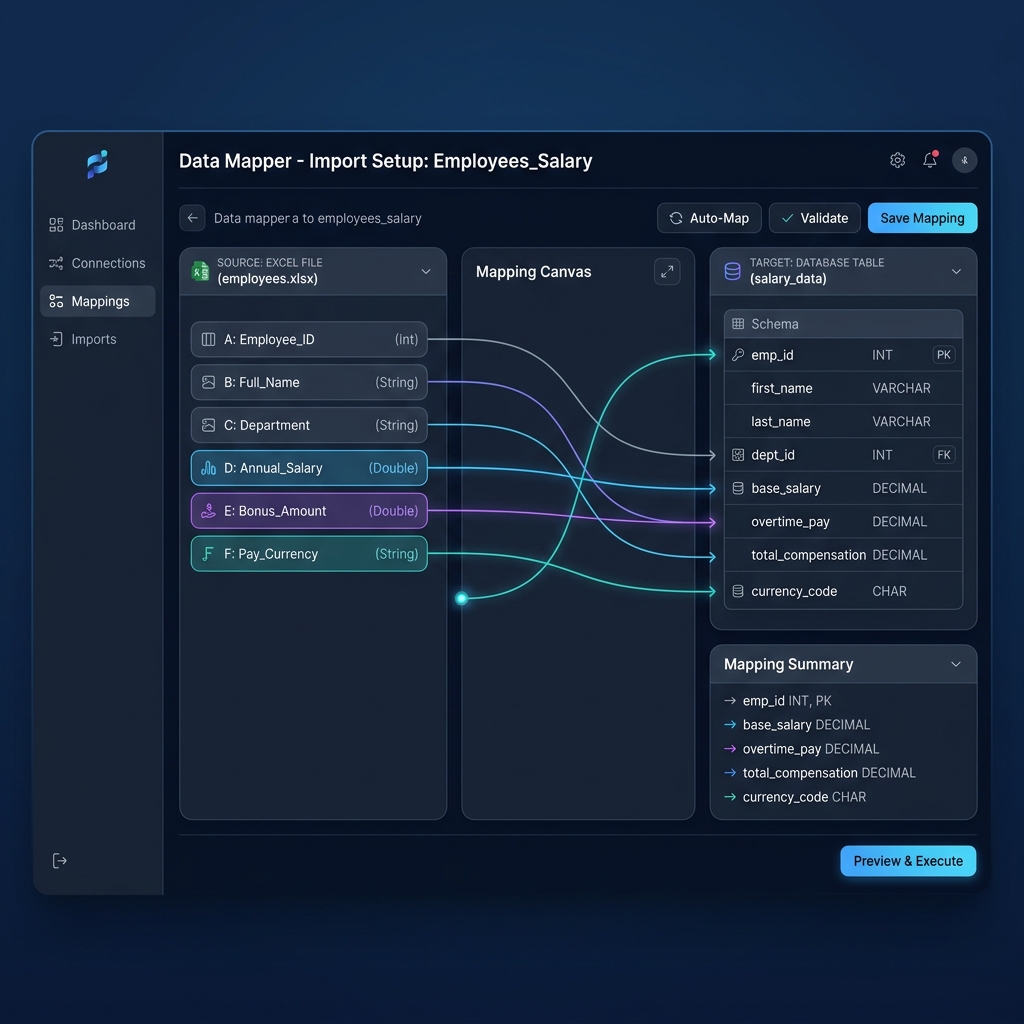
- Step 3: Map Columns in the Visual Mapper: Drag and drop your spreadsheet into PayslipGen. Bind your custom columns to paystub fields:
Tech_Name→ Employee NameProject_ID_County→ Department / Job ReferenceBase_Wages_OT→ Gross Taxable EarningsGSA_MIE_Stipend→ Non-Taxable Reimbursement 1GSA_Lodging_Per_Diem→ Non-Taxable Reimbursement 2Rig_Mileage_Allowance→ Other Non-Taxable AllowanceTax_Withholding_FICA→ Statutory DeductionsNet_Disbursed_Pay→ Net Pay
- Step 4: Enable AES-256 PDF Password Encryption:Protect field technician privacy by enabling automated password protection. You can configure the system to lock each PDF with the technician's Date of Birth (YYYYMMDD) or the last 4 digits of their SSN.
- Step 5: Bulk Export & SMTP Emailing: Click "Generate Payslips."Within two seconds, PayslipGen compiles professional, clean PDF paystubs for your entire roster. Connect your corporate Google Workspace or Office 365 SMTP account to dispatch encrypted PDFs directly to each field technician's email inbox automatically.
Frequently Asked Questions (FAQs)
Can a CRM firm pay a flat $150/day per diem without breaking down lodging and meals?
While paying an unitemized flat per diem is common among small contractors, it creates massive IRS audit vulnerability. Under IRS Revenue Procedure 2011-47 and IRC § 62, per diems are exempt from taxation only if they do not exceed published GSA locality rates and are properly substantiated. If a firm pays $150/day in an area where the GSA M&IE is $68 and the company already pays for motel rooms directly, the entire $150 constitutes taxable wage income.
How is travel time compensated when driving to a remote project site?
Under the Portal-to-Portal Act and FLSA regulations (29 C.F.R. § 785.38), travel that is all in a day's work (such as driving from the field hotel to the remote survey corridor) is compensable working time. For out-of-town travel, travel during normal working hours on non-working days (e.g., Saturday or Sunday travel) must also be paid at the technician's regular hourly rate.
What happens if an archaeologist camps instead of staying in the designated hotel?
If the firm offers paid commercial hotel lodging but the technician chooses to camp voluntarily, the firm cannot legally pay the non-taxable GSA lodging rate in cash, because no commercial lodging expense was incurred. Doing so violates IRS Accountable Plan rules. The technician remains entitled to their daily non-taxable M&IE per diem.
How do we handle state tax withholding when a pipeline crosses state borders?
Technicians must generally pay state income tax to the state where the physical labor occurred. When a project crosses state boundaries (e.g., from Utah into Nevada), the hours worked in each state must be tracked and reported separately on the employee's paystub and year-end Form W-2.
Does PayslipGen limit how many seasonal technicians we can add?
No. PayslipGen includes unlimited employees, unlimited pay runs, and unlimited PDF exports under its one-time $49 lifetime license. Whether you have 5 technicians in the winter or 150 seasonal hires across three regional field offices in July, you never pay extra fees.
Master Field CRM Payroll Without Cloud SaaS Tolls
Generate compliant, itemized archaeology field paystubs with clear GSA per diem and rig pay segregation. 100% offline desktop security for a single one-time payment of $49.
Get PayslipGen for $49 (Lifetime Access)Conclusion: Protect Your Firm and Your Field Technicians
Field archaeologists and environmental technicians perform critical, physically grueling work to preserve cultural heritage while advancing national infrastructure. They deserve transparent, mathematically exact, and prompt compensation statements that honor their travel and labor.
By mastering GSA per diem compliance under IRC § 62, tracking shoddy weather time transparently, and generating encrypted PDF payslips with PayslipGen, environmental consulting firms eliminate payday disputes, maintain pristine audit readiness, and save thousands of dollars every year in unnecessary software subscriptions.
(Managing other specialty mobile field workforces? Explore our detailed guides on Travel Nurse GSA Per Diem Stipends, Construction Worker Bulk Payslip Templates, and Certified Payroll Reports for Davis-Bacon Projects.)