
Mining & Quarry Equipment Operator Paystub Generator: How to Calculate MSHA Mandatory Safety Pay, Bench Travel & Pit Tonnage Bonuses in Excel
Key Takeaways
- ✓MSHA Mandatory Safety Training Wages: Under Federal Mine Safety and Health Administration (MSHA) regulations (30 CFR Part 46 for aggregate quarries and Part 48 for metal/nonmetal surface mines), all mandatory training—including the 8-hour annual refresher and 24-hour new miner training—must be conducted during normal working hours and paid at the miner's regular hourly rate with full benefits.
- ✓Portal-to-Bench Travel Time Compensability: Under federal mining law and the Fair Labor Standards Act (FLSA), travel time from the central security check-in, change house, or brass board to remote pit excavation benches, drill lines, or primary crushers constitutes compensable working hours that must be tracked and paid on the employee's paystub.
- ✓Clean Aggregate Tonnage Incentives: Quarry and pit operators balance safety with production velocity by utilizing tiered clean aggregate tonnage bonuses ($0.08 to $0.18 per clean crushed ton past daily quota). To comply with MSHA safety mandates, production bonuses must incorporate a safety qualification gate: disqualifying crews if lost-time injuries or reportable safety infractions occur during the production period.
- ✓Air-Gapped Rural Pit Sovereignty: Surface mines, sand pits, and rock quarries operate in remote rural canyons with zero reliable cellular or broadband internet. Cloud payroll platforms (Gusto, ADP, Workday) fail completely under remote field conditions. Mining operators maintain master tonnage sheets in Excel and generate encrypted, professional PDF paystubs offline using PayslipGen for a one-time $49 payment.
Deep inside an open-pit limestone quarry or aggregate sand-and-gravel plant, heavy equipment operators maneuver 60-ton articulated haul trucks, 100-ton hydraulic face excavators, and high-capacity jaw crushers. In this high-consequence operating environment, compensation is dictated by heavy equipment certification classes, federal mine safety mandates, and production tonnage incentives.
When the shift change whistle blows, the pit superintendent and quarry timekeeper must reconcile an intricate compensation matrix:
- Certified Machine Operator Rates: High-reach excavator operators (Cat 390 / Komatsu PC1250) command higher base wages than haul truck drivers (Cat 745) or utility water truck drivers.
- Mandatory MSHA Safety Pay: Hours spent attending mandatory 30 CFR Part 46 annual safety training must be segregated and paid at the miner's regular hourly rate under federal law.
- Portal-to-Bench Travel: Transporting operators in crew vans from the scale house down two miles of switchbacks to the blast bench is compensable portal travel time under the federal Portal-to-Portal Act.
- Aggregate Tonnage Production Bonuses: When the pit crushes 14,500 tons of DOT-spec clean stone against an 11,000-ton quota, operators earn tiered per-ton incentive distributions, contingent upon zero reportable MSHA lost-time safety incidents.
Managing this specialized payroll through off-the-shelf cloud SaaS applications is an operational failure. Quarries are situated in mountainous valleys, rural riverbeds, or underground deposits where internet connectivity is nonexistent. Furthermore, mining operations cannot accept monthly recurring SaaS fees during winter seasonal plant shutdowns.
In this technical guide, we examine federal MSHA wage regulations, break down portal travel compensation, outline aggregate tonnage bonus formulas in Excel, and show how quarry bookkeepers use PayslipGen to generate audit-ready, password-protected PDF paystubs completely offline on any field office computer.
Try Our Interactive Demo Instantly
Want to see how an offline-capable, client-side payslip generator works in practice? Try our brand-new interactive demo right in your browser. Upload a sample CSV, map your columns, and generate beautifully designed PDF payslips—with zero data ever being transmitted to our servers.
Launch Free Demo NowChapter 1: Federal Regulatory Framework: MSHA 30 CFR Part 46/48 & Travel Time
Mining and mineral extraction payroll is governed by federal mining statutes administered by the Mine Safety and Health Administration (MSHA) under the Federal Mine Safety and Health Act of 1977, alongside Department of Labor wage-and-hour rules.
1. Mandatory MSHA Training Compensation: 30 CFR § 46.10 & § 48.10
Federal law mandates extensive safety training for every individual working on a mine site:
- New Miner Training: Minimum 24 hours of instruction for surface aggregate miners (30 CFR § 46.5) and 40 hours for underground miners (30 CFR § 48.5) before beginning independent work.
- Annual Refresher Training: Minimum 8 hours of mandatory safety instruction every 12 months (30 CFR § 46.8).
- Site-Specific Hazard Training: Mandatory safety briefings before operating on a new bench or facility.
Federal Statutory Mandate: 30 CFR § 46.10(a)
"Training must be conducted during normal working hours. Persons attending training must be compensated at their normal rate of pay and receive all associated benefits they would normally receive."
A mine operator cannot require equipment operators to complete MSHA safety courses on uncompensated personal time, nor pay training at a discounted sub-minimum training wage. Training hours must appear on the paystub at the miner's full regular rate of pay.
2. Portal-to-Bench Travel Time Compensability
In large surface quarries and open-pit mines, the physical distance between the main security gate, scale house, or brass change house and the active working highwall can be two to four miles.
Under the Portal-to-Portal Act (29 U.S.C. § 254) and federal case law governing extractive industries, once an operator checks in at the brass board, dons their required personal protective equipment (hard hat, MSHA-approved steel-toe metatarsal boots, safety glasses, high-visibility vest, respirator), and boards a company personnel carrier to ride down to the pit floor, that transit time is compensable working time.
Failing to record this daily travel time (which often averages 30 to 45 minutes per shift) results in substantial unrecorded overtime liability under the FLSA.
Chapter 2: Heavy Equipment Operator Rate Classifications
Aggregate quarries and mining operations categorize operators based on machinery scale, skill certification, and operating hazard levels:
| Classification Code | Equipment Operations | Typical Machinery Models | Base Hourly Wage Range |
|---|---|---|---|
| Class IV (Master Tech) | High-reach bench excavators, rotary blast hole drills, draglines | Cat 390 / 6015B, Komatsu PC1250, Epiroc Pit Viper | $36.00 – $48.00 / hr |
| Class III (Heavy Plant) | Primary crusher feeding loaders, heavy bulldozers, track crushers | Cat 988K / 992K, Cat D8T / D9T, Terex Finlay Jaw | $32.00 – $40.00 / hr |
| Class II (Haulage) | Articulated & rigid haul trucks, motor graders, aggregate loadout loaders | Cat 745 / 777G, Komatsu HD465, Cat 16M Grader | $26.00 – $34.00 / hr |
| Class I (Support) | Dust suppression water trucks, fuel & lube service trucks, skid steers | Peterbilt 4,000-gal Water Truck, Cat 299D3 | $22.00 – $28.00 / hr |
Chapter 3: Aggregate Clean Tonnage Production Bonuses: Balancing Speed & Safety
In commercial quarries supplying crushed limestone, granite ballast, or concrete aggregate to highway and infrastructure projects, plant profitability hinges on daily crushed tonnage throughput.
1. The Mechanics of the Clean Tonnage Pool
Quarries set a baseline daily production quota (e.g., 10,000 clean crushed tons per shift). Every ton processed over this quota generates an incentive pool distributed among the active shift production crew:
Example: If the plant produces 14,200 tons against a 10,000-ton quota, the excess 4,200 tons creates a $504.00 shift pool. In an 8-operator production circuit, each qualified operator earns a $63.00 daily production bonus.
2. The MSHA Safety Qualification Gate
Under federal mine safety guidelines, production bonuses must never encourage miners to bypass lock-out/tag-out (LOTO) procedures, operate uninspected machinery, or exceed safe highwall speed limits.
MSHA Compliance Rule: Safety Gating on Production Pay
MSHA discourages pure speed-based incentive plans that penalize reporting safety hazards. Modern quarries implement a Safety Multiplier Gate: the tonnage bonus is paid only if the shift completes operations with zero MSHA-reportable lost-time injuries, zero citations for uninspected pre-shift equipment checks (MSHA Form 5000-23 logs), and full environmental dust suppression compliance.
Chapter 4: Shift Differentials & Blended FLSA Overtime Calculations
Quarries frequently run continuous operations with two 10-hour or 12-hour shifts:
- Day Shift (6:00 AM – 4:30 PM): Standard base rate.
- Night / Swing Shift (4:30 PM – 3:00 AM): Includes a Night Shift Differential ($2.50 to $4.00/hour) to compensate for decreased visibility and extreme nocturnal quarry conditions.
Calculating FLSA Regular Rate with Production Bonuses
When operators receive both hourly wages and weekly aggregate tonnage bonuses, federal law (29 C.F.R. § 778.208) requires that non-discretionary production bonuses be incorporated into the regular rate of pay for overtime calculations:
Total Straight-Time Earnings = (Hourly Operating Wages) + (MSHA Safety Wages) + (Bench Travel) + (Tonnage Bonus)
Regular Hourly Rate = Total Straight-Time Earnings ÷ Total Hours Worked
Overtime Premium = (Regular Hourly Rate × 0.5) × Overtime Hours Worked (> 40 hrs)
Chapter 5: Master Excel Mining & Quarry Payroll Blueprint (With Formulas)
Below is the production-tested Excel blueprint for an aggregate limestone quarry processing a bi-weekly payroll cycle for a Class III pit loader operator:
| Col | Header Name | Sample Value | Excel Formula Specification | Description |
|---|---|---|---|---|
| A | Operator_Name | Garrett Stone | Text input | Class III Pit Loader Operator |
| B | Base_Operating_Hours | 76.0 | Scalehouse timecard | Machine operating hours |
| C | Certified_Base_Rate | $34.00 | Wage matrix | Class III certified machine rate |
| D | Portal_Travel_Hours | 6.5 | Pit transit log | Gate-to-bench crew transport |
| E | MSHA_Safety_Hours | 8.0 | Training register | 30 CFR Part 46 annual refresher |
| F | Total_Hours_Worked | 90.5 | =B2+D2+E2 | Total bi-weekly hours |
| G | Straight_Time_Pay | $3,077.00 | =F2*C2 | Straight time for all hours |
| H | Excess_Clean_Tons | 4,500 | Crusher weight scale log | Clean tons past bi-weekly quota |
| I | Tonnage_Bonus_Pay | $450.00 | =H2*0.10 | $0.10/ton operator share |
| J | Night_Shift_Diff_Hours | 35.0 | Night log hours | Hours worked past 4:30 PM |
| K | Shift_Diff_Earnings | $105.00 | =J2*3.00 | $3.00/hr night differential |
| L | Regular_Rate_of_Pay | $40.13 / hr | =(G2+I2+K2)/F2 | Blended rate for overtime |
| M | FLSA_Overtime_Hours | 10.5 | =MAX(0, F2-80) | Hours exceeding 80 in 2-week cycle |
| N | FLSA_Overtime_Premium | $210.68 | =M2*(L2*0.5) | Half-time premium on blended rate |
| O | TOTAL_GROSS_COMPENSATION | $3,842.68 | =G2+I2+K2+N2 | Subject to FICA/FITW |
Chapter 6: Why Air-Gapped Desktop Software is Essential in Extractive Industries
Mining, quarrying, and mineral aggregate operations face distinct technical and security challenges that render standard cloud software unusable:
1. Zero Connectivity in Mountain & Canyon Pit Locations
Quarries and gravel pits are naturally located where mineral deposits exist: along remote river bottoms, inside deep rock canyons, or on rural mountain flanks. Physical rock walls shield pit facilities from cellular signals.
Cloud payroll platforms (Gusto, Workday, QuickBooks Online) require continuous internet connectivity and multi-factor authentication (MFA) SMS codes. When the pit office experiences satellite outages or cellular dead zones, cloud software locks you out completely.
2. Protecting Proprietary Extraction & Yield Data
Aggregate production volumes, daily crushing yields, and certified machine operating costs are high-value commercial secrets. Uploading internal tonnage logs, customer delivery volumes, and employee tax data to third-party public cloud servers creates unnecessary cybersecurity vulnerabilities.
With PayslipGen, the entire calculation and PDF generation engine operates 100% locally on your quarry office PC (Windows, Mac, or Linux). Zero data packets ever touch the internet.
| Feature / Capability | Workday / ADP Enterprise | QuickBooks Online Payroll | PayslipGen Desktop Software |
|---|---|---|---|
| Internet Connection Requirement | 100% Mandatory (Cloud) | 100% Mandatory (Cloud) | Zero (100% Air-Gapped Offline) |
| Winter Layup Software Costs | Full subscription billed | Full subscription billed | $0.00 (One-time $49 purchase) |
| MSHA & Portal Itemization | Complex enterprise customization | Inflexible standard fields | 100% Native Excel Support |
| Proprietary Tonnage Privacy | Hosted on multi-tenant cloud | Hosted on Intuit servers | Stored 100% on Local PC Hard Drive |
| 3-Year Software Cost (20 Operators) | $8,400.00+ | $5,760.00 | $49.00 (Lifetime License) |
Chapter 7: Step-by-Step Mining Paystub Generation in PayslipGen
Here is how quarry bookkeepers and safety managers generate audit-proof paystubs directly from Excel using PayslipGen:
Step 1: Compile Shift Logs in Excel
At the close of the bi-weekly cycle, enter certified operating hours, portal bench travel hours, MSHA training hours, clean tonnage production tallies, and night shift differentials into your master spreadsheet.
Step 2: Launch PayslipGen on Your Field PC
Open PayslipGen on your scale house or shop computer. Because PayslipGen is completely offline, no internet connection is required to load the software or parse data.
Step 3: Map Spreadsheet Headers Visually
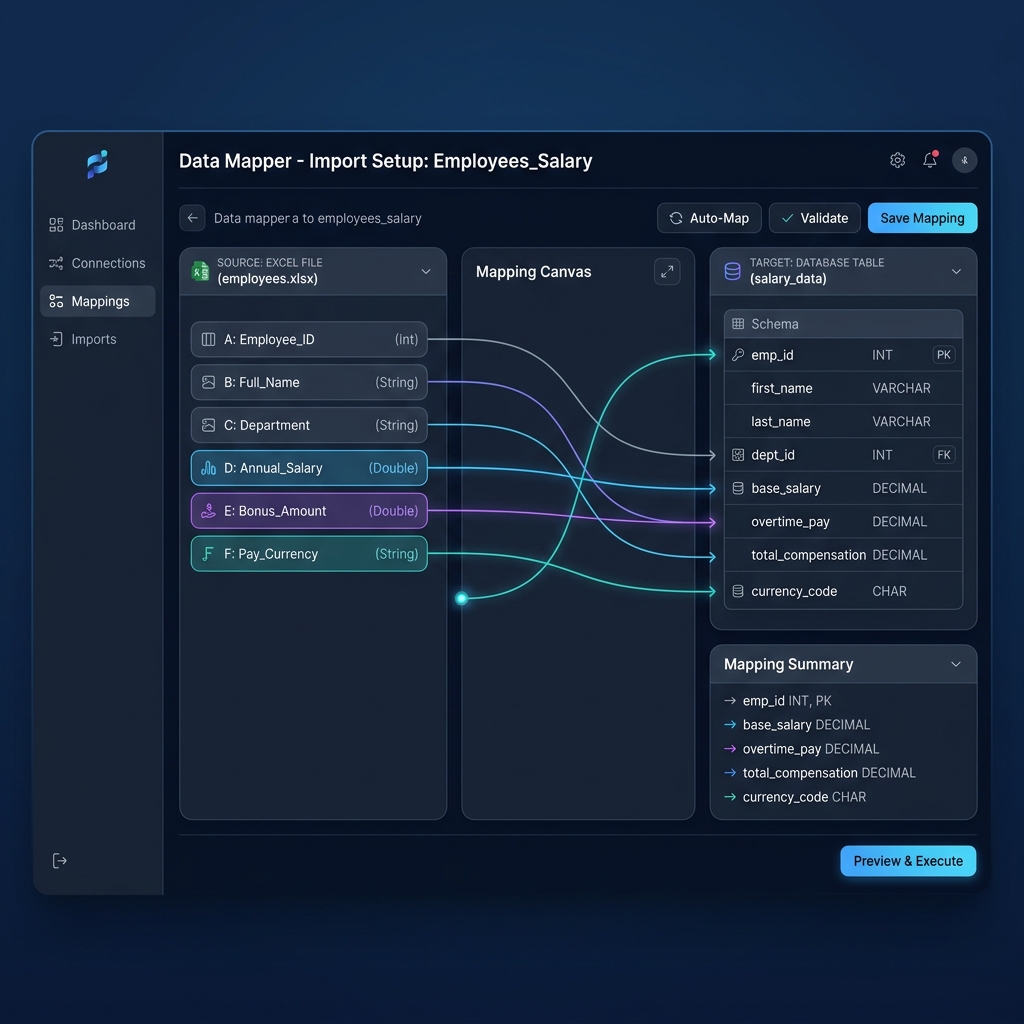
Drag and drop your .xlsx or .csv file into PayslipGen. The visual mapper pairs your columns directly to standard paystub fields:
Operator_Name→ Employee NameTotal_Hours_Worked→ Total Hours WorkedStraight_Time_Pay→ Regular WagesPortal_Travel_Hours→ Other Allowance 1 (Bench Travel)MSHA_Safety_Hours→ Other Allowance 2 (MSHA Training)Tonnage_Bonus_Pay→ Production BonusFLSA_Overtime_Premium→ Overtime WagesTOTAL_GROSS_COMPENSATION→ Gross Earnings
Step 4: Enable AES-256 PDF Password Encryption
Prevent breakroom wage comparison by checking "Password Protect PDFs"in PayslipGen. The software encrypts each individual PDF using the miner's Date of Birth or the last 4 digits of their SSN.
Step 5: Batch Generate and Export
Click "Generate All Payslips". Within 2 seconds, PayslipGen compiles high-resolution, vector PDF paystubs formatted with your quarry's company logo, MSHA mine ID number, and itemized pay codes. Print them directly on the pit office printer or save them to your encrypted internal backup drive.
Frequently Asked Questions (FAQs)
Is an employer legally required to pay for mandatory MSHA safety training?
Yes, unconditionally. Under 30 CFR § 46.10 (for aggregate quarries) and 30 CFR § 48.10 (for underground mines), all mandatory MSHA training must be conducted during normal working hours and paid at the miner's regular hourly rate with all normal benefits. Employers cannot require workers to take online safety training unpaid at home, nor pay a reduced training wage.
Why is portal-to-bench travel time compensable under federal law?
Under the Portal-to-Portal Act and FLSA interpretations, travel that occurs after an employee checks in at the central mine portal, change house, or brass station—and while being transported across mine property to active highwall benches or crusher plants—is part of the employee's continuous workday and principal activities. It must be compensated as working hours.
How does a tonnage production bonus affect overtime pay?
Under 29 C.F.R. § 778.208, non-discretionary production bonuses—such as aggregate tonnage incentives—must be added to straight-time hourly wages when calculating the regular rate of pay for the workweek. If an operator works overtime, the employer must recalculate the regular rate to include the tonnage bonus and pay an additional 0.5 times that boosted rate for all overtime hours worked.
Can a quarry tie tonnage bonuses to zero-injury safety records?
Yes, provided the policy is carefully designed. While MSHA penalizes incentive programs that discourage workers from reporting workplace injuries or equipment hazards, quarries can lawfully structure group bonuses contingent upon following pre-shift inspection protocols, zero lost-time accidents, and 100% compliance with safety operating rules.
Does PayslipGen require internet connectivity at the mine site?
No. PayslipGen is 100% offline desktop software. It does not require web access, cloud API authentications, or remote servers. You can run payroll and generate vector PDF paystubs on an air-gapped field PC in a remote quarry with zero cellular or broadband connection.
Command Mining & Quarry Payroll Without Cloud SaaS Fees
Calculate MSHA mandatory training pay, bench travel time, and clean aggregate tonnage production bonuses in Excel. Generate encrypted PDF paystubs offline for a one-time payment of $49.
Get PayslipGen for $49 (Lifetime Access)Conclusion: Secure Sovereign Control Over Your Quarry Payroll
Operating an aggregate quarry or surface mine requires immense discipline, capital machinery investments, and absolute adherence to federal safety laws. Your equipment operators braving steep pit haul roads and operating high-tonnage machines deserve transparent, accurate, and timely paystubs.
By tracking certified equipment wages, MSHA safety pay, and clean tonnage production incentives in Excel—and transforming them into encrypted, institutional-grade PDF paystubs with PayslipGen—you protect your business from MSHA wage audits, keep proprietary extraction metrics private, and eliminate thousands of dollars in recurring software fees.
(Looking to streamline other industrial and equipment payroll operations? Explore our guides on Davis-Bacon Certified Payroll & Form WH-347, Construction Worker Payslip Templates, or how to Air-Gapped Payroll for Defense Contractors.)