
How to Send Bulk Payslips Through Gmail Without Getting Blocked
Key Takeaways
- ✓Dispatching bulk payslip emails in rapid bursts triggers Gmail velocity filters and structural homogeneity algorithms, causing spam quarantines.
- ✓Google Workspace caps sending at 2,000 emails/day (500/day for standard Gmail), but unthrottled mail merges trigger automated blocks long before hitting daily caps.
- ✓Throttled delivery simulates organic sending behavior by pacing outbound messages in small batches with randomized micro-delays and automatic backoff handling.
- ✓PayslipGen pairs dynamic email personalization with automated SMTP throttling to ensure high-volume payslip dispatch through Gmail without inbox deliverability issues.
Navigating the labyrinthine complexities of corporate email delivery often feels like an insurmountable challenge, particularly when the end goal is distributing something as critical and time-sensitive as monthly employee payslips. For human resources professionals, finance departments, and business owners who rely on Gmail or Google Workspace to manage their enterprise communications, encountering algorithmic roadblocks and aggressive spam filters is an all-too-frequent source of profound organizational anxiety.
When processing payroll, timeliness and absolute discretion are not merely preferred—they are foundational necessities dictated by both labor laws and the inherent trust established between an employer and their workforce. Yet, when an administrator attempts to dispatch hundreds of identical emails containing encrypted PDF attachments within a highly compressed timeframe, Google’s sophisticated security infrastructure frequently perceives this legitimate administrative task as a malicious spam campaign. Consequently, without warning or transparent explanation, entire batches of critical financial documents are abruptly quarantined, bounced back with arcane error codes, or, perhaps worst of all, silently relegated to the recipients' spam folders, leaving employees deeply frustrated and entirely unaware that they have actually been paid.
Try Our Interactive Demo Instantly
Want to see how an offline-capable, client-side payslip generator works in practice? Try our brand-new interactive demo right in your browser. Upload a sample CSV, map your columns, and generate beautifully designed PDF payslips—with zero data ever being transmitted to our servers.
Launch Free Demo NowUnderstanding how to orchestrate the mass distribution of payslips through Gmail without triggering these catastrophic algorithmic penalties requires a multifaceted comprehension of modern email protocols, an awareness of sender reputation mechanics, and, crucially, the implementation of specialized software architectures designed explicitly to mimic human sending behavior. It is no longer sufficient to merely blind carbon copy (BCC) a sprawling list of addresses; today's regulatory and technological environment demands a much more nuanced, surgically precise approach to automated communication.
The Anatomy of Gmail's Anti-Spam Architecture
To effectively circumvent the draconian delivery limitations imposed by modern email providers, one must first deconstruct the underlying logic that drives Gmail's formidable anti-spam architecture. Google utilizes a continuously evolving, machine-learning-driven ecosystem that analyzes billions of data points in real-time to protect its users from phishing attempts, malware distribution, and unsolicited commercial bulk mail. This system operates on a zero-trust model, meaning that any sudden deviation from your historically established sending patterns immediately triggers heightened scrutiny and potential throttling.
When you initiate a bulk dispatch of payslips, several specific algorithmic triggers are simultaneously activated. First, the velocity of the outbound messages is meticulously tracked; if your account transitions from sending an average of twenty emails per day to attempting to blast five hundred emails within a thirty-second window, the sheer mathematical improbability of such an action being performed manually acts as an immediate red flag. The server assumes a compromised account or a rogue script has taken over, immediately applying rate limits that effectively paralyze the delivery process.
Furthermore, the structural homogeneity of the emails themselves compounds the problem. Payslip emails typically contain identical subject lines (e.g., "Your Monthly Payslip - [Month]"), nearly identical body text, and attachments of similar file sizes. In the eyes of a rudimentary or even moderately advanced spam filter, this high degree of uniformity is indistinguishable from a widespread phishing campaign attempting to distribute malicious payloads disguised as financial documents. When you combine high-velocity sending with structural homogeneity, you are essentially presenting Google’s algorithms with the textbook definition of a spam attack, practically guaranteeing that your account will be temporarily suspended or permanently shadow-banned from reaching external inboxes.
It is also imperative to recognize that Google enforces strict, hard-coded limits on the sheer volume of emails that can be transmitted within a rolling twenty-four-hour period. While a standard consumer Gmail account is generally capped at five hundred outbound messages per day, Google Workspace (formerly G Suite) accounts boast a more generous ceiling of two thousand messages. However, these figures represent absolute maximums under optimal conditions; realistically, attempting to approach these limits in a single, sustained burst will inevitably trigger defensive throttling mechanisms long before the theoretical cap is reached. Understanding this fundamental architectural reality is the first crucial step in engineering a reliable, friction-free delivery pipeline.
The Hidden Costs of Deliverability Failures
When payslip emails fail to deliver due to algorithmic blocks, the resulting organizational chaos is profound. HR departments are inundated with panicked inquiries, productivity plummets as staff investigate missing documents, and the overall perception of administrative competence is severely undermined. Resolving these issues reactively is exponentially more time-consuming than preventing them proactively.
Why Traditional Mail Merges Catastrophically Fail
Historically, resource-constrained businesses have attempted to solve the bulk communication dilemma by relying on rudimentary mail merge functions built into legacy word processors or spreadsheet applications. While these tools were revolutionary in their time, they are woefully ill-equipped to navigate the sophisticated, heavily guarded landscape of contemporary email delivery, particularly when dealing with high-stakes financial documentation like payslips.
The primary fatal flaw of a traditional mail merge lies in its brutal, unrefined approach to execution. Once the user clicks "send," the underlying script relentlessly hammers the configured SMTP server, attempting to push the entire queue of generated emails onto the outbound network as rapidly as the local processor and internet connection will allow. There is absolutely no concept of pacing, pacing variance, or server-side feedback monitoring. It is a brute-force assault on the email provider’s infrastructure, and as established previously, Google’s algorithms are explicitly designed to neutralize such behavior instantaneously.
Moreover, traditional mail merges offer virtually no visibility into the actual delivery lifecycle of the emails they generate. If an email address contains a subtle typographical error, or if a recipient's mailbox has exceeded its storage quota, the mail merge process remains blissfully ignorant of the failure. The localized software simply marks the task as completed, leaving the administrator with a dangerously false sense of security while a significant percentage of the workforce remains unnotified and unpaid in the eyes of their personal records. This lack of bidirectional communication between the sending client and the receiving server makes troubleshooting bounced emails an agonizingly opaque, manual process of hunting through cryptic non-delivery reports (NDRs) scattered haphazardly throughout the administrator's inbox.
The Strategic Importance of Throttled Email Delivery
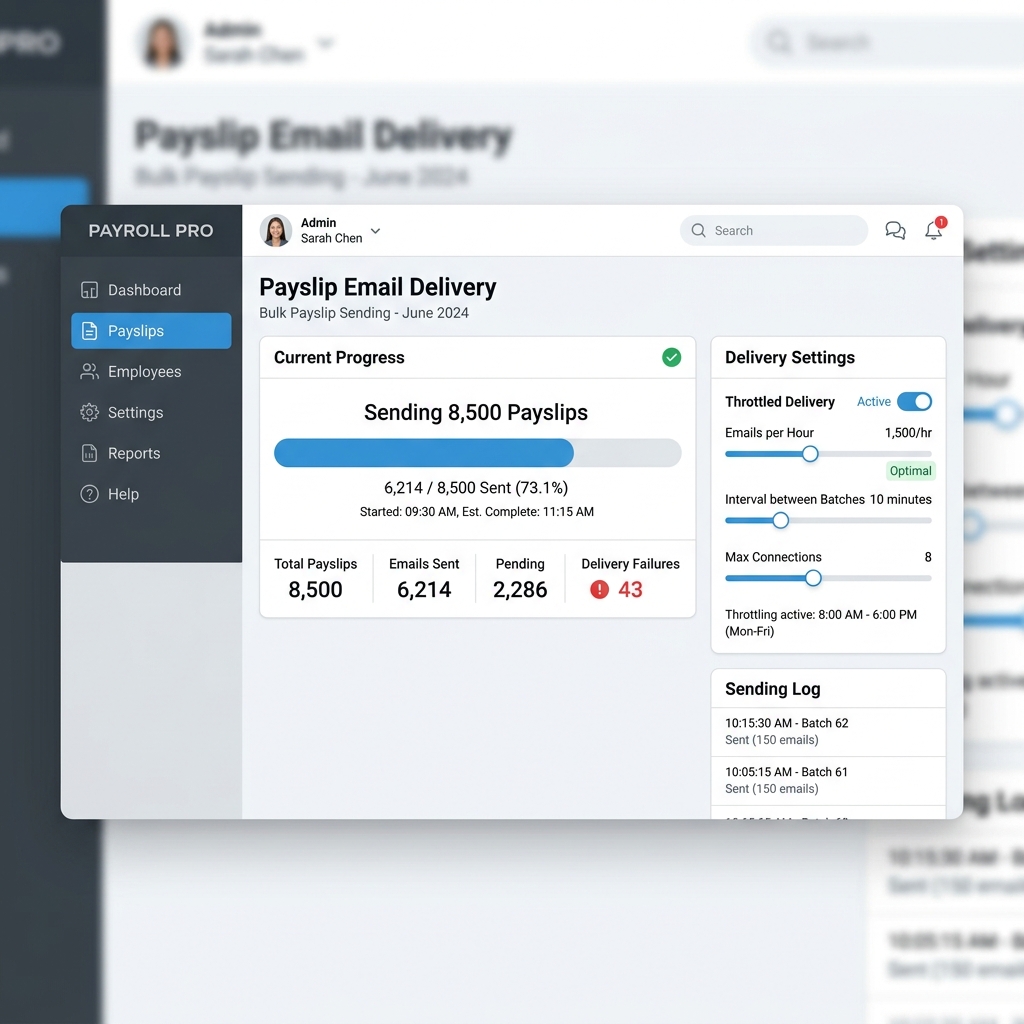
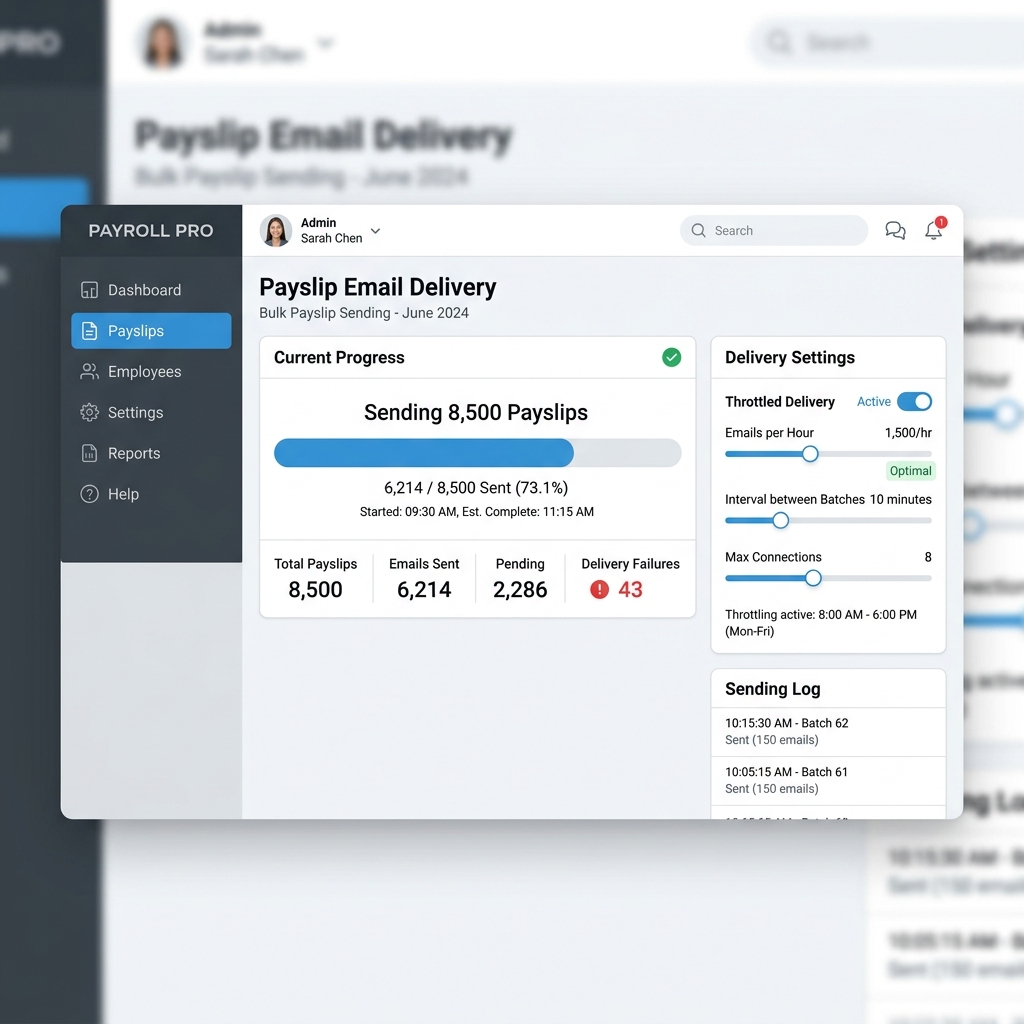
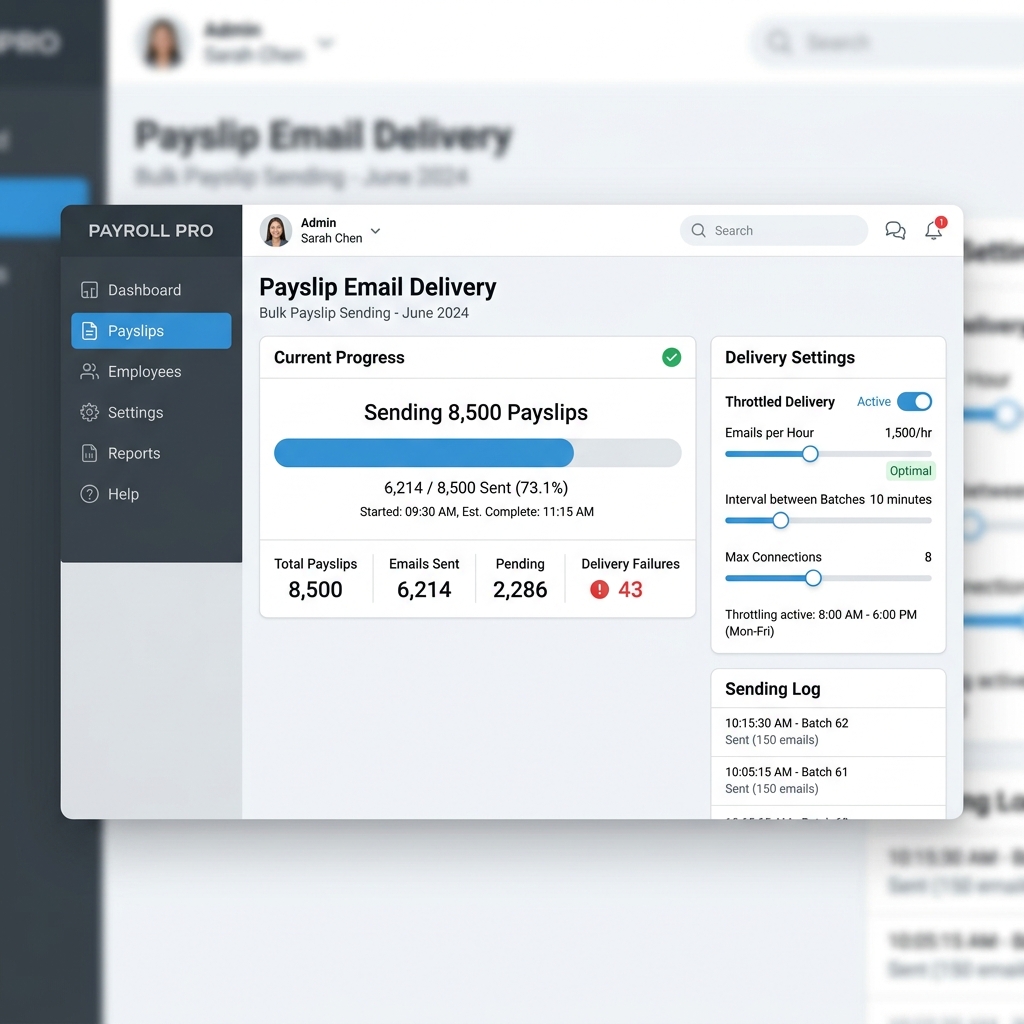
The definitive solution to bypassing Gmail's aggressive anti-spam countermeasures without compromising the efficiency of your payroll operations lies in the sophisticated implementation of throttled email delivery. Throttling, in this context, refers to the deliberate, algorithmic pacing of outbound messages to artificially simulate the organic sending behavior of a human operator, thereby sidestepping the velocity-based triggers that precipitate automated server blocks.
Instead of attempting to transmit five hundred emails in a single, frenetic thirty-second burst, a properly engineered throttling system will intelligently distribute that workload over a strategically determined timeframe. For example, the software might be configured to send a batch of fifteen emails, pause execution for forty-five seconds, send another batch of twelve emails, and perhaps even introduce randomized micro-delays between individual message transmissions. To Google's sophisticated monitoring algorithms, this carefully orchestrated cadence appears indistinguishable from a highly diligent human administrator manually composing and sending messages throughout the course of a standard workday.
This deliberate pacing is not merely a theoretical circumvention technique; it is a vital best practice endorsed by email delivery experts globally. By respecting the receiving server's processing capabilities and avoiding sudden spikes in outbound volume, you actively cultivate and protect your domain's sender reputation. A pristine sender reputation is the ultimate currency in the realm of email deliverability; it ensures that when your messages arrive at their destination, they are welcomed by the receiving mail transfer agent (MTA) and routed directly to the primary inbox, rather than being subjected to secondary heuristic analysis or quietly shuttled into the dreaded spam folder.
Furthermore, advanced throttling mechanisms are deeply integrated with active SMTP connection management. If the software detects that Google is beginning to apply soft rate limits—perhaps responding with transient error codes indicating that the server is temporarily too busy to accept new mail—the intelligent delivery system will automatically back off, extending the delay intervals dynamically to allow the remote server to recover. Once the connection stabilizes, the system seamlessly resumes transmission, ensuring absolute delivery fidelity without requiring any manual intervention or panicked troubleshooting from the user.
Implementing a Reliable Delivery Pipeline for Payroll
Transitioning from chaotic, unpredictable mail merges to a highly reliable, throttled delivery pipeline requires the adoption of purpose-built software solutions explicitly engineered for the nuanced demands of payroll administration. Attempting to build these intricate pacing mechanisms into custom scripts or relying on generalized marketing platforms often results in critical compliance failures, as marketing tools are designed for newsletters, not highly sensitive, individualized financial documents equipped with unique password protections.
A dedicated desktop application designed for secure payslip generation inherently understands the delicate dance required to communicate successfully with strict providers like Gmail. These modern applications empower human resource professionals by abstracting away the formidable complexities of SMTP protocols, rate limiting logic, and connection retries. Within a highly intuitive, minimalistic user interface, administrators can configure comprehensive sending profiles that dictate exactly how the software should pace its outbound communications, adjusting batch sizes and pause durations to perfectly align with the specific constraints of their organizational Google Workspace environment.
Beyond mere pacing, these systems also incorporate sophisticated personalization variables. By dynamically injecting unique employee identifiers, individualized subject line markers, and highly tailored body copy into every single message, the software actively disrupts the structural homogeneity that spam filters are trained to detect. When every outbound email possesses a unique algorithmic fingerprint, the likelihood of triggering a blanket spam categorization is drastically reduced, further cementing the reliability of the entire distribution ecosystem.
Ultimately, implementing a robust delivery pipeline is about reclaiming control over your internal communications and eliminating the pervasive anxiety that historically accompanies payday. By leveraging intelligent throttling, dynamic personalization, and real-time SMTP telemetry, modern businesses can guarantee that their employees receive their vital financial documentation securely, promptly, and without the administrative friction that inevitably arises when relying on antiquated, non-specialized methodologies.
Stop Getting Blocked by Gmail
Upgrade to a smarter workflow. Get real-time delivery telemetry, identify bounced emails instantly, and retry failed deliveries without manually repeating the entire process.
Built-in throttled email delivery.Conclusion
Successfully navigating the stringent security parameters of Gmail and other major email providers is no longer a matter of luck or sheer persistence; it is an exercise in applied technical strategy. By understanding the velocity and content-based triggers that precipitate automated blocking, and by adopting intelligent software solutions that utilize sophisticated throttling and pacing algorithms to mimic organic human behavior, organizations can completely eradicate the disruptive phenomena of bounced payslips and mass spam quarantines. Embracing these advanced delivery methodologies ensures that the critical link between employer and employee remains unbroken, fostering trust, reducing administrative overhead, and transforming the monthly payroll distribution from a source of dread into a seamless, entirely predictable automated workflow.